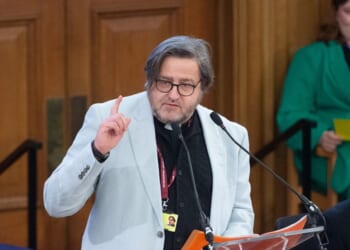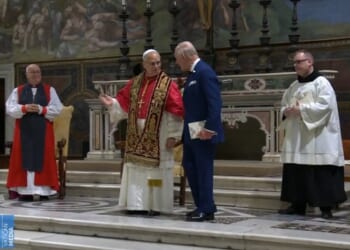
“WHAT sort of Archbishop do I feel called to be?” Archbishop Mullally asked in her first presidential address to the General Synod last month, just under a fortnight after the confirmation of her election. Referring to her vocation to nursing and then to the priesthood, episcopate, and archiepiscopate, she declared: “The theme that has run through of all those chapters of my life has been washing feet, and serving and caring for others. And so, I believe that I have been called to love and serve the diocese of Canterbury, the Church of England, and the Anglican Communion, not through developing new programmes and initiatives, but by being a shepherd, who works collaboratively and in partnership, enabling others to flourish.” Archbishop Welby’s first presidential address, in July 2013, struck a different note. While he also spoke of service and faith in Christ, he used the word “revolution” 21 times, to convey how the world was undergoing seismic changes, and how the Church should respond. To minister the gospel in a time of “revolution”, the Church would need to “look afresh at all our structures, to reimagine ministry”, he said.
He was true to his word: as the Revd Professor Andrew Atherstone, a biographer of both Archbishops, said on the Church Times podcast last week: Archbishop Welby was “a missionary activist”, who “hoped the Church of England would change from top to bottom”. “Every few months, under the Welby regime, there was a new policy initiative.” Archbishop Mullally, Professor Atherstone observed, was “a different character: much calmer in her process, much more consensual”. Marking her 64th birthday yesterday, the day after her installation, the new Archbishop has less than half the time that her predecessor had until she reaches the retirement age. Professor Atherstone argued that, paradoxically, “she can afford to be less impatient.” She has scant time to reshape the C of E; and, besides, her legacy was secured when she became the first female Archbishop in the Church’s 1400-year history.
This is not to suggest that Archbishop Mullally will be inactive or idle; her background points to somebody who knows how to get things done, and who has the steel to make difficult decisions. But, from the perspective of our readers who serve in parishes, some of whom have felt undervalued by a hierarchy that seems fixated on markers of “success”, a less anxious, foot-washing Archbishop will be welcome. Nor should Archbishop Mullally’s penchant for collaboration and process lead us to believe that she will be merely a “civil servant” Archbishop. Nurtured in an Evangelical environment as a teenager and young adult, she believes deeply in gospel proclamation, in word and deed; she is also acutely conscious of the socio-political implications of the Christian faith. Few would argue against the need for a new chapter for the Church of England after the turmoil of the past 18 months. It is to be hoped that Anglicans up and down the country will be diligent in praying for their new Archbishop as she embarks on her public ministry.