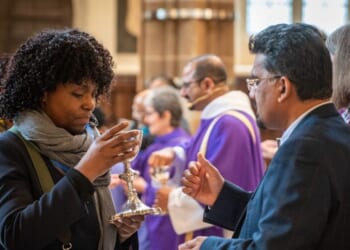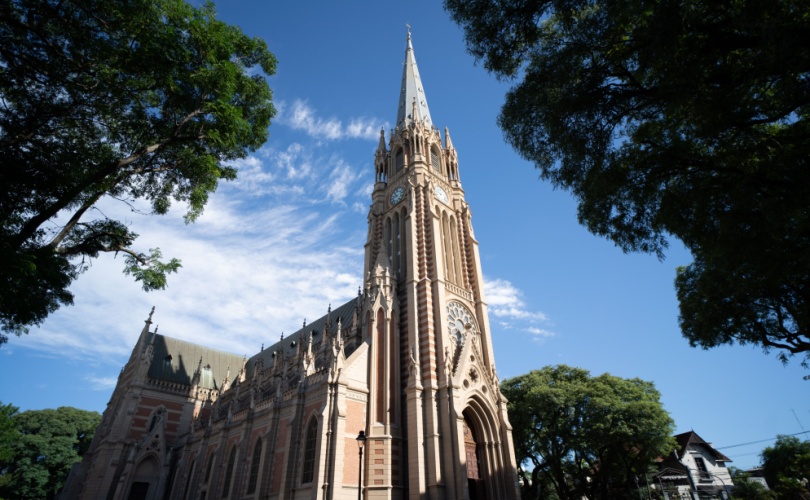
(LifeSiteNews) — A priest in the Cathedral of San Isidro in Argentina blessed two lesbian women dressed as brides, a traditional missionary priest reported.
“In the chapel where the Tabernacle is, at 6.15 pm, there was a blessing of two lesbian women dressed as brides,” Father Joao Silveira shared on Twitter.
Yesterday in the Cathedral of Buenos Aires: “In the chapel where the Tabernacle is, at 6.15 pm, there was a blessing of two lesbian women dressed as brides. I told the priest: One thing is accompaniment, but we can’t consent to sin, much less bless it. He replied: It’s pastoral.”
— Father João Silveira (@joaosilveiraaa) December 11, 2025
“I told the priest: ‘One thing is accompaniment, but we can’t consent to sin, much less bless it.’ He replied, ‘It’s pastoral,’” Fr. Silveira said. He did not identify the priest who gave the blessing.
“Heartbreaking. This Pastor is a wolf in sheep’s clothing. He needs catechism 101 and sent on a retreat for 6 weeks in silence and pray,” Sherrill Bergeron commented on X.
The Cathedral of San Isidro, located within the province of Buenos Aires, appears to embrace the Church of Pope Francis. Its website has a page dedicated to “Laudato Si week” in honor of Francis’ encyclical stoking fear over climate change and the supposedly dire consequences of failing to take drastic measures to fight such change.
While the declaration Fiducia Supplicans, issued by Pope Francis and current Prefect of the Dicastery for the Doctrine of the Faith (DDF) Cardinal Victor Manuel Fernández, states that “blessings for couples in irregular situations and for couples of the same sex” are permissible, such blessings contradict unchangeable Catholic teaching that the Church cannot bless sinful relationships.
While Fernández makes clear in the document that such blessings must not be construed as blessings “proper to the sacrament of marriage,” he admits that the text’s “theological reflection, based on the pastoral vision of Pope Francis, implies a real development from what has been said about blessings in the Magisterium and the official texts of the Church.”
Moreover, the fact that the lesbians in the Cathedral of Buenos Aires were dressed like brides suggests they viewed their blessing as equivalent to, or akin to a marriage.
In 2021, the CDF stated clearly that the Church does not have the “power to give the blessing to unions of persons of the same sex.”
The CDF stated that it is “not licit to impart a blessing on relationships, or partnerships, even stable, that involve sexual activity outside of marriage (i.e., outside the indissoluble union of a man and a woman open in itself to the transmission of life), as is the case of the unions between persons of the same sex.”
While defenders of Fiducia Supplicans stress that the document is not about the blessing of same-sex couples but rather the blessings of individuals, Fernandez emphasized in the Vatican declaration that the blessings he addresses are imparted to relationships in particular.
In paragraph 31 of the text, Fernández wrote that:
Within the horizon outlined here is the possibility of blessings of couples in irregular situations and of same-sex couples, the form of which should not find any ritual fixation on the part of ecclesial authorities, in order not to produce confusion with the blessing proper to the sacrament of marriage.
In these cases, a blessing is imparted that not only has ascending value but is also the invocation of a descending blessing from God Himself on those who, recognizing themselves to be destitute and in need of His help, do not claim legitimacy of their own status, but beg that all that is true, good, and humanly valid in their lives and relationships be invested, healed and elevated by the presence of the Holy Spirit.
These forms of blessing express a supplication to God to grant those aids that come from the impulses of His Spirit – what classical theology calls ‘present graces’ – so that human relationships may mature and grow in fidelity to the Gospel message, free themselves from their imperfections and frailties, and express themselves in the ever-increasing dimension of divine love.
Fernández’s suggestion that there is “good” in same-sex relationships also defies the reality of such relationships as gravely morally sinful.
In his first letter to the Corinthians, St. Paul states that homosexual actions are sinful, explaining that “neither fornicators, nor idolaters, nor adulterers” will “inherit the kingdom of God,” but rather, according to his letter to the Romans, those who practice homosexuality will receive “in their own persons the due penalty for their error.”
Accordingly, the Catholic Church teaches that homosexual activity is mortally sinful and the homosexual inclination is “objectively disordered.”