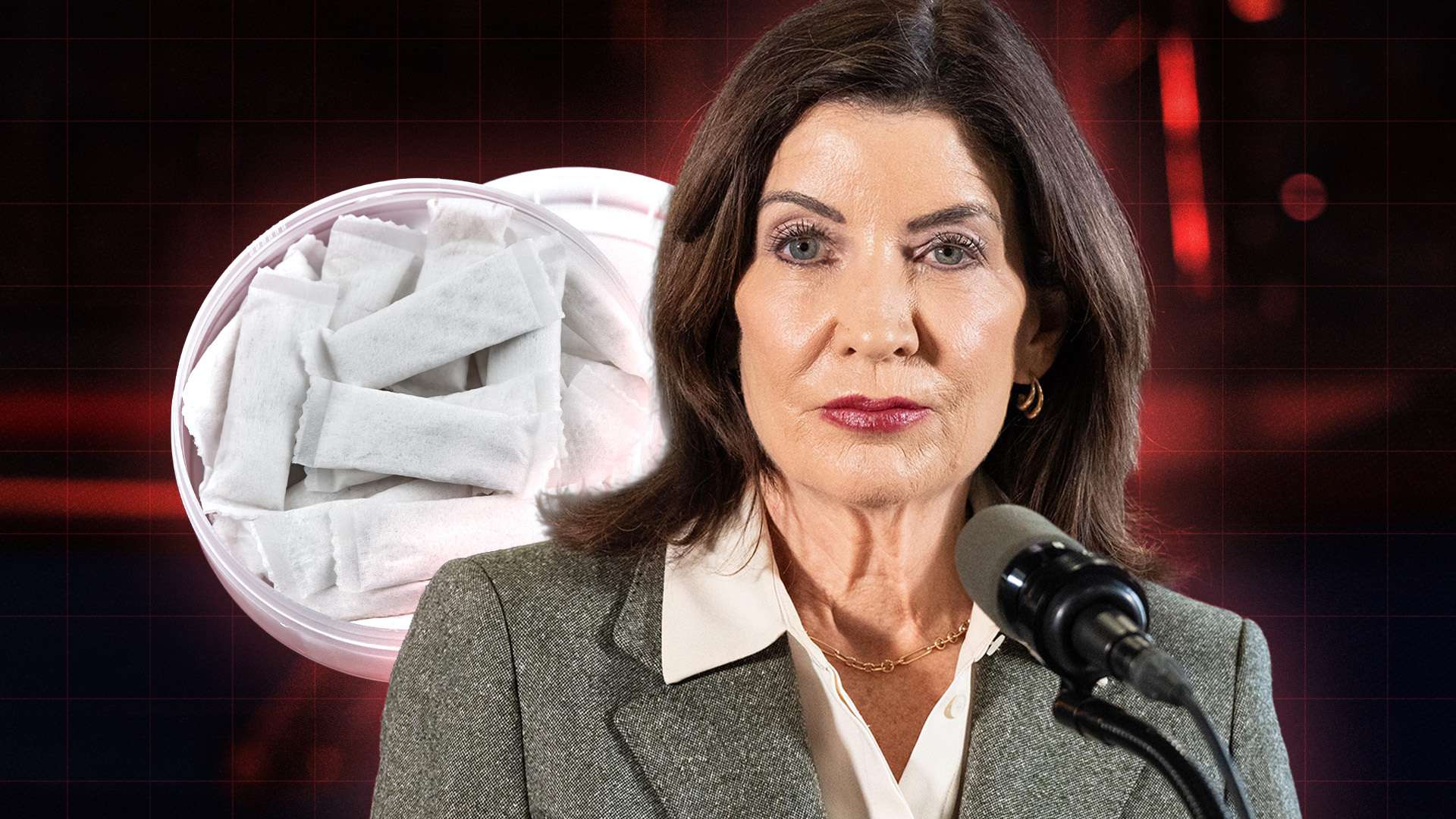
New York Gov. Kathy Hochul’s plan to raise taxes on nicotine pouches like Zyn is facing staunch pushback from New York voters.
In January, Hochul released her budget proposal for FY 2027, which included a provision to levy the same 75 percent wholesale tax that cigarettes face on nicotine pouches. The new duty is expected to raise $18 million in FY 2027 and $44 million upon full implementation the following year in FY 2028.
Unsurprisingly, proposing to make a popular product more expensive is not being well-received by the state’s voters. According to a Morning Consult poll obtained by Reason, less than half of New York voters support the tax on nicotine pouches. The poll, which surveyed 517 adults and was conducted from February 11–15, also found that 37 percent of respondents think that nicotine pouches should be taxed at a lower rate. As many as 39 percent of respondents either use nicotine pouches or have close family or friends who do.
Some lawmakers have recognized that, in addition to being unpopular, the tax could harm public health. “Is it smart to tax nicotine pouches higher than cigarettes, which is combustion fire in your lungs?” state Sen. Nathalia Fernandez (D–Bronx), who chairs the Alcoholism and Substance Use Disorders Committee, recently asked. “If we are making the safer product more expensive, is that actually helping the public?”
Unfortunately, Fernandez appears to be in the minority with her thinking. During the budget briefing, New York State Budget Director Blake Washington said that nicotine pouches are a “public health concern” and that he sees cigarettes and nicotine pouches as “a distinction without a difference.” He added that “there’s an addictive property to both, and that’s really the thrust behind it.” Meanwhile, lawmakers have moved forward to implement the tax, reports the Times Union.
Yet the logic behind Washington and other lawmakers’ comments runs counter to what most health science says. Nicotine pouches—which are made from food-grade products, contain no tobacco, produce no smoke, and do not cause second-hand exposure—have been found to be far less harmful than cigarettes, and are an effective tool for smokers to quit.
The use of oral nicotine products in Sweden has drastically reduced smoking rates among adults. Based on national data from 2008 to 2022, the percentage of cigarette smokers decreased from 15.3 to 8.5 percent among women and from 12.9 to 8.8 percent among men. During the same period, the percentage of snus users increased from 3.2 to 7.1 percent among women and from 20.1 to 22.9 percent among men. It is no coincidence that Sweden also has the lowest rate of lung cancer in Europe. Delon Human, who has advised three World Health Organization director-generals and leads Smoke Free Sweden, says this was achieved by “embracing and encouraging the use of alternative nicotine products such as snus, oral nicotine pouches and vapes.”
While encouraging smoking alternatives has saved lives, making them more expensive discourages smokers from quitting. One analysis of Minnesota’s 95 percent tax on vapes estimates that the duty increased adult smoking and prevented 32,400 smokers from quitting.
In New York, where smoking kills about 30,000 adults each year and remains the leading cause of preventable death in the state, making it harder to get nicotine alternatives can be a matter of life and death. By taxing these life-saving products, Hochul’s proposed tax is not only unpopular but also incredibly irresponsible.