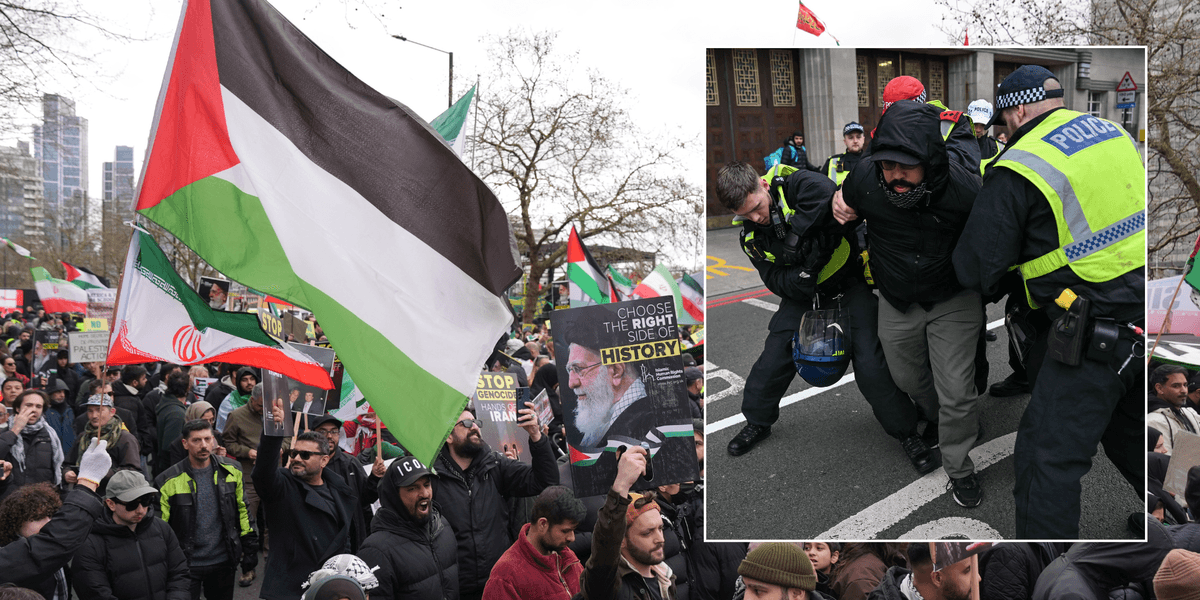
Three protesters have been arrested after thousands took to the streets of London in support of Iran’s Islamic regime.
Police said that one person had been arrested for displaying support for a proscribed organisation, one for dangerous driving and another for “threatening and abusive behaviour”.
The arrests were made during the static Al Quds Day protest and counter-demonstration, which took place in central London today.
In a post on X, the Metropolitan Police said: “Lambeth Bridge remains closed to keep both groups apart.
“Officers have made three arrests, one for showing support for a proscribed organisation, one for dangerous driving and a third for threatening and abusive behaviour.”
Bobby Vylan, the controversial English punk rapper, was also in attendance, leading chants of “death, death to the IDF” at the protest today.
The lead singer of Bob Vylan, took to the stage at the static demonstration, encouraging chants of “death, death to the IDF” as he did during his band’s set at Glastonbury last year.
The police have said they will be investigating chants made by a speaker at the static protest.

Three have been arrested at protests in the capital
|
GETTY
They are “aware of chanting made by a speaker at the Al Quds protest and will be investigating”.
The Metropolitan Police continued in an X post: “We recognise the concern footage and chanting like this causes, particularly with London’s Jewish communities.
“When this language had been used previously we sought advice from the CPS who determined that there would be insufficient evidence to take a case forward.”
Participants waved Iranian flags and displayed images of the late Supreme Leader, Ayatollah Ali Khamenei, with placards claiming the slain despot was on the “right side of history”.

Thousands of protesters have taken to the streets of London in support of Iran’s Islamic regime
|
GETTY

The Met said: ‘Officers have made three arrests, one for showing support for a proscribed organisation, one for dangerous driving and a third for threatening and abusive behaviour’
|
PA

Participants waved Iranian flags and displayed images of the late Supreme Leader, Ayatollah Ali Khamenei
|
GETTY
The police have said on Sunday afternoon the Al Quds Day protest has now dispersed on Sunday afternoon and there were “no attempts from either side to breach conditions by marching”.
On another post on X, the force said: “Both protests concluded and dispersed at 1500hrs as planned.
“Our policing plan worked with both groups kept apart and we saw no attempts from either side to breach conditions by marching.”
They assembled at Albert Embankment on Sunday, following Home Secretary Shabana Mahmood’s decision to prohibit the planned march through central London.

The protestors were gathering in support of Iran’s Islamist regime
|
GETTY

More than 1,000 police officers, including personnel drafted in from other forces, are on duty across the area to preserve order
|
GETTY

The demonstrators are gathering for Quds Day, an annual pro-Palestinian event that opposes Israel and Zionism
|
PA
The purpose of the demonstration was to mark Al Quds Day, an annual pro-Palestinian event that opposes Israel and Zionism.
Counter-protestors gathered on the north bank, with some displaying flags of Israel and Iran before the Islamic revolution.
Metropolitan Police commanders deployed an unprecedented tactic to prevent clashes between the two sides, positioning the River Thames itself as a physical barrier separating the groups.
More than 1,000 police officers, including personnel drafted in from other forces, are on duty across the area, while Lambeth Bridge has been closed to all but emergency vehicles.

The annual gathering is usually held in the last days of Ramadan
|
GETTY

Counter-protestors waved a variety of flags
|
GETTY

Scotland Yard used the River Thames itself as a physical barrier separating the groups.
|
GETTY

Counter-protestors gathered on the north bank, with some displaying flags of Israel and Iran before the Islamic revolution
|
GETTY
Scotland Yard Commissioner Sir Mark Rowley made the unusual decision to request the march be prohibited, citing significant concerns about the likelihood of serious public disorder.
The Home Secretary granted the application, citing the demonstration’s scale and the presence of numerous counter-protests against the backdrop of ongoing hostilities in the Middle East.
However, while authorities possess the power to ban marches, the law does not extend to preventing static gatherings, meaning organisers were able to call on supporters to convene in the capital regardless.
Officers have been instructed to act swiftly against any behaviour that crosses into criminality during the demonstrations.
The Metropolitan Police stated this would encompass voicing support for proscribed terrorist organisations, engaging in hate speech, or calling for a global intifada.