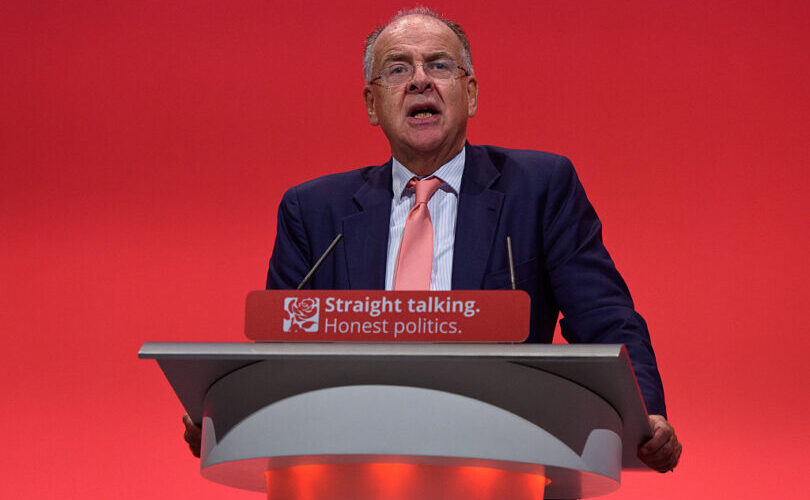
(LifeSiteNews) — In a stunning moment in the UK House of Lords, Lord Charles Leslie Falconer, Baron Falconer of Thoroton, stated that “pregnancy should not be a bar” to assisted suicide. Falconer served as Secretary of State for Justice under Prime Minister Tony Blair and is both a longtime advocate of assisted suicide and the bill’s sponsor in the House of Lords. A video of the exchange, posted by Right to Life UK, has racked up over 1.4 million views on X:
⚡SHOCKING! Lord Falconer says “pregnancy should not be a bar” to assisted suicide!
After Lord Mackinlay (@cmackinlay) tells Peers that Oregon protects viable unborn babies from assisted suicide, Lord Falconer seems completely unmoved & unbothered about this issue.… pic.twitter.com/xW5FxZxyNp
— Right To Life UK (@RightToLifeUK) December 12, 2025
“There is a big issue here,” Lord Craig Mackinlay, Baron Mackinlay of Richborough, told the peers. “In other states around the world who have had assisted dying for some time have differences of view. In Oregon, since 1997, there is a requirement to keep the mother alive as long as possible, particularly when there is a viable fetus.”
“The Netherlands takes a completely different view, and that is one of feticide, where the fetus has to be terminated by one means or another,” he continued. “Often by intracardiac injection of potassium chloride before the mother can be euthanized.”
“On which end of the scale does [the noble lord] refer these things, because we are in a situation where the Royal Colleges are against his whole system, and we will be relying on them to fill in the gaps of this legislation,” Lord Mackinlay concluded. “I think it is incumbent on us to fill in those gaps for them, because they’re not keen on this.”
“The noble lord puts it accurately,” Lord Falconer responded. “Some countries have taken one view, and other countries have taken another. It’s clear from the choice that I am supporting that we take the view that pregnancy should not be a bar to it.”
The context for Falconer’s statement is even more chilling. Baroness Tanni Grey-Thompson, a disability rights campaigner and legendary Welsh Paralympian, has thus far tabled 115 of the 947 proposed amendments to the assisted suicide bill. During debate, she cited the fact that pregnant women may request assisted suicide.
“In 2022, a paper on the epidemiology of cancer in pregnancy found that it occurred in approximately one in 1,000 pregnancies, which would be more than 500 cases a year in England,” she said. Not all of these would be terminal, she noted. “In terms of the numbers who could be impacted by the Bill, this is a really important group of amendments.” She noted that most countries that have legalized assisted suicide have safeguards in place for pregnant women, and observed:
Suicide is also the leading cause of maternal death during pregnancy in industrialized countries and the leading cause of maternal mortality in the first 12 months after childbirth. Professor Mark Taubert, hospital consultant and clinical director in palliative medicine at the Velindre University NHS Trust in Wales, has raised this issue many times.
It would be useful for further information to be provided on the impact of the Bill on pregnant women or those who have recently given birth, particularly given the risk of postnatal depression and other pregnancy and maternity-related mental health conditions.
When Lord Falconer started to respond, Lord Mackinlay interjected his question, which prompted Falconer’s answer that “pregnancy should not be a bar” to assisted suicide.
Lord Falconer’s single, clinical statement is the reductio ad absurdum—or perhaps the inevitable conclusion—of the Culture of Death: a pregnant woman being euthanized, with her baby being killed either just prior to her own demise by lethal injection or perishing with her. The conscience of Lord Falconer is so hardened that the specter of this double killing does not cause him to bat an eye. After all, Westminster just decriminalized abortion until birth—why should the life of a viable baby be a barrier to her mother’s suicide?