JONATHAN TEPPER describes finishing his memoir Shooting Up as “like an eight- or nine-month pregnancy — something that had been gestating for years, and suddenly it was out in the world”.
The book, recalling a childhood lived among addiction, poverty, and the AIDS epidemic in Madrid in the 1980s and ’90s, took nearly two decades to complete. “It’s nice to see the little creature out in the world,” he says, with a sense of pride.
Perhaps the “pregnancy” was difficult because of the subject matter: seven-year-old children do not usually hand out Evangelical pamphlets to heroin addicts in exchange for ice cream in foreign countries. They do not usually learn to identify danger by the glint of discarded syringes, or from the sudden tightening of an adult’s grip. Yet, this was Tepper’s childhood, and he recounts it without shock or spectacle. “When you’re very young,” he says, “you don’t really know what’s normal. . . It’s your environment, you are normal.”
His parents were American Evangelical missionaries, drawn by what they believed to be a divine summons to work among the drug users of San Blas, Madrid, a then notorious heroin market in Europe. Almost all his formative years were spent with his parents on mission.
Writing this book was not a therapeutic exercise for him. “I didn’t set out to write it to process anything, or to heal myself,” he tells me. “I wanted to tell a beautiful story of friends and family, of people and a neighbourhood that were disappearing.”
In conversation, he is restrained but also open; empathy seems a natural gift. This is replicated in the way in which he describes events in his memoir. There are extreme moments, but the telling is calm, lucid, almost gentle. Horror arrives not through emphasis, but through accumulation. “Humans need stories,” he says. “They need some kind of shape — not to explain things away, but to hold them.”
His upbringing as the son of missionaries gave him a window to view the world and people which has continued to mould him. “That outsider perspective never really leaves you,” he says. “It shapes how you look at people, and how careful you are about judging them. . . I’ve always felt like an outsider . . . as a missionary’s kid, later in the US, then in Britain even now, really.” A successful career in finance has meant that he has lived internationally throughout his career.
THE decision to move to Spain, made by his parents more than 40 years ago, would lead to the founding of Betel International, a substance-abuse charity and Christian community that now operates in more than 100 urban areas worldwide. The book returns to the earliest days of that movement, when its future impact was far from clear, and its costs were borne most by those closest to it.
In the memoir, mostly written from his perspective as a child, Mr Tepper cannot distinguish courage from recklessness; he knows only that this is the life that he has been given. “You can’t pick your parents,” he writes, “but they get to pick your life.”
In conversation, he is resistant to retrospective judgement of his parents. There was bitterness, he acknowledges, particularly in early adolescence, but it did not settle. “Had things turned out very badly,” he says, “I probably would still be bitter at my parents.” Instead, what emerges in the book is a slow movement towards gratitude, complicated but real.
One of the things that he was most determined not to do, he says, was to retrofit his childhood with adult understanding. “That outside perspective of a child allows for a sort of innocent, even naïve, and sometimes wrong view of the world,” he explains. He wanted to capture not only what happened, but what he believed at the time, even when those beliefs were mistaken.
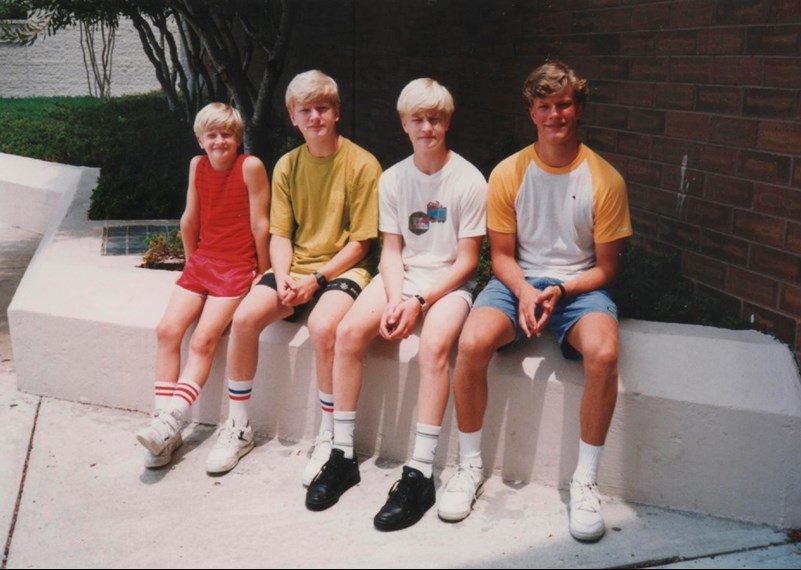 The Tepper brothers a few weeks before Timothy died
“Moral understanding”, he reflects, “comes through encounter, not instruction.” His childhood was shaped not by sermons, but by people: addicts who joked with him, adults who frightened him, and parents who loved him fiercely and exposed him to risk in the same breath. The reader can feel the unease of this without being told what to think.
San Blas is not merely the setting of Shooting Up; it is one of its central characters. Mr Tepper describes the neighbourhood with an eye for systems rather than symbols. Heroin is not an abstract evil, but a daily fact, shaping rhythms of movement, speech, fear, and hope. Addiction is infrastructural.
When he writes about drugs, it is not excessive. He describes how heroin is cooked with lemon juice in Coke cans, how veins collapse, how addicts move from arms to groin to neck with the calm precision of people for whom these details were once routine. The horror lies precisely in that calm. Nothing is stylised; nothing is redeemed by lyricism. This is just how it was.
In the book, it is startling to see how his younger self builds relationships with drug addicts and dealers — the very people parents usually tell their children to stay away from. But the challenge is seeing that the full range of humanity was represented in the community. Some are funny, frightening, generous, volatile; some are protective; some are cruel. Moral categories blur.
OUR conversation pivots when we discuss the death of his brother Timothy, aged nine, in a road accident while the family were in the United States. It is a key moment in his memoir — and, indeed, his life. Jonathan, who was a teenager at the time and a passenger in the same vehicle, escaped uninjured. He wrote the chapter recounting Timothy’s death in a single sitting.
“It was such an intense, vivid memory,” he says. It was also the moment childhood ended. “That was the turning point in my life. You go from being essentially carefree, even when people are suffering around you, to suddenly understanding the magnitude of death. . . Before that, death felt abstract. After that, it was real, and it was everywhere.”
One of his most unsettling insights concerns forgetting. The worst loss, Mr Tepper suggests, is not only the person, but the erosion of their presence in the mind. When he realises that he has gone a morning without thinking of Timothy, grief collapses into guilt. “Thoughts of suicide seduced me,” he writes. In conversation, he is matter-of-fact: “The real reason I never killed myself,” he says, “was that I didn’t want my parents to lose another son.”
Although Shooting Up could be described as a book about faith, the author resists that framing. “I don’t feel I have all the answers,” he says. “I don’t want this to be a Christian book as such . . . although people have told me they’ve come to faith after reading it. What I wanted to do was to tell a beautiful story and let people draw their own conclusions.”
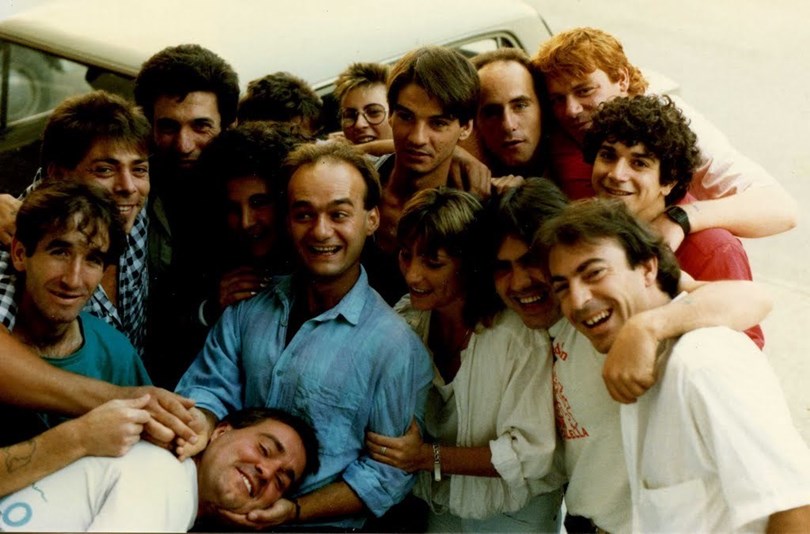 The addicts in the early years of the Betel programme. Most died of AIDS in the years that followed
As the narrative widens beyond childhood, its deeper purpose comes into focus. This is not simply a story told for understanding, or even for healing: it is an act of preservation. Mr Tepper is acutely aware that many of the people who populate his early life — addicts, friends, children who died young — are in danger of vanishing entirely. If the book achieved nothing else, he says, it would still be worth it, if it allowed the children of those who died to “feel their warmth and love”.
Memory, he knows, is fragile. Writing becomes a way of resisting erasure. That concern has gained further resonance now that he is a father. “One day,” he says quietly, “my son will lose me.” He speaks of life as “a long chain of love”, passed down and broken, repaired and broken again. Shooting Up is written against forgetting. Mr Tepper has one central mission for his writing: “I just hope that the book speaks for itself. I hope just seeing love in action does that.”
Shooting Up: A memoir of love, loss and addiction by Jonathan Tepper is published by Constable at £25 (Church Times Bookshop £22.50); 978-1-4087-2495-8978.