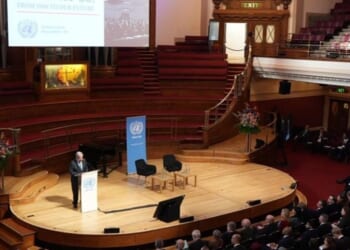
A CAROL service on Whitehall organised by the anti-Islam campaigner Tommy Robinson passed without major incident on Saturday, with turnout much lower than at a previous Unite the Kingdom (UTK) event.
Mr Robinson had promised that Saturday’s event would be non-political, and this injunction was repeated multiple times from the bauble-bedecked stage, flanked by illuminated crosses, which had been set up on Whitehall.
In the build-up, Church of England bishops had criticised the event for claiming to put “Christ back into Christmas” (News, 10 December). Church House released a video saying that a “story of hope, joy, and love” was being told this Christmas in churches across the country (News, 12 December).
On Saturday morning, the former Archbishop of Canterbury Lord Williams added his voice. Christ, he said, was a child “who grows up to offer his life so that dividing walls of hostility between different communities — and between humanity itself and the love of God — can be broken down in a new togetherness”. He asked: “Are we ready to put this Christ back into Christmas today?”
C of E opposition was referred to several times at Saturday’s event by speakers including by Mr Robinson, when he addressed the crowd at the end of the gathering. “The way they’ve acted this week is the reason that churches are empty,” he told supporters.
About 1500 people attended the gathering. At a UTK march in September, police estimated that the crowd reached between 110,000 and 150,000 (News, 19 September).
Mr Robinson said that he had been driven away from Christianity by church opposition to his early activism with the English Defence League. “I hated the Church for betraying us,” he said.
But, while serving a prison sentence for contempt of court for repeating false claims against a Syrian refugee, he came to Christ, he said. “As I understand the Bible, when the pastor done lessons with me for the life of Jesus, I understood that Jesus would have stood against the establishment, he would have stood with the sinners.”
He found it “hard” to call himself a Christian, he said, “because I know I live a life of sin, and then I realise that Jesus stood with the sinners.”
A previous speaker, whose “masculine Christianity” was praised by Mr Robinson, encouraged those gathered to attend a non-C of E church. “Sadly, the Church of England have said they don’t seem to want us,” he said. “Join a church that loves you.”
Richard, a car mechanic from Dagenham, attends a C of E church, but said that he was the “black sheep” there; although, on the whole, he was made to feel welcome, he said that there were some there that “look down on me”.
He rejected both assertions that some think that those in UTK are “racists” and “using Christ as a tool, just to better our means. We’re not as bad as what you think we are.”
Danny and Jamie have been attending Tower Hamlets Community Church, an independent Evangelical church in north London, for five or six months. “Any event regarding Christ I’m going to attend,” Jamie said.
They had both attended the UTK march in September. While they did not agree with Mr Robinson “on every point”, they were ardent that national identity needed to be protected. “We should be proud to be Christians, proud to celebrate these days, proud to fly the England flag,” Danny said.
TOWARDS the back of the crowd on Whitehall was one person who made it clear that she was not there in support of Mr Robinson. “I went with my placards which made very clear that I was not part of the UTK gathering,” the Minister of Bonny Downs Baptist Church, in east London, the Revd Dr Sally Mann, said.
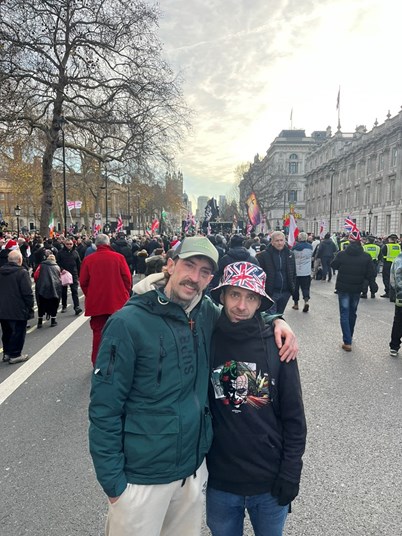 FRANCIS MARTIN/CHURCH TIMESFRANCIS MARTIN/CHURCH TIMES
She sat down with two chairs, and had a steady flow of interlocutors. People were “angry on the surface, and then very quickly hurt and lonely”, she said on Sunday.
“It was actually like pastoring a youth group, and I don’t mean that in a patronising way. I meant that we need to recognise that there’s a loss of a sense of identity for a lot of people,” she said.
Dr Mann had also been part of a gathering on the steps of St Martin-in-the-Fields earlier that morning, before Mr Robinson’s supporters started to arrive in neighbouring Trafalgar Square.
About 120 people sang carols outside St Martin-in-the-Fields, displaying banners saying that Jesus was a refugee. A live nativity, with donkeys and sheep, stood at the centre of the crowd.
Afterwards, the Vicar of St Martin-in-the-Fields, the Revd Dr Sam Wells, explained that “a bunch of us got together when we heard that there was going to be the Stephen Yaxley-Lennon [Mr Robinson’s real name] down Whitehall today, and it was claiming a Christian message.
“We felt that wasn’t the Christian message that we should be sending to the country,” he said. He described it as the “manipulation of people who are fearful and anxious”, referring in particular to the state of the economy.
Another of the organisers, Dr Krish Kandiah, who founded the refugee charity Sanctuary Foundation, hoped that the words of the carols being sung might “boomerang back” and change the hearts of Mr Robinson’s supporters.
He said that Mr Robinson was spreading “fear and division, but at the core of the Christmas story and Christmas carols . . . is justice, kindness, redemption.”
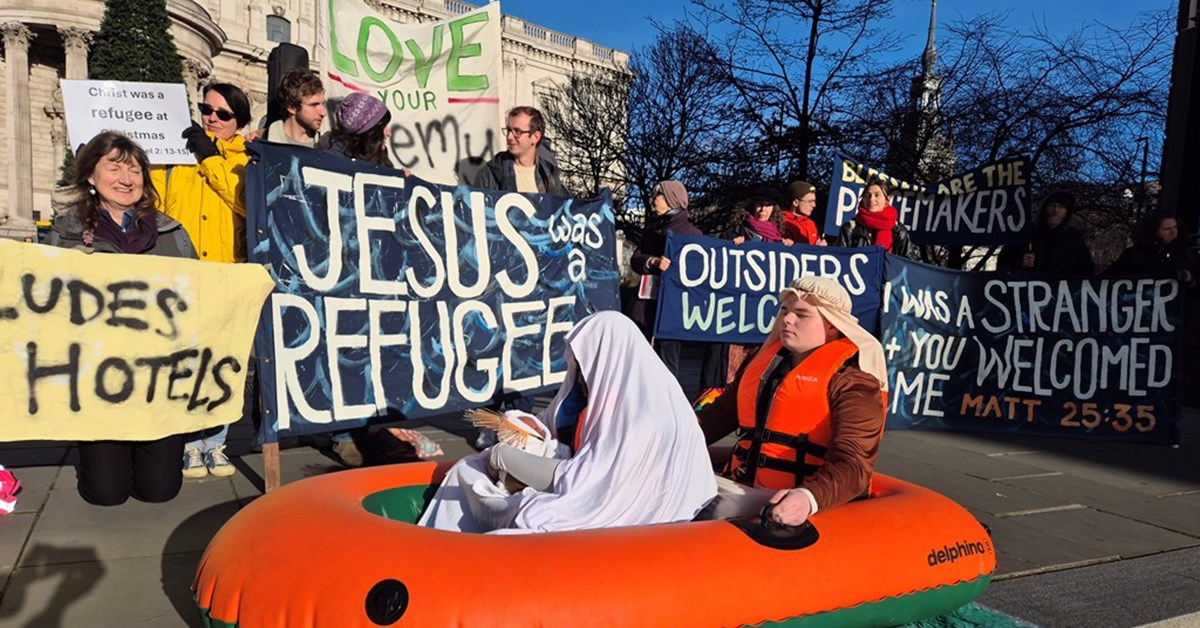
Later that morning, another demonstration, organised by the charities Better Story and Christians for a Welcoming Britain, took place outside St Paul’s Cathedral. Alongside a live tableau depicting Mary, Joseph, and the infant Jesus in a rubber dinghy, activists stood in silence holding posters saying that Jesus was a refugee.
One of the Better Story organisers, Tommy Sharpe, said: “One of the messages we’re trying to give through this stunt is that beautiful story of God incarnate, which shows that every human has value.”
There were many questions about asylum policy, he said, and the message was not that small-boat crossings should be welcomed. “But we are pro the people on small boats, and we think they are precious and valuable in God’s eyes.”
The refugee charity Care4Calais joined Stand Up To Racism to organise a demonstration on Whitehall. Starting at the same time as the UTK event, the two groups were kept far apart by police.
The musician and campaigner Billy Bragg, who sang at the demonstration, told the Church Times that there was a trend, coming from the United States, of “seeking to portray the idea of empathy as toxic. But was there ever a more empathic geezer than Jesus Christ?” he asked, describing Mr Robinson’s supporters as “hypocrites”.
Churches were “running the foodbank, trying to fill the gaps where the state is failing”, he said. He was happy to be in solidarity with those Christians offering a different message to Mr Robinson.
THE music at the UTK event was not to everyone’s taste. Three women from Preston, who declined to give their names, were disappointed at the lack of congregational singing.
There was no big screen to display lyrics, and it seemed that not enough hymn sheets had been printed. The music was led by a pastor, Rikki Doolan, who is close to Mr Robinson, and by musicians from the Pentecostal Spirit Embassy church, founded by Uebert Angel, a self-styled prophet.
The women from Preston had been expecting a more traditional carol service, and seemed unmoved by the mixture of evangelism and patriotism that was expressed in the speeches that interspersed the songs.
The Minister of Clarendon Park Congregational Church in Leicester, the Revd Gwyn Davies, attended the UTK gathering out of “inquisitiveness”, he said. He described his politics as “broadly” aligned with those of the organisers.
He said that it was “hypocritical” for those on the “liberal Left to say theirs is true Christianity, and somebody who believes in a more traditional Christian value has got it wrong.”
It was “good for the country” to have large public celebrations of Christmas “without bringing a political angle into it”, he said.
One of the speakers, a social-media influencer known as Based and Bougie, referred to “Marxist lies that this country is a secular country, a liberal country”. But, for the most part, Mr Robinson’s insistence that the event should be non-political was upheld.
In a blog post on Sunday, the founder of the Centre for the Study of Bible and Violence, Dr Helen Paynter, reflected on how this defied her expectations. She wrote: “Tommy Robinson may have said some racist things in the past. He didn’t today. We can say the one thing without unsaying the other. None of us is entirely monochrome, and growth (and repentance) is possible.”
She reflected: “Rather than blanket-condemning them for the things they have said and done, perhaps we should comment on particular moments, particular actions.”