THE Peter Jackson films of The Lord of the Rings were so successful, both artistically and commercially, that they have become almost as famous as the books, and people quote lines from the films which are not in the book, mistakenly claiming that they are quoting Tolkien. But at least those films are visually beautiful and faithful enough to the books as not to be a travesty (unlike the subsequent Hobbit films).
It is fortunate that some of the earlier film proposals put to Tolkien himself in the late 1960s and early ’70s never saw the light of day. One American film “treatment” proposed to eliminate all the tedious walking of the fellowship on their long quest by simply having them flown by eagles to each significant destination. This was, of course, a classically American approach, coming from a country that worships the automobile and designs cities in which walking is almost impossible.
Needless to say, such a treatment entirely missed the point. It is precisely the walking — companionably side by side, or helping one another in the struggle through hostile terrain — that is at the heart of the fellowship and the heart of the quest. The journey is at least as significant as the destination, the struggle as the achievement. The reflective poetry of Bilbo’s “Walking Song” could never have emerged from a culture of cars and trains:
Roads go ever ever on
Under cloud and under star,
Yet feet that wandering have gone
Turn at last to home afar.
Indeed, Tolkien makes this clear in one of his letters: “As I tried to express it in Bilbo’s Walking Song, even an afternoon-to-evening walk may have important effects. When Sam had got no further than the Woody End he had already had an ‘eye-opener’. For if there is anything in a journey of any length, for me it is this: a deliverance from the plantlike state of helpless passive sufferer, an exercise however small of will, and mobility — and of curiosity, without which a rational mind becomes stultified.”
I love this insight, and I love the oblique glance at suffering, the quiet determination and stoicism in those understated phrases “the plantlike state of helpless passive sufferer” and “an exercise however small of will”. Anyone who has ever suffered from depression will know what that is about.
I certainly find that daily walks are essential for a balanced state of mind, and it is while I am walking that both my prayers and my poems have their beginning and find their form. My daily walks can be a matter of routine and habit, but sometimes the need to put the pen or laptop down and go for a walk comes like an imperative, an impulse that must be obeyed, and, whatever the problem that has prompted the walk, even if I do not consciously ponder it while I am walking, it seems, somehow, if not solved, at least more soluble by the time I get home again.
The Latin tag Solvitur ambulando (“It is solved by walking”) is usually attributed to St Augustine, but, whoever first said it, I have many times proved it to be true.
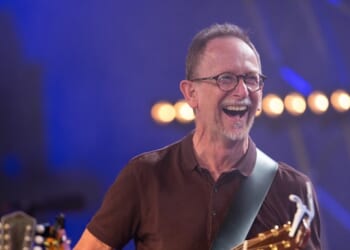
Join the Revd Dr Malcolm Guite in the Temple Church, London, on Tuesday 17 February at 7 p.m., for “Merlin’s Isle: A Journey in Words and Music”, a concert weaving together poetry and song in celebration of his new four-part poetic cycle, Merlin’s Isle. Tickets £15, or £10 for Church Times subscribers. canterburypress.co.uk/events