THE campaign behind the National Year of Reading 2026 is a sign of our times, being an attempt to recover the joys of silent reading in a noisy world dominated by social media. Yet, not so long ago, most adults heard stories rather than read them. Dickens was read aloud in pubs; so one copy of a serial number reached many more “readers” than are indicated by his long print runs.
Before the invention of movable type, and before the modern idea of originality emerged, the so-called Matter of Britain — Arthur, Camelot, and all that — was told and retold orally, only to be written down later in various compilations. And the most accessible medium for the oral transmission of old stories was the ballad, also written down quite late in the game.
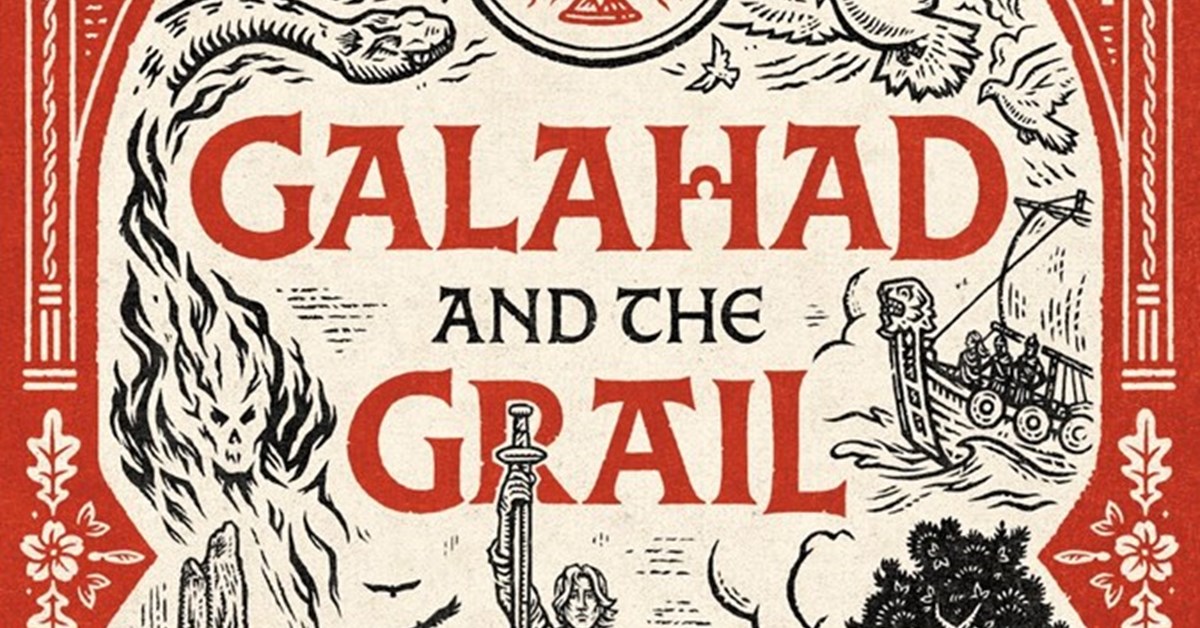
The priest, poet, and academic Malcolm Guite, resident poet of this parish, is now bringing Arthurian legend and the ballad tradition together in Merlin’s Isle: An Arthuriad in four books. In the first book, Galahad and the Grail, he recommends that we read the poem aloud, “because that physicality of sound and breath and speech is what it’s made for”. He’s right. I read all 314 pages aloud and was transported into an imagined space that is at once strange and familiar, distant from and close to us, mysterious and credible.
The simplicity of the ballad form and the steady pulse that drives the narrative forward perfectly complement the bareness of the Arthurian subject matter, particularly vis-à-vis the quest for the Grail. In the absence of the kind of descriptive detail that is the preserve of the novel, action follows action in rapid succession, deeds have immediate repercussions, and lives are saved or lost in a stanza or two. I paused my reading only when tired, being unused to the exercise.
If any of this reminds you of Coleridge’s “The Rime of the Ancient Mariner” and the enthralment of the wedding guest, you are spot on. In an essay at the end of the volume, Guite explains that the form of that great poem, on which he has published a book, was highly influential. Coleridge’s adaptation of the ballad form, including the expansion of the 4-3-4-3 stanza to raise the tension or reveal a hidden truth, was an aspect of the Romantic revival of the ballad. Now Guite aims to do the same for our generation.
Although he invokes the Inklings — Lewis, Tolkien, Charles Williams, et al. — in his explanatory essay, and although his podcasts are presented as tutorials with him as a Merlin lookalike, this Arthuriad is utterly fresh. In 1922, Eliot’s The Waste Land evoked memories of the trenches. Guite’s portrayal of the Waste Land is informed by our shared anxieties relating to climate change. Malory’s women are often spectators; Guite’s are active participants in the quest. All this is without commentary in the poem, which succeeds in making goodness, truth, and beauty interesting: a rare achievement
As a student at Cambridge, the poet rediscovered the legends of King Arthur in their original sources and “became aware of how so many modern versions of them seemed to marginalise or even erase the deep Christian impulse that had formed their original telling”. He now hopes that his Arthuriad “might baptise the imagination of the growing generation brought up in a secular world, trapped in ‘the immanent frame’ and deprived of their inheritance of the gospel”. It is a noble hope. This is a poem of sacramental re-enchantment, grounded in the holy eucharist.
Dr Michael Wheeler is a Visiting Professor at the University of Southampton.
Galahad and the Grail: Merlin’s Isle Volume 1
Malcolm Guite
Canterbury Press £30
(978-1-78622-712-6)
Church Times Bookshop £27