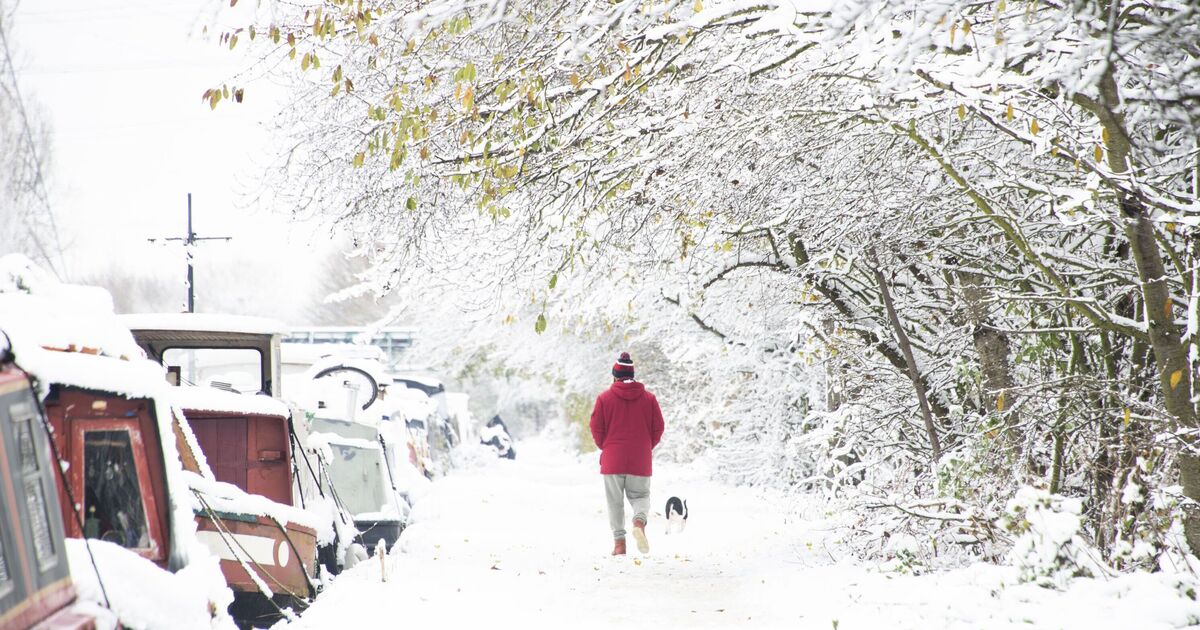
The Met Office has issued a verdict on the Beast from the East (Image: Getty)
The Met Office has issued its long-range forecast, giving its verdict on a possible “Beast from the East” soon to arrive in the UK. The agency issued a series of warnings earlier this month as a bitter freeze descended on the country, leaving hundreds of miles of land covered in ice and snow.
The frigid conditions resulted in yellow, amber and even a rare red weather alert, warning the cold and the snow could pose a “danger to life” and even cut off communities as temperatures in the worst-hit areas plummeted well below 0C. Some of the worst conditions could still be yet to come, however, with weather maps capturing a countrywide snow blast and temperatures as low as -12C towards the end of January. Weather maps show a bitter chill is set to take hold, with the first signs of another, potentially more severe cold spell taking shape around January 28. The maps from WXCharts show a blanket more than 600 miles wide stretching across the length of the country by January 30.
READ MORE: One-off £225 cost of living payments awarded in January and February
READ MORE: Snow maps show blizzard blasting 51 UK cities as England turns white
A cloudy Saturday afternoon for most ☁️
Some showers and spells of rain at times ??????️
The best of the brightness in the southwest and across the Northern Isles ⛅ pic.twitter.com/BEtcIqQxW1
— Met Office (@metoffice) January 17, 2026
The first glimpses of that snow look set to arrive by January 27, with showers first hitting Wales, Scotland and Northern Ireland early that morning around 6am.
Over the following 12 hours, increasingly heavy snow, which will at its peak fall at up to 0.4 inches (more than a centimetre) per hour, is expected to cover nearly the entire country. By 6pm, the band of snow will stretch from Colchester in the south up to just below Inverness in Scotland.
After briefly stopping for a day, the snow will pick up again on January 29, when it will paint the entire country from tip to tail – more than 600 miles – settling to depths of up to two inches.
Only London and the easternmost coast of England, the far west coast in Devon and some limited parts of southern Wales will go without snow by 6am on Friday, January 30. At the same time, temperatures will sink to extreme lows, with maps showing between -1 1C and -6 6C in England, and comparable -5 5C in Wales.
In Scotland, the mercury could plunge as low as -12C in exposed Inverness between 12am and 6am alone, keeping snow settled on the ground as it falls.
The Met Office said in its latest long-range forecast, which covers the same period as WXCharts’ maps (January 20 to 29), that the UK would come under “some influence from the east”, which could produce colder conditions “later in the period”. The agency said the transition “increases the chance of snow across the country”.
The forecasters said: “Throughout this period, the UK will see a battle between Atlantic weather systems attempting to arrive from the west while high pressure and colder conditions attempt to exert some influence from the east.
“Initially, milder Atlantic air is expected to dominate. This should maintain often cloudy, changeable conditions with showers or longer spells of rain for most. The wettest weather in western parts of the country, drier in the east. Temperatures overall likely to be around average with some night frosts in clearer areas. Later in the period, there is an increased chance that conditions will turn colder.”
“This aspect of the forecast is still somewhat uncertain but the potential transition to colder weather also increases the chance of snow across parts of the country.”
However, Met Office spokesperson Grahame said the “immediate future” would see temperatures remain near average, and added the forecast of cold weather could easily change before the January maps show heavy widespread snowfall. He said: “In the immediate future colder weather isn’t expected to return for the UK. Temperatures for most of next week should remain near average.
“While there’s still a slight possibility that winds from the east could bring a chill during the final week of January, that is still a long time away giving time for the forecast to change. For now, it’s just as probable that milder southern air will persist, keeping the cold at bay.”