THE Jerusalem Palm Sunday procession, from the Mount of Olives to the Old City, has been cancelled owing to security concerns over the Middle East conflict.
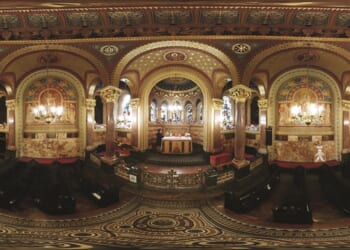
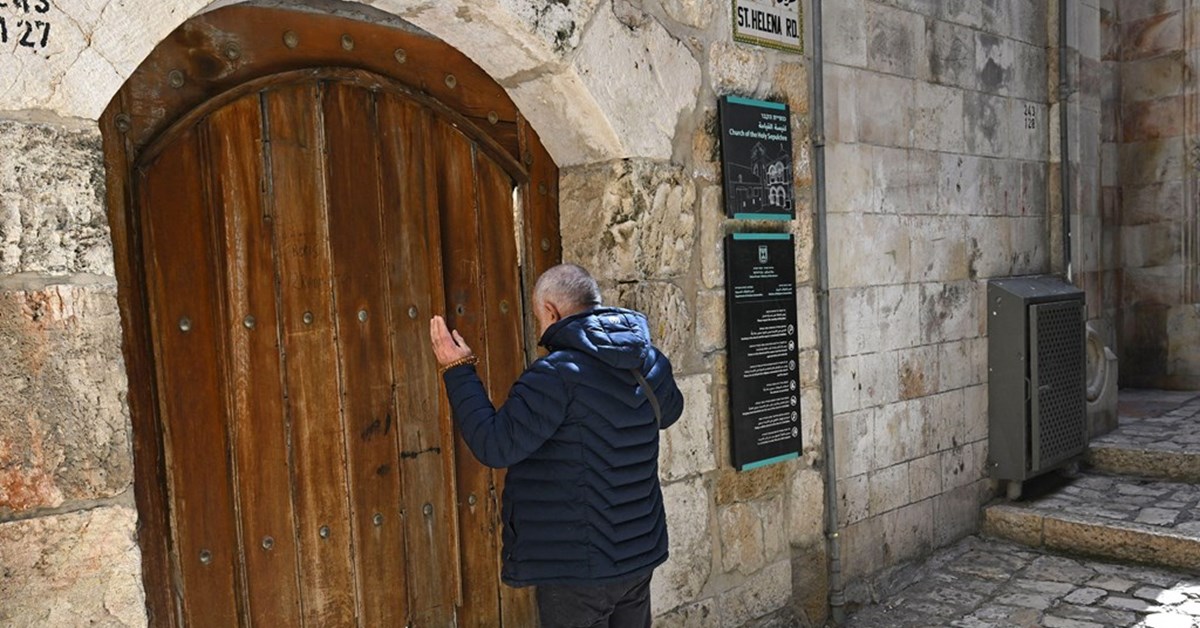
Holy sites in Jerusalem — including the Western Wall, the Temple Mount, and the al-Aqsa compound, as well as churches — will remain closed over Easter, and until further notice, after shrapnel hit the roof of the Church of the Holy Sepulchre after an Iranian missile strike last Friday.
Closure of the Holy Sepulchre is highly unusual. In 2018, the Heads of Churches issued instructions that the Holy Sepulchre should be closed during a tax dispute with the Israeli government. Covid restrictions also shut down access to all the holy sites, and prevented many of the normal Holy Week and Easter services in 2020 and 2021.
The Dean of St George’s College, Jerusalem, the Very Revd Canon Richard Sewell, told the Church Times on Tuesday: “It is heartbreaking that war-time restrictions are going to cause Holy Week and Easter celebrations to be significantly curtailed or cancelled. Instead, Christians will enter into the events of Jesus’s Passion and celebrate the resurrection of Christ in smaller-scale and personal ways. However, even wartime restrictions cannot prevent the good news of Christ’s resurrection breaking out of the dark tomb of war, death, and danger.”
The Latin Patriarch of Jerusalem, Cardinal Pierbattista Pizzaballa, announced the cancellation of the Palm Sunday procession, and said that the Maundy Thursday Chrism Mass had also been postponed.
“The restrictions imposed by the conflict and the events of recent days do not bode well for any imminent improvement,” he said.
“Due to the war, this year we were unable to experience the traditional Lenten journey in Jerusalem, with the solemn celebrations at the Holy Sepulchre and in the Holy Places of the Passion. Though we were able to pray and prepare personally, we felt the loss of the community journey towards Easter.”
He continued: “This is a wound that adds to the many others inflicted by the conflict. But we must not allow ourselves to be discouraged. Though we may not gather as we would like, let us not give up prayer.”
Xavier Abu Eid, a member of the Palestinian Anglican community, told the Church Times: “This is a war of choice that Israel has conducted, promoting chaos in the region to the extent that even our masses have been affected. Thousands of Palestinian Christians and Muslims have been prevented from praying in our holy sites during Lent and Ramadan.”
Canon Sewell said that most Palestinians did not accept that Israel had authority over the Old City. “It must be remembered that East Jerusalem was illegally annexed by Israel in 1980,” he said. “Nevertheless, they are the de facto ruling authority; so, whether we accept it or not, they make the rules. But the rules are resented.
“Among Christians and Muslims, there is a strong feeling that these restrictions are part of an ongoing process of discrimination against them. It is undoubtedly true that religious freedoms for non-Jews in Jerusalem are under sustained threat. However, these wartime orders impact Christians, Muslims, and Jews equally, and are more to do with the terrible and unintended impact of war rather than a direct attack on religious freedom to worship.”
In a social-media post, he addressed the “hurt” and “outrage” that many have expressed over the closure of holy sites. He wrote: “Israel imposed war-time restrictions across the country shortly after the war commenced [on 27 February]. This bans gatherings of more than 50 people in all public places including synagogues, churches and mosques. In addition holy sites in the Old City were closed including the Western Wall, the al-Aqsa compound and the Holy Sepulchre. The reason given is the lack of bomb shelters in the Old City as well as the likelihood of large numbers of people gathering in each of these sites. These restrictions are being enforced in all three sites as I have seen with my own eyes. Outside the Old City the 50-person limit applies. So it’s not a matter of the persecution of Christians, of Muslims or of targeting Palestinians.”
Canon Sewell set out the wider context, in which Muslims and Christians have experienced increasing restrictions on their right and freedom to worship. “There is a very real fear that Israel’s government is sympathetic to Jewish factions who seek to wrest control of the al-Aqsa compound (which Jews call the Temple Mount) and ultimately to destroy both holy buildings and rebuild the Jewish temple. This isn’t a flight of fantasy. There is real evidence that plans for this are developing strongly. Restrictions on Christians celebrating Easter in the Holy Sepulchre in recent years also has caused great pain and anger.”
He warned that “simplistic messages condemning Israel’s closure of this site or that site without the wider context” risked fanning the flames of inter-religious animosity . “They should stop. The wider context of Israel’s lack of protection for religious diversity, in Jerusalem especially, should certainly be acted upon.”
On Tuesday, Israeli media reported that six people had been injured in Tel Aviv by a missile attack, as Iran launched a wave of attacks on Israel just hours after President Trump had claimed that the United States had held “very good” talks with Iran’s leadership. Iranian officials denied that such talks had taken place. “There is a profound sense of a region in a cataclysmic crisis controlled by leaders who care very little for anything other than their own skewed political agenda,” Canon Sewell said.
On Sunday, Pope Leo described the conflict as a “scandal to the whole human family”, and renewed his repeated call for an immediate ceasefire.
CAFOD’s country representative for the occupied Palestinian territory and Israel, Elizabeth Funnell, said this week that “the increase in violence . . . means Palestinians’ lives are increasingly restricted, with people finding it difficult to go to work, farm their land or access essential services. Meanwhile more footage has emerged over the weekend, of large groups of Israeli settlers raiding Palestinian villages, throwing stones, and setting fire to homes and vehicles. Our Israeli partner Yesh Din has told us that during the first two weeks of the conflict they recorded an average of ten attacks on Palestinians a day.
“Most people in Gaza are unable to return home, five months after a ceasefire agreement was signed. Families are having to ration what food they can access where they are. For those families still able to be together, our partners tell us the majority cannot yet afford for everyone to have a meal together at the same time.”