Britain’s Office for National Statistics has answered an interesting question, as posed by the London Times: “How many households give more than they take from the state?” The answer explains a lot about contemporary political life:
Putting the numbers together reveals something stark. Nearly two thirds of households take more from the state than they pay into it.
This chart tells the story. The ONS analysis included indirect as well as direct taxes. “Benefits in kind” are services provided by the state, like the National Health Service and public schools:
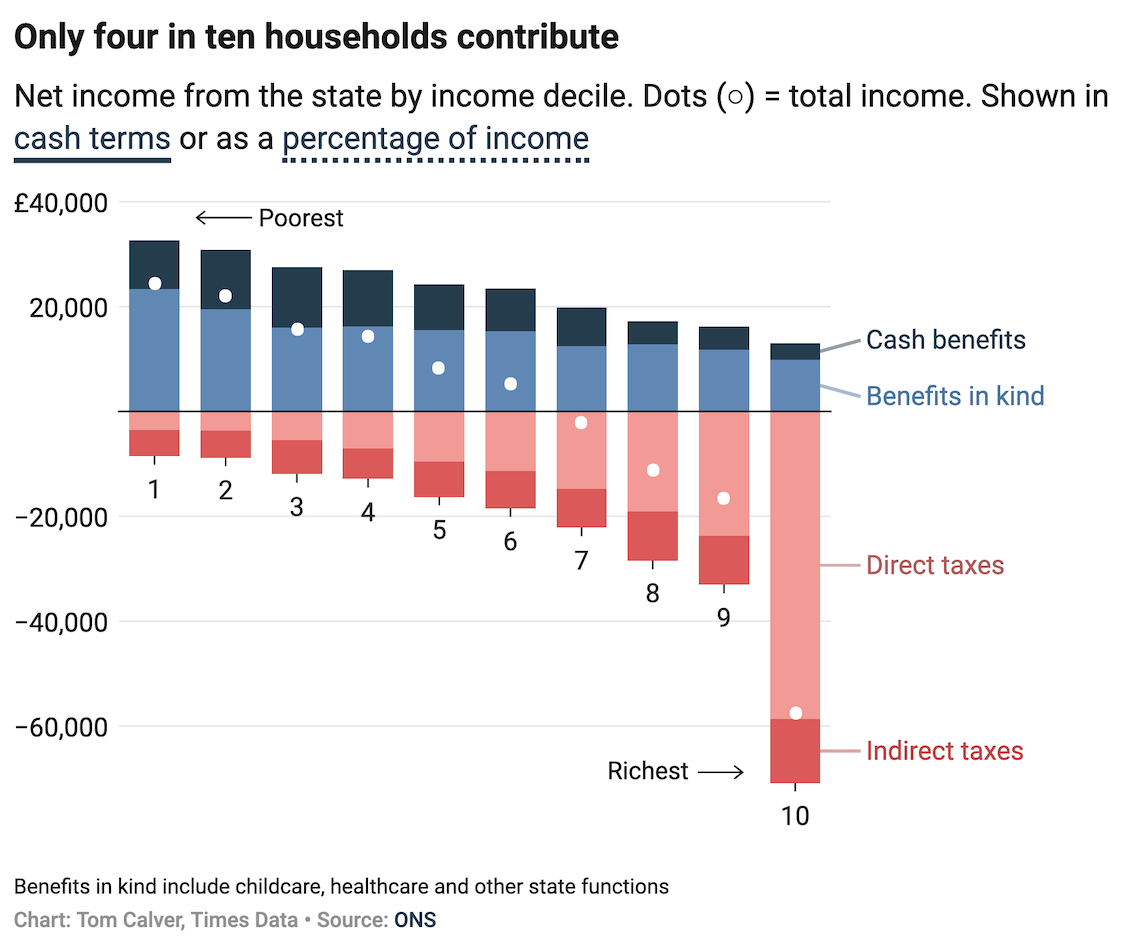
As in America, the “rich,” here the top 10%, pay vastly more than their fair share and pretty much row the boat for everyone else. Notable, however, is the recent change in status for middle-income Britons:
But the data shows that even households in the sixth decile — the one just above the middle, which earns £40,800 before taxes — receives, on balance, £5,000 more from the state than it puts in. This is equivalent to 11 per cent of its total post-tax income.
It was not always thus. The ONS data goes all the way back to 2002. If we apply the same analysis then, we see that the average household in the sixth decile used to be a net contributor of about £3,100 a year. In just two decades middle earners went from being net contributors to net recipients.
When slightly above-average households are net recipients of state largesse, you have reached a tipping point.
Of course, voters won’t necessarily see it that way. Britain’s government could only measure inputs–pounds–not outputs, value. So the slightly above average Englishman may not think he is getting more from the government, in terms of quality, than he is paying for. Still.
I don’t know whether anyone has done a similar analysis for the U.S. If so, it would be interesting to see. The Democrats’ medium-term plan is to make a majority of Americans dependent on the state, so that they form a permanent anti-freedom, pro-government voting bloc. I think we are dangerously close to seeing the realization of that dystopian vision.