Israeli Prime Minister Benjamin Netanyahu on Wednesday unveiled a $108 billion, decade-long investment to build an independent Israeli munitions industry.
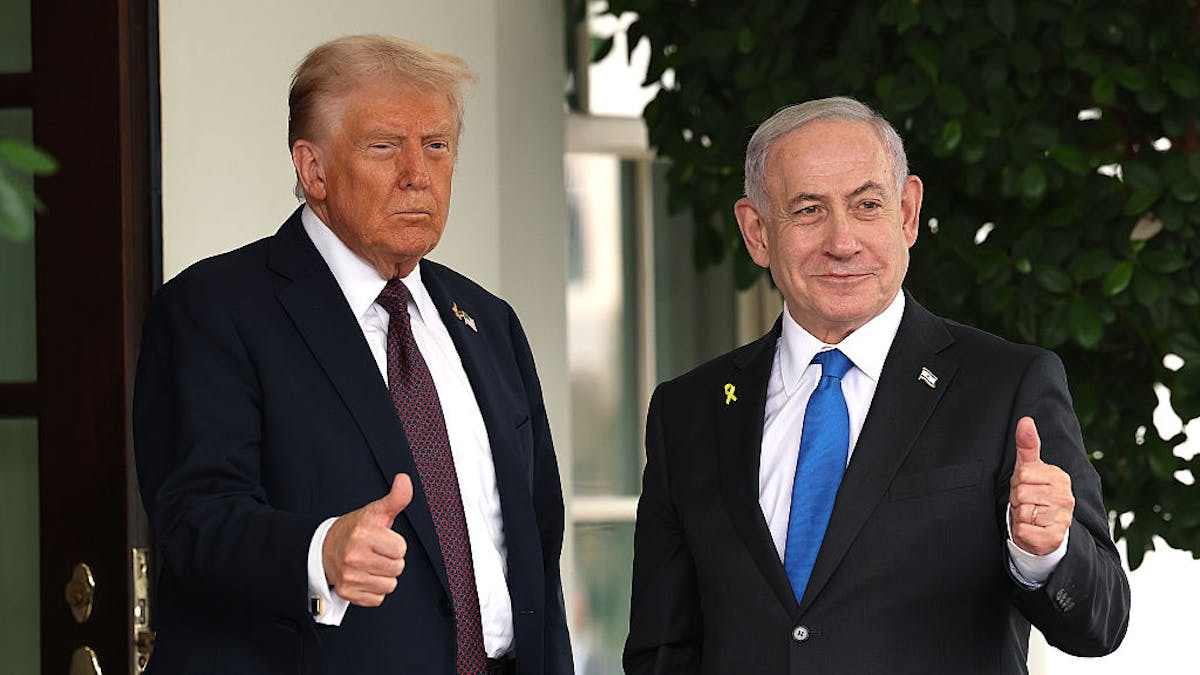
The announcement comes ahead of Netanyahu’s meeting with President Donald Trump next week and amid growing calls from voices on both the Left and Right to reduce or cut off United States military funding for Israel. The meeting will be the fifth time Netanyahu has met with Trump since he was inaugurated last January.
“I approved, along with the defense minister and finance minister, a sum of NIS 350 billion [$108 billion] over the next decade to build an independent Israeli munitions industry,” Netanyahu said at an Israeli Air Force pilot graduation ceremony, the Times of Israel reported.
Netanyahu said such an investment is necessary to “reduce our dependence on all players, including friends,” following several countries imposing restrictions on its weapons sales, including under former President Joe Biden’s administration.
Netanyahu will meet with President Trump on Monday at Mar‑a‑Lago, as he prepares to unveil a new governing entity for Gaza. The new Gazan government will be supported by a Trump-led Board of Peace with former U.N. envoy Nickolay Mladenov as the representative on the ground, reported Axios.
Special Envoy Steve Witkoff and Jared Kushner have reportedly been coordinating with Arab partners and Turkey on the second-phase of the ceasefire, which includes disarming Hamas and demilitarizing the Gaza Strip.
Netanyahu has long advocated for reducing Israel’s dependence on other countries for military equipment. Earlier this year he said Israel would become a “super-Sparta,” a remark that drew criticism until he clarified he was referring only to the defense industry, not the broader economy.
Israel is currently the world’s eighth-largest arms exporter with $15 billion in sales in 2024. However, the Jewish state has still relied on munitions and military equipment from other countries, especially since October 7, 2023.
Israel’s extremely cost-efficient “Iron Beam” laser system which can shoot down missiles, mortar rounds and drones is expected to be delivered to the military by the end of the month. Each interception is estimated to cost as little as $2, which is a sharp decline from the Iron Dome interceptor missiles that can cost between $100,000 and $1 million each.
The Iron Beam technology, which was developed with Israel’s Rafael Defense Industries and U.S.-based Lockheed Martin is reportedly being shared with the U.S. Army’s directed energy program, reported Fox News.
Since Israel’s war against Hamas began, several countries have restricted or halted arms exports to Israel, including Belgium, France, Italy, Japan, the Netherlands, Slovenia, Spain, the United Kingdom, and the United States under former President Joe Biden.
Christmas Sale – Get 40% off New DailyWire+ Annual Memberships
The United States currently provides Israel with about $3.3 billion annually, which Israel uses exclusively to purchase American defense equipment, plus an additional roughly $500 million per year for cooperative missile defense programs.
Supporters of United States military aid to Israel say it strengthens American and Israeli security by deterring Iran, Hezbollah, and other terrorist groups. They argue that because the aid must be spent on American defense equipment, it also subsidizes American defense companies, supports domestic jobs, and allows technology to be tested in real combat which provides data that can improve the technology and United States military readiness.
A growing number of lawmakers on both sides have called for a reduction or an end to funding for Israel, including Reps. Marjorie Taylor Greene (R‑GA), Thomas Massie (R‑KY), Ilhan Omar (D‑MN), Rashida Tlaib (D‑MI), Summer Lee (D‑PA), and Al Green (D‑TX), who voted in July for a failed amendment to cut $500 million from the Iron Dome program.
There is a growing number of voices within Israel opposed to accepting American funding, arguing that it limits Israel’s freedom to conduct military operations and exposes the country to political pressure associated with the aid.