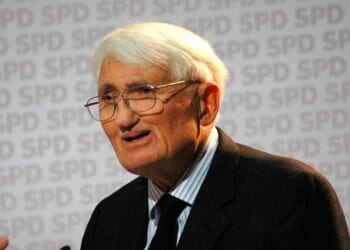
MALCOLM GUITE is an interviewer’s dream. Speaking from his book-lined study at home in Norfolk, he says he is still jet-lagged after recent speaking engagements in the United States. It is hard to believe. He is as excited, garrulous, and engaging as if we were yacking together over a pint in the snug of a Cambridge pub.
Certainly, he has reasons to be buzzing. His exquisite new book, Galahad and the Grail, is part one of a planned four-volume poem sequence, Merlin’s Isle. It is a retelling of the tales of King Arthur, which, Dr Guite says is “a ballad cycle, but it has turned into an epic and, in a sense, a national epic”.
Dr Guite is no stranger to ambition. His study of Coleridge was structured through The Rime of the Ancient Mariner, and — I say this as a poet — I find his talent for sonnets somewhat prodigious. Merlin’s Isle, however, is on another level. With characteristic self-deprecation and wit, Dr Guite says that “it may be the folly of my dotage.”
Certainly, on the evidence of Galahad and the Grail, it will be the fruit of a lifetime’s interest in the legends of Logres, the classical name for Arthurian Britain. As he explains, Dr Guite’s fascination with Arthur began when his mother read the stories to him as a child. This interest only deepened when he went up to read English at Cambridge.
Dr Guite says that when he pitched Merlin’s Isle to publishers, he needed to provide the “unique selling point”, or USP. For him, it was that “no one has done this since Tennyson in the Idylls of the King — but I had to point out to them that the ‘unique selling point’ might be the ‘unique sinking point’.” He does not need to worry. Galahad is a rollicking good read.
As Dr Guite puts it: “I start in media res with the Galahad story.” There is no faffing about. We are quickly into the action, as Galahad — the youthful and untested “red cross knight” — heads off with Lancelot and others in search of the means to heal the Wasteland which surrounds the Grail-Castle, the home of the perpetually wounded Fisher King. Galahad is full of thriller-like twists and turns, and its pages reveal the child Malcolm’s love of story.
THIS IS no high fantasy edition of a Boys’ Own story, however. Dr Guite is clear that he wants to write against poetry that is “another little adventure in the dialect of me”, where people “don’t write on the main page”. He is profoundly suspicious of what he calls the “Disneyfication” of the Arthurian legend.
He explains that one of the reasons for starting with Galahad’s story (rather than, say, the coming of King Arthur) is that he wants to “recover the sacramental side” of the Arthuriad. He writes, then, against the fashion, established since at least James Frazer’s classic 19th-century text The Golden Bough, which claims that the Arthuriad comprises pre-Christian stories that have received what Dr Guite calls a “Christian buff”.
I am the first to admit that I grew up on cinematic versions of Arthur such as Excalibur, Disney’s The Sword in the Stone, and — Lord, help me — Monty Python and the Holy Grail. As such, I find Dr Guite’s take on Galahad strikingly and movingly full of faith.
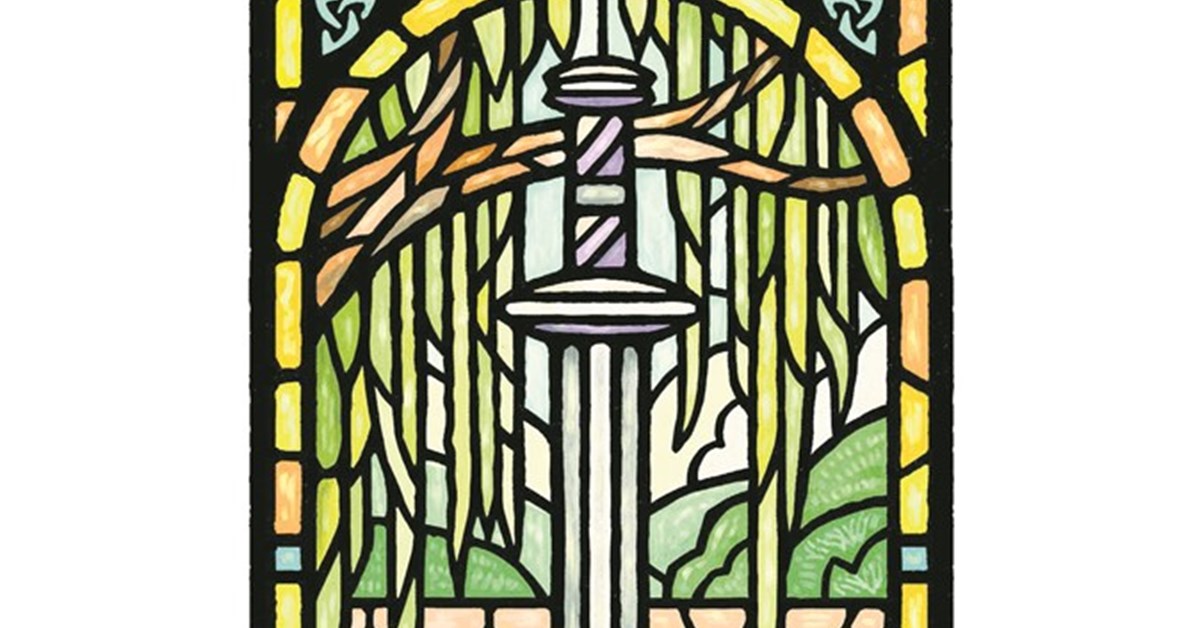
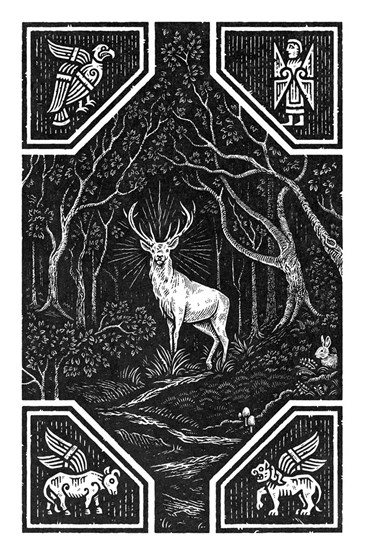 Illustration by Stephen Crotts from Galahad and the Grail
Events begin at Pentecost and end at Michaelmas, when Galahad ritually heals the Wasteland with the Grail, and the Fisher King with the spear that pierced Christ. Christ’s wounds.
Dr Guite reminds me that, in medieval Christianity, lay people were not permitted to receive Christ’s blood from the eucharistic chalice. He wonders: “What if that chalice that lay people never get near suddenly appeared in a king’s court?” His version of the Grail legend is a response to theological ideas which marginalise lay people. “Let’s test the idea that laity can’t touch it,” he says. “I love the idea that the storytellers can bust it out of its ecclesial cage and set it free in the courts and woods of Logres.”
There is another sort of enchantment at play, too: the deep magic of language itself. Dr Guite smiles modestly when I say he is an acknowledged master of the sonnet. Its power is lyrical and shaped, classically, around the development of a poetic argument. His new project is written in the easier rhythms and sounds of the ballad.
To explain his decision, he says: “I’ve been wanting to do this epic poem for ever, but my problem has been form.” He adds that he found the way to write it while “I was getting on with another task — my book on Coleridge . . . and all the while I was saying, look what he does with the Ballad . . . he reinvents the ballad form, and he turns it into the most delicate instrument, all the while preserving the rhythm and a compelling forward narrative.”
SO, WHAT does Dr Guite want a ballad version of the Arthuriad to offer? “I hope,” he says, “it will have this element of chant and incantation.” Indeed, he hopes that his readers will read it aloud. “The rhythm takes over, and it’s like the music in a film . . . it enchants you, and it indicates to you a different and deeper way of reading the text.”
He has a point. I confess I am not much of a fan of ballad. I find its rhythms and sounds too obvious and easy. They do not make me sit up and take notice. As I read Galahad, however, I found myself reading it out loud, almost chanting it. It was wonderful, comforting — and, indeed, enchanting. Dr Guite is delighted, and reminds me: “Chant is contained in the word enchant.”
He is particularly animated when describing the risks of writing about what he calls “the matter of Britain”. The stories of Arthur have always been popular as adventures, but they also have political horizons. It is no surprise that they were popular during the reign of Henry VIII, when he was trying to forge a new vision of the English nation. So, how does he respond to suggestions that the stories in Merlin’s Isle might be co-opted by those who want to intimidate and exclude?
“I wrote this precisely to get there before they start using this stuff. I want to recover the long story of a nation without bashing people.” Dr Guite gives two examples from the Arthur legends which clearly resist those who use, to borrow his words, “a flag as a threat”.
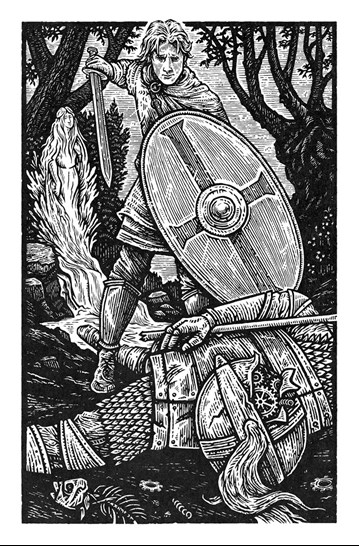 Illustration by Stephen Crotts from Galahad and the Grail
He says: “The Arthurian stories are not about the English, but are pre-English. Here are their languages before you get to English: Welsh, Breton, Anglo-Norman, French, Middle High German.” We both laugh when he adds, “In my version, Arthur can’t even stand to hear the English tongue, but I have Merlin telling Arthur that one day an English poet will celebrate his story, and his story will be for all the nation. To celebrate Arthur is to celebrate the multilingual nature of the nation.”
Guite’s second example is even more striking and timely. “When we get the story of the Grail — and I tell the backstory of it in this volume — it starts with a bunch of Middle Eastern refugees arriving in a small boat, Joseph of Arimathea and his people fleeing the sack of Jerusalem. They don’t speak the language, all they’ve got is the memory of their own tradition . . . and they have these sacred things [the Grail and the Spear of Longinus] which hold the memory.”
Guite also reminds me that, in Geoffrey of Monmouth’s version of the Grail, Britain is founded by Brutus and his band of refugees from Troy. For Dr Guite, Arthurian legend suggests that political and religious refugees “together . . . founded the Britain I love, the soil I delight in . . . the country I love is the country I love precisely because of all these layers and accretions.”
It is a wonderful note on which to end. Dr Guite’s claim that, if we live in a “disenchanted” world, poetry and story can revivify it, is heartening. At the end of Galahad, he calls the Grail quest “the quest of joy, the quest of tears”. He says, “I think any story we tell in this our exile has to have an element of elegy. One of the extraordinary things about the Arthurian story is how tragedy is woven through it, and hasn’t been ironed out.”
At times, Guite strikes me almost as a character out of the pages of fantasy — part wild-haired wizard, part pipe-smoking hobbit. With his smoky voice he could read a shopping list and I would be enchanted. As his writing reveals, however, the real site of enchantment is God. The God found in Guite’s Arthuriad brings forth extraordinary things from failure. Indeed, the occasion of wickedness can, just sometimes, be the occasion for a great redemption.
Galahad and the Grail: Merlin’s Isle Volume 1 by Malcolm Guite is published by Canterbury Press at £30 (Church Times Bookshop £24); 978-1-78622-712-6. It is reviewed here. Read Malcolm Guite’s latest Poet’s Corner here.