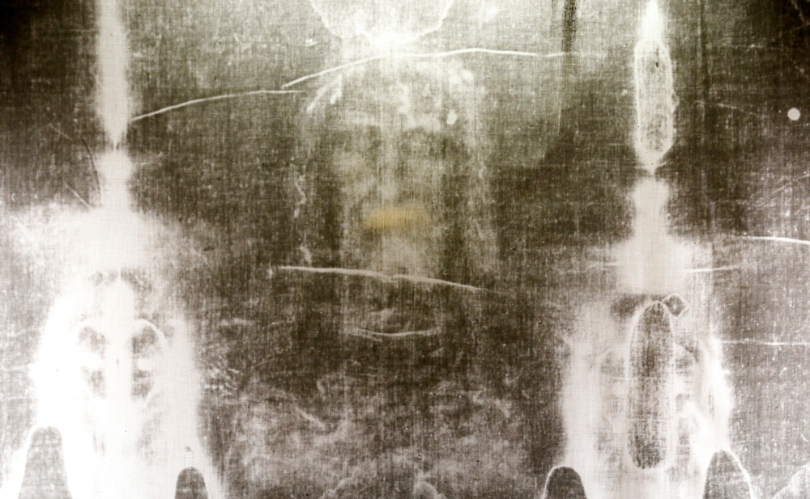
VATICAN CITY (LifeSiteNews) — Pope Leo XIV accessed for the first time “Avvolti,” a new digital project that allows the image of the Shroud of Turin to be deeply explored online.
On January 9, during an audience held in the Apostolic Palace in Vatican City, Cardinal Roberto Repole, Archbishop of Turin and Pontifical Custodian of the Shroud, presented Pope Leo XIV with “Avvolti,” a digital initiative created by the Archdiocese of Turin for the jubilee that enables users to view and explore the image of the Shroud of Turin from any electronic device.
“Too often, we mistake optimism for hope,” the cardinal remarked. “True hope emerges in the darkest moments, when all seems lost, yet faith endures. The Shroud, in this sense, is not merely an image of suffering but a trace of the Resurrection – a testament to the possibility of divine intervention,” said Repole during the project’s unveiling back in March 2025.
“Avvolti” is described by its promoters as an unprecedented digital experience. Through the website, users can access the project using smartphones, tablets, or computers from anywhere in the world. The platform allows viewers to move across the full image of the Shroud and to zoom in on specific details, such as the face analysis or the wounds from the flagellation, the crown of thorns, and the nails.
READ: USCCB president meets with Trump, Vance at White House
Each section is accompanied by explanatory texts and references to passages from the Gospels that describe the Passion of Jesus. The project has been designed, according to the Archdiocese of Turin, to combine scientific rigor in its images and texts with a format that is accessible to non-specialists, with the explicit aim of reaching a broad international public rather than a purely academic audience.
The presentation to Pope Leo XIV marked the Holy Father’s first official access to the online experience. The Vatican has not released additional statements beyond confirming the presentation and the Pope’s participation in the digital experience.
Repole has stated that the launch of this global digital experience is a central element of the program of initiatives connected to the Shroud for the past Jubilee Year 2025. He added that further projects are planned for the coming months as part of a longer path of preparation leading toward the Jubilee of 2033, which will mark 2,000 years since the events traditionally associated with the Passion of Christ.
In the spring of 2025, a dedicated “Avvolti” tent was installed in Piazza Castello in Turin, where visitors could experience a life-size, 1:1 digital reproduction of the Shroud displayed on a specially constructed table measuring five metres in length. The exhibition ran for eight days, from April 28 to May 5, and recorded more than 30,000 visitors from 79 different countries. The digital program, now available online, is an adapted version of the content originally presented on that table.
The launch of “Avvolti” takes place within a long-standing and complex debate over the origin and nature of the Shroud of Turin. Over the decades, numerous scientific, historical, and iconographic studies have been conducted, some of which have challenged skeptical theories that identify the Shroud as a medieval forgery.
READ: Tucker Carlson interviews Shroud of Turin expert, proving the resurrection of Jesus is real
Among the scholars who have most stridently defended the authenticity of the Shroud through academic and popular publications, there is the Italian chemist Emanuela Marinelli, author –among other works – of the compendium Light from the Sepulchre (2017).
Marinelli and other sindonologists have argued, in their published studies, that various elements of the Shroud are difficult to reconcile with the hypothesis of a medieval creation, including the anatomical precision of the image, its correspondence with details described in the canonical Gospels, and the process by which the image was formed, with inverted luminosity. These positions remain part of an ongoing academic discussion and are documented in peer-reviewed publications, conference proceedings, and several books dedicated to the Shroud.