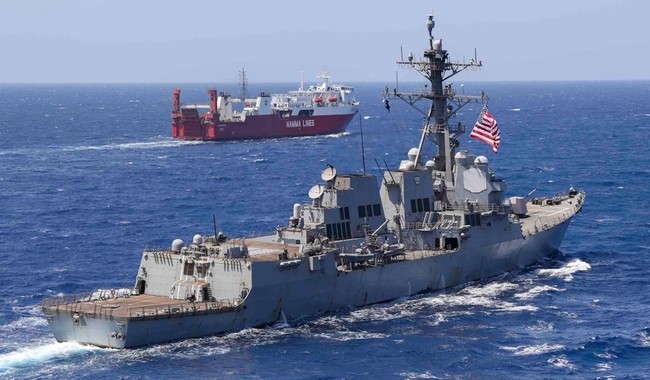
Our United States Navy’s ships are big, complex machines. As such, they take a lot of maintenance and repair to keep them in fighting trim, and in recent years, the backlog of those necessary tasks and repairs has increased. That’s a problem, wherein almost half of the fleet may be down for maintenance and repairs at any given time.
But we solve today’s problems with tomorrow’s technology, as I’m fond of pointing out, and now some of that new technology is here today. A company called Gecko Robotics has developed robot swarms controlled by artificial intelligence that may be able to handle some of these essential tasks quickly and efficiently, increasing the readiness of the fleet.
Swarms of wall-climbing robots will soon be crawling across U.S. Navy warships in a $71 million effort to slash repair delays and boost fleet readiness as China continues expanding its naval power.
Under the five-year contract, Gecko will begin work on 18 ships in the U.S. Pacific Fleet, with the initial award valued at up to $54 million. The contract vehicle is structured to allow other military services to access the technology as well.
The push comes at a critical moment. Only about 60% of U.S. Navy ships are operational at any given time as maintenance backlogs sideline a significant share of the fleet, according to industry estimates.
China, meanwhile, is ramping up its efforts to build a blue-water navy. At present, they have a lot of ships, over 300, but not a lot of reach; their at-sea replenishment capacity isn’t up to much, and they remain mostly a regional navy. But they are building more ships, and that means that keeping our own fleet dialed in is as important as it’s ever been.
These robots appear to be mostly useful for inspection and identification of possible problems with hulls, decks, and so forth.
The AI-powered machines, developed by Pittsburgh-based Gecko Robotics, scale hulls, flight decks and other hard-to-reach steel surfaces, scanning for corrosion, metal fatigue and weld defects.
Instead of relying on sailors or shipyard workers suspended on ropes or scaffolding to inspect ships point by point, the robots collect millions of data points and feed them into a digital platform designed to flag structural problems early.
“Where value hasn’t improved, that’s where opportunity lives. Cracking the cost equation is just as important as cracking the physics equation,” Justin Fanelli, chief technology officer for the Department of the Navy, said in a statement on the new deal. “We’re now seeing solutions that make innovation adoption easier and in doing so save time, money and risk.”
That’s interesting.
Read More: Highlights: President Trump Speaks to the Navy 250 Celebration
US Navy Using Questionable Stealth Warship to Test New, High-Tech Weapon System
The implications of this technology are significant. I’m not a robotics expert, but it seems like something that would be useful on a ship today may be useful for aircraft or armored vehicles tomorrow. And we note with some reassurance that the robots, at least for now, don’t appear to be carrying out any repairs themselves, just identifying possible problems for human workmen to deal with. Now, we can hope that these machines’ sensors and AI are properly calibrated, as missing a problem could prove disastrous, especially if a ship is standing into harm’s way.
But if it works, this could be a key to increasing readiness. A ship at sea, with a full load of fuel and weapons, is far more effective than a ship that’s in dry dock waiting for maintenance people to get to it.
Editor’s Note: Thanks to President Trump and Defense Secretary Pete Hegseth’s leadership, the warrior ethos is coming back to America’s military.
Help us report on Trump and Hegesth’s successes as they make our military great again. Join RedState VIP and use promo code FIGHT to get 60% off your membership.