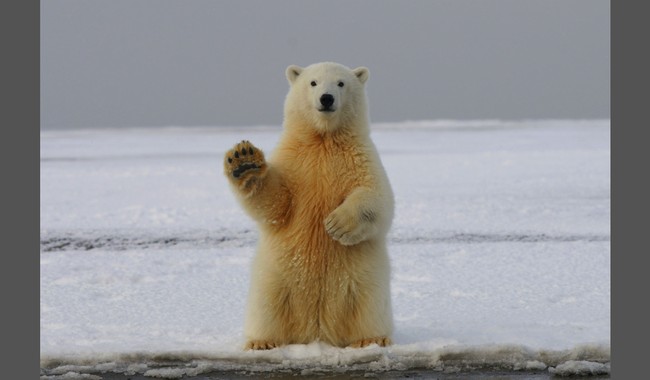
Polar bears are remarkable critters. They are a circumpolar species, found all over the Arctic, from Scandinavia to Russia to Alaska to Canada and thence to Greenland. They are the largest bear extant, and the only bear that feeds exclusively on meat.
Some biologists have been worried about how polar bears will fare in our time of receding sea ice in some parts of the Arctic, but one new study indicates that the great white bears are more adaptable than some thought.
Some polar bears, it seems, are doing well out climate change and reduced ice levels in the Arctic, so a study in Nature Scientific Reports says. Although ‘body condition index’ (BCI) was observed declining for the first five years of the 1995-2019 study, it didn’t stay that way:
We assessed how intrinsic (female reproductive state, age) and both males and females, BCI declined until 2000, but increased afterwards, during a period with rapid loss of sea ice. In models including sea ice metrics and climate (Arctic Oscillation), there was no support for the predicted negative effect of warmer weather and habitat loss. This indicates a complex relationship between habitat, ecosystem structure, energy intake, and energy expenditure. Increases in some prey species, including harbour seals, reindeer, and walrus, may partly offset reduced access to seals. Our findings underline the importance not to extrapolate findings across populations.
The key line there is “there was no support for the predicted negative effect of warmer weather and habitat loss”.
The other key line is “increases in some prey species, including harbour seals, reindeer, and walrus.” In other words, if one favored prey declines, big apex predators can find alternatives.
Bears, in general, are pretty sharp critters and very adaptable. Polar bears (Ursus maritimus) and their close relatives, the brown/grizzly bears (Ursus arctos), are smart and adaptable. Brown/griz and their North American cousins, the black bear (Ursus americanus), have been pretty successful because they can eat just about anything, and they will. Polar bears are capable of exploiting new prey species, and a mildly warming Arctic may well present just that.
Read More: Springtime in Alaska: Take Care and Beware of the Bears Up There
Drill, Baby, Drill: Arctic National Wildlife Refuge Now Open to Drilling
And if they don’t?
Well, that would be sad. But we might also note that over 99 percent of all the species that ever lived on this planet are extinct now. In some cases, that’s not a bad thing, as there are no huge predatory gorgonopsids or building-sized sauropods wandering around. But nature is harsh on that; the only constant in the environment is that the environment changes. The climate changes, new food sources appear, old ones disappear, and the animals that live in that environment adapt or perish. A lot of species faded away at the end of the last major glaciation, including mammoths and mastodons, the primeval great bison. Other critters adapted: Brown bears, black bears, moose, and plenty of other species, from insects to vast caribou herds. Some remained in the Arctic, closer to those lost Ice Age environments, like muskoxen and, yes, polar bears. They adapted. And right now, it seems like polar bears are adapting, as well. Good.
You can view the Nature report here.
Editor’s Note: Do you enjoy RedState’s conservative reporting that takes on the radical left and woke media? Support our work so that we can continue to bring you the truth.
Join RedState VIP and use the promo code FIGHT to get 60% off your VIP membership!