(LifeSiteNews) — New York’s new Democratic socialist mayor never misses a chance to preach “inclusiveness.” Well, here’s his moment. If Zohran Mamdani truly wants to lead with substance instead of slogans, he could finally confront a question City Hall just might tiptoe around: Why are pro‑lifers still denied their own banner in the New York City St. Patrick’s Day parade when LGBT groups have marched freely for more than 10 years?
It would be a gutsy move — and he wouldn’t be standing alone.
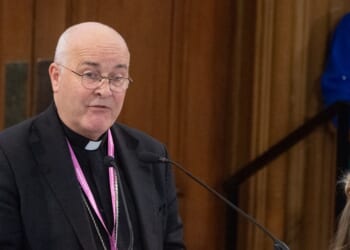
The city’s new Catholic leader, Archbishop Ronald Hicks, a man of integrity much like his predecessor, Cardinal Timothy Dolan, will review the parade this year on March 17 from the steps of St. Patrick’s Cathedral, a parade that still refuses to allow a pro‑life unit. The contradiction is impossible to ignore. Bishop Hicks would surely add his voice to the call for consistency.
If the mayor and Bishop Hicks — two of the most influential figures in the Big Apple — demanded genuine inclusiveness, they’d have a powerful coalition behind them. Thousands of pro‑life advocates and faithful Catholics would rally in support. Such a stand would restore coherence and moral clarity to an event that claims to celebrate Irish heritage and Catholic identity.
But in progressive New York, led by a mayor who has already infuriated Catholics — a city that many brand the abortion capital of the world — this won’t be an easy sell.
Muslim Mayor Mamdani’s no‑show at Archbishop Hicks’ recent installation angered the city’s 2.5 million Catholics. Already dogged by longstanding antisemitism accusations, he further inflamed tensions by placing trans activist, Ceyenne Doroshow, on his inaugural committee. St. Patrick’s Cathedral says Doroshow misled them into hosting a “sacrilegious” funeral for transgender activist Cecilia Gentili in 2024 as Lent began.
We don’t object to New York electing the city’s first Muslim mayor. It’s Mamdani’s growing pattern of anti‑Catholic posturing. That’s why we doubt he’ll push for pro‑life inclusion in the St. Patrick’s Day Parade.
Still, other civic leaders in New York, and even officials in Ireland whose government has long taken an interest in the parade, could join the push. And that would be remarkable, given the very tradition of Ireland’s commitment to inclusiveness.
Some leaders need to step up — even if the pro‑choice mayor won’t, and Bishop Hicks is trapped behind secretive parade protocols that have tied the archdiocese’s hands for a decade on the exclusion of pro‑life groups. One can hardly imagine the late Cardinal John O’Connor— who made the pro‑life cause central to his ministry in New York and endured fierce criticism from gay‑rights activists— staying silent in a moment like this. (True to his beliefs, he’d almost certainly argue for excluding gay‑rights groups from marching under their own banner, saying their presence is incompatible with the Catholic character of New York City’s St. Patrick’s Day parade.)
The sidelined pro‑lifers and Catholic faithful want a parade reflecting the full breadth of Irish Catholic identity, not one edited to please corporate sponsors and cultural gatekeepers.
And that’s where the story really begins.
The parade didn’t simply “evolve.” The shift was engineered — and the fingerprints remain. For centuries, the rule was simple: no political banners. Gay groups weren’t banned from marching; they were barred from marching as political units. The same applied to pro‑life groups. The day honors St. Patrick, not causes. The only longstanding exception was a banner reading: England Get Out of Ireland.
Then came the pressure campaign — in New York and Ireland.
Shockingly, the Irish government — represented each year by a cabinet‑level minister in the parade’s line of march— took a side. On the parade’s 250th anniversary in 2011, Irish Foreign Affairs Minister Eamon Gilmore publicly criticized organizers for refusing to let gay groups march under their banner. “Exclusion is not an Irish thing,” he declared.
Apparently, it is — at least if you’re pro‑life.
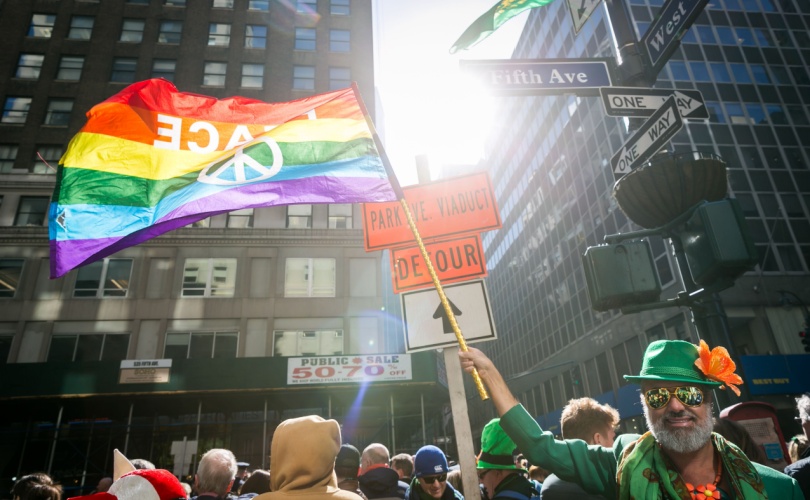
A chorus of senior Irish officials joined in. President Mary McAleese declined an invitation to serve as Grand Marshal in 2011, later calling the exclusion of LGBTQ groups “undemocratic.” In New York, local political leaders — from former Mayor Bill de Blasio to Council Speaker Melissa Mark‑Viverito — boycotted the parade outright over its ban on gay‑rights groups.
But pro‑life groups? Still ignored.
On April 1, 2014, a parade official warned that Heineken, Guinness, Manhattan College, Fairfield University, the Irish government, and even Ford were threatening to pull support unless gay rights groups were allowed to march with banners. This was no gentle persuasion. It was a coordinated squeeze by corporate sponsors, elite institutions, and a foreign government: change your rules or lose the money.
The organizers folded. By 2015, gay groups marched under their own banners.
What didn’t change? The shameful treatment of pro‑lifers. Despite promises that rule changes would open the St. Patrick’s Day Parade to both gay and pro‑life groups, pro‑life marchers were never actually welcome. One parade official even admitted it outright: Asked if a pro‑life group could ever march under its own banner, he replied, “That won’t happen.”
More than a decade later, pro‑life groups still remain on the sidewalks. Organizations like Irish Pro Life USA have petitioned and applied, year after year, only to be ignored or slow‑walked. Parade officials who eagerly negotiate with corporate sponsors go silent when the request comes from pro‑life Catholics.
The old “no political banners” rule — tossed aside when inconvenient — is magically resurrected when the cause is one New York’s cultural elites dislike.
And that’s why the new mayor and the new bishop matter. If the parade can accommodate corporate‑approved LGBTQ groups, it can make room for Irish Americans and all who believe in protecting unborn life.
Whether that happens will tell New Yorkers who truly believes in inclusion — and who only believes in it when it’s easy.
John Aidan Byrne, a U.S. citizen born and raised in Ireland, is a journalist and media entrepreneur based in New Jersey. He is the founder and leader of Irish Pro‑Life USA. Irish Pro-Life USA is a grassroots U.S.-based pro-life organization for the Irish diaspora and Friends of Ireland in America, dedicated to full civil rights for babies in the womb and pro-family, anti-abortion policies in Ireland, America and worldwide.