AT THE BAFTAs the other night, as the Prince and Princess of Wales arrived, a voice rang out from the press pack: “Your Royal Highnesses, is the monarchy in peril?”
It was shouted, not asked. The oafish tone was not accidental. The modern ritual of reporters’ shouting questions at public figures who are walking past — knowing perfectly well that they will not answer — has a different function. It is performative. The act of asking becomes the story. The purpose is simple: to create a television clip. Silence, a stiff smile, or an averted gaze becomes an invitation to inference. It is not just scrutiny masquerading as spectacle, but, rather, an attempt to stoke a media feeding frenzy.
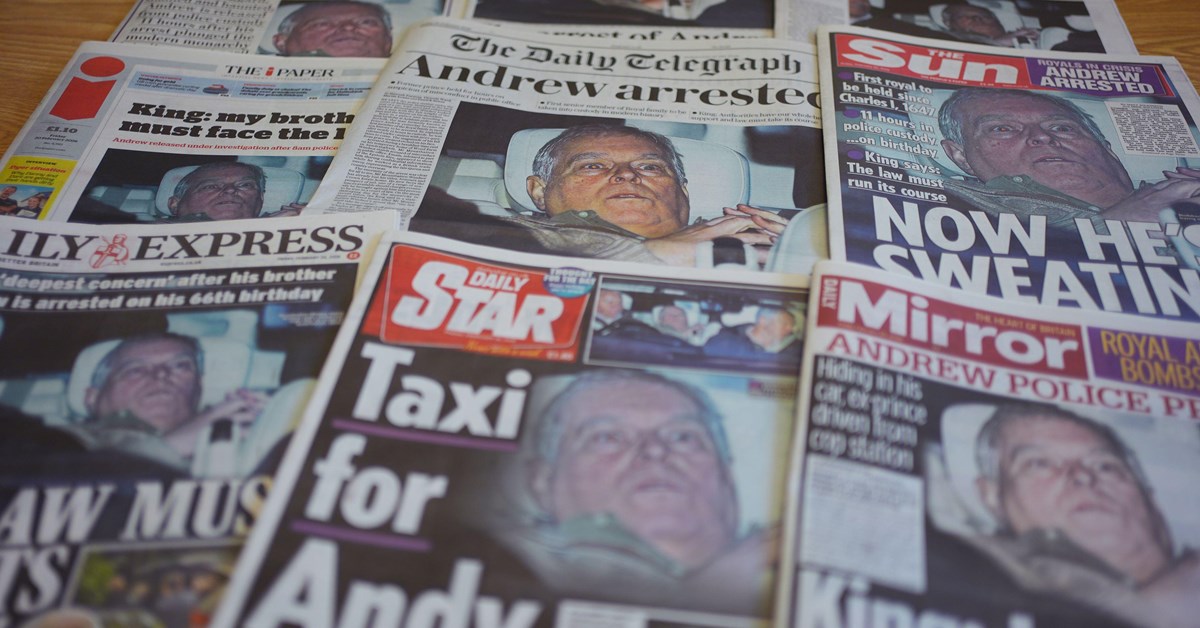
Within hours of the arrest of Andrew Mountbatten-Windsor, BBC royal correspondents were again prophesying doom in the form of questions. Is this the beginning of the end? Is the monarchy facing its gravest crisis in decades? Such was the unevidenced speculation among the metropolitan elite. The chattering classes must have something to chatter about.
The language of “existential threat” has long been deployed to suggest that history is pivoting. It happened in 1997 after the late Queen’s tardy response to the death of Diana, Princess of Wales. It happened in 1992, the “annus horribilis” of the marital breakdowns of three of the monarch’s children and the great fire at Windsor Castle. It even happened in 1987 — we are reminded in Entitled, Andrew Lownie’s exposé of the extravagances of the now deposed Duke and Duchess of York — because of the preposterous It’s a Royal Knockout television show.
None of these was existential; nor, even, was the decision of Edward VIII to walk away from the throne. Through the process of abdication, succession, and his later ostracism, the institution ensured that the rupture did not prove fatal.
Today’s comparisons often verge on the absurd. To suggest that the scandalous conduct of the former Duke of York has triggered a “constitutional crisis” is like arguing that the treacherous behaviour of the disgraced Cabinet minister Lord Mandelson puts democracy itself in jeopardy.
The individual may fall; the system absorbs the shock, as history repeatedly shows. The monarchy survived “bad” kings such as John, Edward II, and Richard II, and “mad” monarchs such as Henry VI and George III. Even when Oliver Cromwell cut off the head of Charles I, and installed a republic, the Crown was back within a generation. Incompetence, tyranny, civil war, and regicide — none of it has proved fatal to the monarchy.
Polling suggests that support for the monarchy, though lower than in the mid-20th century, remains at 64 per cent, comfortably ahead of support for its abolition. The institution is less emotionally sacrosanct than it once was, perhaps. That does not mean that it is on the brink.
This is not to deny that there are serious issues. Public scrutiny of taxpayer-subsidised royal finances is both legitimate and necessary. The convention that Parliament tread lightly when questioning royal matters is outdated and needs revision. MPs must investigate the functioning of Britain’s trade envoys. And we need a public inquiry into how the British political, royal, and financial Establishment was so easily entrapped in the Epstein web. But this moral panic over the future of the monarchy is misplaced.