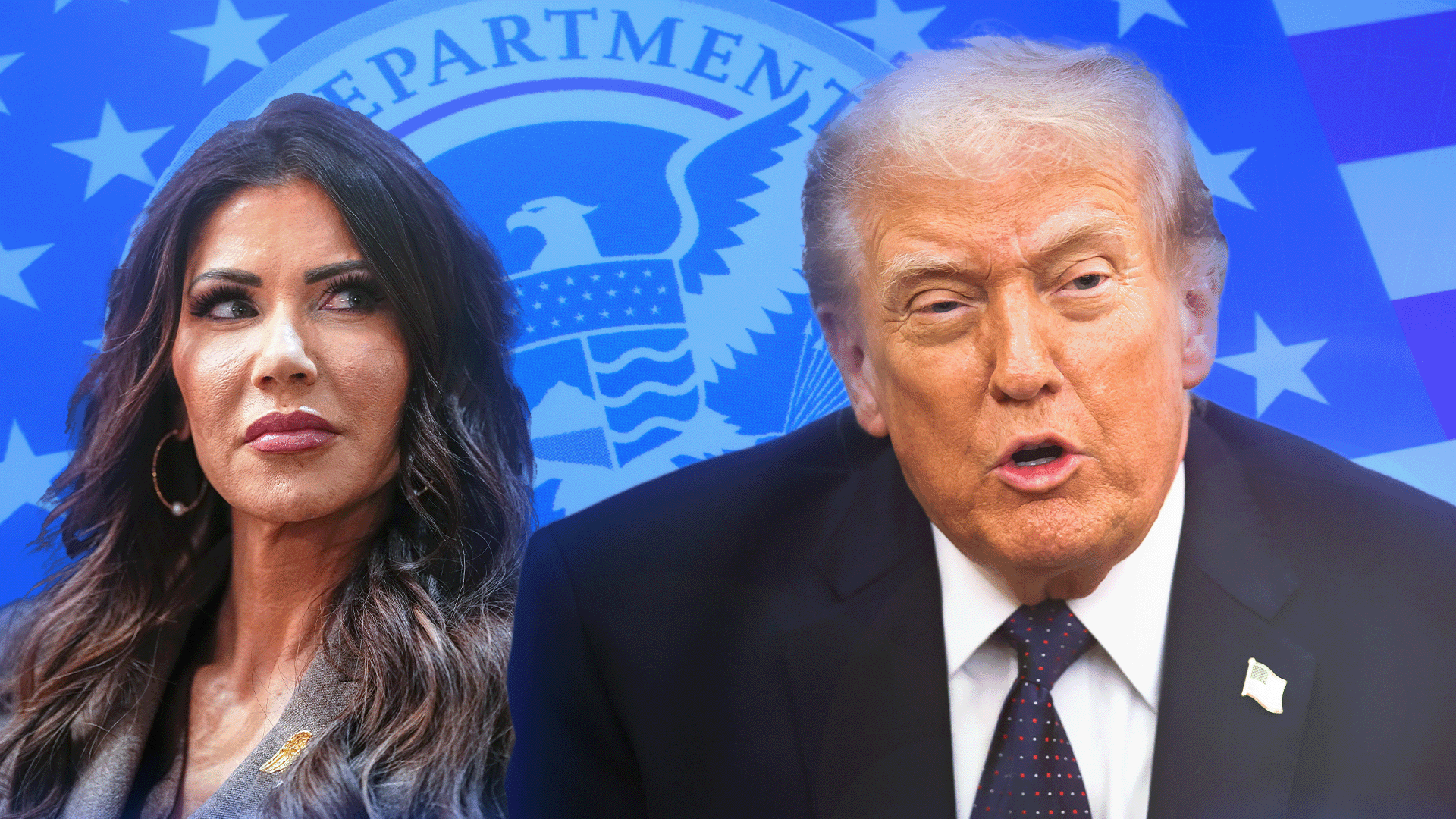
“A president who valued honesty, transparency, and accountability would already have canned” Department of Homeland Security (DHS) Secretary Kristi Noem, I wrote on Wednesday. President Donald Trump did just that the next day. Like me, Trump reportedly was troubled by Noem’s testimony before the Senate Judiciary Committee on Tuesday, but for different reasons. Since his decision apparently had little or nothing to do with Noem’s lies about the use of deadly force by her underlings, it should not be read as a sign that the president is concerned about such things.
“The final straw for Trump was Noem’s combative hearing Tuesday before the Senate Judiciary Committee,” The Wall Street Journal reported. “The president watched the testimony and was apoplectic about her performance, telling advisers that evening he would remove her from the job, according to people familiar with the matter.”
What, specifically, angered Trump? Was it Noem’s refusal to admit that she had recklessly tarred Minneapolis protesters Renée Good and Alex Pretti as domestic terrorists after DHS employees fatally shot them? Nope.
“Noem’s decision to allot more than $200 million for an ad campaign, featuring herself urging those living illegally in the U.S. to self-deport, had already rankled the president for months for its self-promotional style,” the Journal noted. “At the hearing, Noem told senators that the president had signed off on the ad campaign—an assertion that upset Trump, who told senators and advisers he hadn’t signed off on such a campaign.”
The New York Times has a similar take: “The immediate catalyst for Ms. Noem’s firing appeared to be her answers during two congressional hearings this week, particularly her under-threat-of-perjury statements that Mr. Trump had approved of tens of millions of dollars of government ads in which she was prominently featured. Mr. Trump denied that to Reuters on Thursday, saying, ‘I never knew anything about it.'”
As Reason‘s Autumn Billings noted on Wednesday, that ad campaign raised serious concerns about the use of taxpayer money, including the dubious justification for the expenditure, the way in which it was approved, the noncompetitive contract award, and the fact that a subcontractor’s CEO happened to be the husband of Tricia McLaughlin, who served as the assistant DHS secretary for public affairs until last week. But for Trump, the crucial points probably were that the ads promoted Noem rather than him and that she falsely claimed they had his approval.
Since Trump does not like it when his appointees embarrass him, you might surmise that part of his motivation in sacking Noem was the bad publicity generated by the stories she initially told about Good and Pretti, which were immediately refuted by video of the encounters. But there is not much evidence to support that theory.
After Immigration and Customs Enforcement (ICE) agent Jonathan Ross killed Good on January 7, Noem said Good had “weaponize[d] her vehicle” by “attempt[ing] to run a law enforcement officer over.” As she told it, “this appears as an attempt to kill or to cause bodily harm to agents, an act of domestic terrorism.”
Trump went even further, which suggests he was not much concerned about getting the facts right. Good “violently, willfully, and viciously ran over the ICE Officer,” he averred, and “it is hard to believe he is alive.”
Contrary to those accounts, footage of the incident showed that Good did not actually run Ross down and suggested she did not deliberately try to do so, since she was steering away from him and the other ICE agents at the scene when she was killed. It was not clear whether Ross was still in the car’s path when he fired the first round, which entered the car through the lower left corner of the windshield. But he was clearly out of the way when fired the second and third rounds, which entered the car through the driver’s side window next to Good.
A week later, Trump walked back his initial portrayal of Good. Although “her actions were pretty tough,” he told CBS News, “I would bet you that she, under normal circumstances, was a very solid, wonderful person.”
After DHS employees killed Pretti on January 24, Noem claimed he was “brandishing” a gun and “attacked those officers.” She also said Pretti “committed an act of domestic terrorism.” According to a DHS statement posted a couple of hours after the shooting, it “look[ed] like a situation where an individual wanted to do maximum damage and massacre law enforcement.”
Trump echoed that assessment. The day of the shooting, he described Pretti as a “gunman,” saying his pistol was “loaded” and “ready to go.” But the next day, he described the shooting as “tragic,” a characterization that was inconsistent with the claim that the Customs and Border Protection (CBP) officers who killed Pretti had interrupted an attempted mass murder.
By that point, it was clear that the DHS account of the shooting was blatantly inaccurate. Videos showed that Pretti never “attacked those officers” and never drew his holstered pistol, which he was licensed to carry. The officers did not even notice the gun until after they tackled him, and he had been disarmed by the time the shooting started.
Despite that evidence, Trump called Pretti an “agitator and, perhaps, insurrectionist” later that week. He also suggested that Pretti was asking for trouble by exercising the constitutional right to bear arms.
“I don’t like it when somebody goes into a protest and he’s got a very powerful, fully loaded gun with two magazines,” Trump told The Wall Street Journal the day after the shooting. “You can’t have guns,” he told reporters a couple of days later. “You can’t walk in with guns. You just can’t.” Trump reiterated that sentiment during a visit to Iowa the same day. “Certainly he shouldn’t have been carrying a gun,” the president said. “I don’t like that he had a gun. I don’t like that he had two fully loaded magazines. That’s a lot of bad stuff.”
It would clearly be hypocritical for Trump to fault Noem for rushing to condemn Good and Pretti when he did the same thing. Although Trump is not exactly a model of moral consistency, it is hard to believe that Noem’s lies about Good and Pretti (or her lies about those lies) offended him. Even after he retreated from portraying Good and Pretti as would-be murderers, he continued to imply that they were responsible for their own deaths.
As the evidence that Noem refused to wait for comes to light, Sen. Thom Tillis (R–N.C.) predicted during Tuesday’s hearing, “it’s going to prove that Ms. Good and Mr. Pretti probably should not have been shot in the face and in the back.” He expressed exasperation at “the fact that you can’t admit to a mistake.” But the truth is that no one wants to admit these mistakes.
Deputy White House Chief of Staff Stephen Miller, the leading proponent of Trump’s aggressive deportation campaign, described Pretti as a “would-be assassin” and “a domestic terrorist” who “tried to assassinate federal law enforcement.” He later said he had been relying on “reports from CBP on the ground”—the same excuse that Noem repeatedly offered on Tuesday.
Privately, Noem also reportedly blamed Miller. “A source briefed on the process of assembling the [DHS] press statement” about Pretti, Axios reported three days after his death, said Miller “heard ‘gun’ and knew what the narrative would be: Pretti came to ‘massacre’ cops.” Axios said Noem likewise attributed that “narrative” to Miller: “Noem has complained to others that she feels she’s being hung out to dry over the episode and has made sure to emphasize she took direction from Miller and the president.” According to “a person who relayed her remarks,” Noem said, “Everything I’ve done, I’ve done at the direction of the president and Stephen.”
Sen. John Kennedy (R–La.) noted that report during Tuesday’s hearing. “You blamed those statements on Mr. Stephen Miller at the White House,” Kennedy said while questioning Noem. “Did you not?”
Noem insisted that was not true. “No, sir, I did not,” she said. “Where you’re seeing that is in a news article of anonymous sources, and anonymous sources say a lot of things, but…I have never said that at all.”
When Kennedy pressed Noem, asking her whether she had uttered the words that Axios attributed to her, she dodged the question. “I enjoy working with the president and with Stephen Miller,” she replied. “And that day we were working to get as much information to the American people as possible. That is what we’ll continue to do.”
Kennedy tried again. “Are you denying that you said that?” he asked. Noem gave another dodgy answer. “I’m not going to speak to that situation that is relayed [based] on anonymous sources,” she said, adding that “no one has heard me say that.”
Except to the extent that Noem privately sought to blame Trump himself, it seems doubtful that any of this bothered him, let alone to the point that it figured in his decision to fire her. Even after the controversies over Noem’s statements about Good and Pretti, Axios reported in the same article that Kennedy cited, Trump was not contemplating a change in personnel. “Despite rumors to the contrary, Noem’s job is safe,” Axios said, citing unnamed White House officials. “She’s doing the job the president wants her to do,” one of those officials said. “There’s no daylight here.”