Side walk
A BRITISH-Iranian Christian sends me a video from her friends in Tehran, to try to help me to understand the scale and meaning of what is happening. I open it with trepidation, wondering whether I am going to see phone footage of bombs, or distressed crowds. Instead, it is a 45-second film of a busy market, not long ago. Outside one of the brightly lit shops is a beautiful red carpet, spread out on the pavement, apparently in everyone’s way as the crowds bustle past on foot, on mopeds, shopping for clothes and food.
After watching for a while, I get it. Everyone, without exception, stops at the edge of the carpet and walks around it, refuses to tread on it, helps family members to notice it and walk around. The instinct that it reveals among the Iranian crowd is to respect, to go out of their way to preserve, to see the unexpected beauty on the pavement, and to inconvenience themselves in order to honour it.
My correspondent explains that the Persian carpet symbolises a garden (indeed, the root of the word paradise is the Persian word pardis, a walled garden). In stepping around the strikingly beautiful red carpet, the crowd is honouring the creativity and beauty of the divine.
Whatever the consequences of “pre-emptive” military strikes, this ordinary scene of gentle respect in the middle of a busy Iranian market communicated to me a deep ache for all that has already been lost, and a lament for all the losses yet to come.
Earth bound
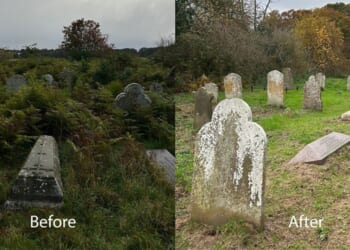
HARD hat on, I visit the site of the long-running excavation for the HS2 rail project at Euston Station to say a prayer with the team who continue to excavate the burial ground around St James’s Gardens. The project manager explains the process, and I am struck by the meticulous way in which the work is done. The driver of the excavator-digger gently scrapes away a layer of earth, while two further team members watch in case they spot anything. As soon as they do, a hand signal stops the driver, everyone downs tools, and hand-brushing begins.
That this excavation and reburial of remains elsewhere is happening at all is, of course, controversial, but — given that it is — I am glad to be standing there in hi-vis as the words “dust to dust” take on new meaning.
Pillars of support
EMERGING from the security gates on the HS2 site, I am awed again by the huge building that is St Pancras Church. It is easy, living in a big city, to stop looking up, and to take for granted the bewildering variety embedded in the built environment.
When the architectural competition for the building of a new church dedicated in honour of St Pancras was held, in 1816, it was won by a local father-and-son firm, who decided to model their building on the Erechtheion, in Athens. I climbed the Acropolis on a trip to Greece last year, and, with my back to the Parthenon, could have been on the Euston Road, so complete was the replication of the temple.
It dates from four centuries before Christ, when Greece had defeated Persia in war and so was free to build its temples in peace. The eight caryatids — sculptures that form the pillars of the temple in Greece, and similarly in London — are a striking presence both there and here. I can’t say that, as idealised Athenian maidens, they speak loudly to me as inspirations; but, in the week of International Women’s Day, in so far as these women are holding up the Church in the UK, I couldn’t possibly comment.
The long view
WHEN St Pancras was dedicated in 1822, Iran (then Persia) was at war with Turkey; British forces were intensifying their military presence in Burma; both Spain and Greece were in conflagrations of civil war; and violent colonial expansion of the United States and the UK continued in the Americas. In that same year, the British Foreign Secretary took his own life, and the new Home Secretary, Robert Peel, began to form a national police force that is still in operation today.
Thinking about all that those caryatids have witnessed, both in Athens and in London, I am struck again by the importance of scale and perspective. The US President may say that he wants to avoid “forever wars”, but, surely, part of the contribution of the Church to our uncertain and volatile world is to keep open and accessible these ancient and historic houses of worship — not least as physical reminders that all of us are part of a much longer story, and “forever prayers” are said now, just as much as then.
Challenging the Zeitgeist
IF THERE are about 30 million people in the UK who identify as Christian, and 4.4 million Muslims, since Lent and Ramadan coincide this year, just under half of the population are currently observing some sort of fasting season. As arguments continue to rage about how secular British society really is, a significant proportion of people are, to varying degrees, removing distraction, abstaining from harmful habits, or reminding themselves, by their change in practice, of their obligations to others, not just themselves.
Alongside this, a striking and unexpected Lenten intervention this year has been the launch of a new EP, Days of Ash, by the Irish rock band U2, deliberately released on Ash Wednesday (Arts, 6 March). The music will mean different things to different listeners: it won’t be to everyone’s taste. But, in releasing these songs lamenting and highlighting contemporary stories of injustice on Ash Wednesday, U2 are deliberately doing political theology in the public square, and will reach millions of people — of all faiths and none — who download their music a staggering 260 million times each year.
This sort of public theology matters, not because numbers are everything, but they’re not nothing in a liberal democracy whose population says that, on the whole, it doesn’t believe in God.
Hold fast
RELENTLESSLY grim news domestically and internationally, putting our leaders under pressure in an uncertain geo-political environment, gives the ashes and dust of Lent particular resonance this year.
But my conviction, in this moment, is that the Church’s vocation is sharpened and clarified. It is to be in all our localities communities of hope, radical welcome, and compassion: communities indelibly marked with the ministry of Jesus, as relentless in love as the injustices are in cruelty. And all the while we can borrow wisdom from our Persian Sufi brothers and sisters, who, a thousand years ago, wrote that “This, too, shall pass.”
The Revd Lucy Winkett is Rector of St James’s, Piccadilly, and Priest-in-Charge of St Pancras Church, Euston Road, in the diocese of London.