Tongues of fire
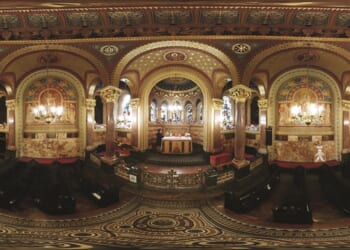
THE thatched roof of the picturesque Dutch Reformed church in Franschhoek, South Africa, where we have been staying, was sprinkle-hosed the other Sunday. Wildfires have snaked across the mountains, and falling ash could spark. Inside the church, on pews of English oak, the white congregation listened in Afrikaans to Lutheran texts from a young male preacher. There was no altar, but a central pulpit, and the Afrikaans words to hymns were up on giant screens. We recognised some of the tunes, but not the words.
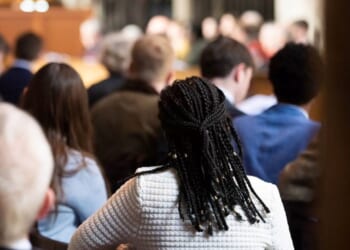
We went on to the Congregational church, to a service also in Afrikaans, in which the black congregation used hymn books with translations in English. A woman in a half-empty middle pew turned round to smile at us for the last hymn, which was sung in English, without organ or piano, but with verve: “Onward, Christian soldiers”.
I was struck by the voluntary racial separation of these two services, having spent the previous day at the King’s Plate horse race in Cape Town, a merry diversity of identity, including a high-camp fashion contingent. At least those choosing different Christian forms of worship can rally behind hymns.
At the Congregational church, we used a hymn book, Sing Hosanna, published in 1975 as an ecumenical bilingual book. A first edition was thought to discourage Anglicans because of the few recognisable hymns. Recommendations from a special committee to enlarge it were accepted in South Africa by the United Congregational Church, the Church of the Province of Southern Africa, the Presbyterian Church, and, finally, the Christian United Church of Southern Africa.
This kind of accommodation has its roots in the Afrikaans language, which came from the Dutch, but was enriched and spoken by the existing and other populations. Language and religious diversity evolve into a common culture.
One of the brighter legacies of the fleeing Huguenots’ arrival in South Africa in the 17th century — apart from viniculture — was religious freedom. In this predominantly Christian country, different denominations rub along. The prosperous, manicured vineyards of Franschhoek may be threatened by untamed nature in the hills above, but at least Christians can worship as they please.
Tipping point
THIS is in contrast to the tragic discord in Nigeria. If the fifty-fifty balance of Muslims and Christians in Nigeria descends into religious conflict, how — as part of a pan-African response — should South Africa intervene, as Nigeria once held South Africa to account over apartheid? One informed Christian I spoke to said that President Trump’s air strikes on the northern Sokoto region had been a wake-up call for pan Africa, as well as for the Nigerian President.
Mainstream religious leaders must now urgently convene to prevent talk of Crusades. The American senator Ted Cruz demands action to stop the persecution of Christians, and the American private military contractor Blackwater signals readiness, but, meanwhile, figures such as the philanthropist Sir Mo Ibrahim and the Islamic scholar Abdallah bin Bayyah are being called on to find ways of peaceful negotiation. Nigerian politicians such as the Roman Catholic and African National Congress member Peter Obi are also highly regarded.
Meanwhile, the UK Government is running a programme for leaders, “Strengthening Peace and Resilience in Nigeria”, which tackles tensions between groups with different ethnic and religious identities in north-central and north-west Nigeria. And the British Council remains actively present across Nigeria, strengthening bonds of arts and culture.
But is it true, I ask. Are Christians being persecuted? Nigerian experts tell me, yes, they are, but not simply because they are Christians. Muslim Fulani herdsmen from the north may clash with Christian farmers, but it is as much to do with land and water as faith. The desertification of the north, around the Chad Delta, creates conflict and migration. The porous border in the north-east allows fighters in from across the Sahel region. The place is awash with guns. Religious zealotry is the powder.
The violent Salafism which is the ideology of Boko Haram is a legacy of the 1979 Iranian revolution. Its hatred of Western education naturally pitches it against the Christian missionary tradition of schools in the south. Yet, this is not the natural state of things. Without the poison of 1979, there is a tradition of Yoruba Christians’ and Muslims’ inter-marrying. The former President Olusegun Obasanjo is a Yoruba born-again Baptist, with a Muslim sister, and he keeps both the Lenten and Ramadan fasts. The Yorubas, like the Anglicans, embrace religious compromise.
Up the candle
NOT everyone agrees with me on the virtue of compromise. I have just read Converts, by Melanie McDonagh, a hugely entertaining account of high-profile British people who became Roman Catholics in the 20th century (Books, 16 January). She has some cracking quotes: for instance, from R. H. Benson, the son of an Archbishop of Canterbury, who wrote of the tolerance of the Anglican Church: “There is a liberty which is more intolerable slavery than the heaviest of chains.”
I take a particular interest in the book because of the untimely death last year of the Observer journalist Rachel Cooke, a former colleague of mine at the Telegraph, who was quick, mischievous, and sceptical. Rachel’s husband wrote movingly of her surprising conversion to Catholicism on her deathbed, and I found a responding quote in McDonagh’s chapter on Oscar Wilde: Catholicism was “the only religion to die in”.
McDonagh makes a good argument for the logical conclusion of Roman Catholicism, and her subjects, such as Muriel Spark, were convinced by the beautiful and poetic progression of John Henry Newman to Rome.
I have crept upwards from my origins as the granddaughter of a Methodist west-country chaplain, towards the Oxford Movement, largely because of my brother, who was a cathedral chorister and so partial to ceremony and liturgy. But I believe, along with the near-miss-RC John Betjeman that we owe it to the Church of England to stay where we are.
Mulish behaviour
EACH night, we watch the chains of fire across the tinder-dry mountains and hear the sound of helicopters in the Western Cape. Luckily, no casualties are reported, but damage is done to land and to livestock. Horses are being hastily transported.
I tried a hack, but the smoke was too thick and the horses were unnerved. My guide explained that animals reacted differently. Poor old sheep, with their inflammable cladding, run in panic. Goats withdraw with more planning and intelligence.
The most ineffective are donkeys, which refuse to acknowledge the superior strength of the fires or to concede territory; so they stand where they are, kicking at the encroaching flames. I wonder what the human equivalents are.
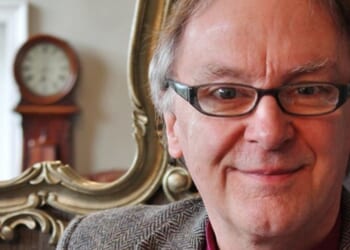
Sarah Sands is a journalist and author.