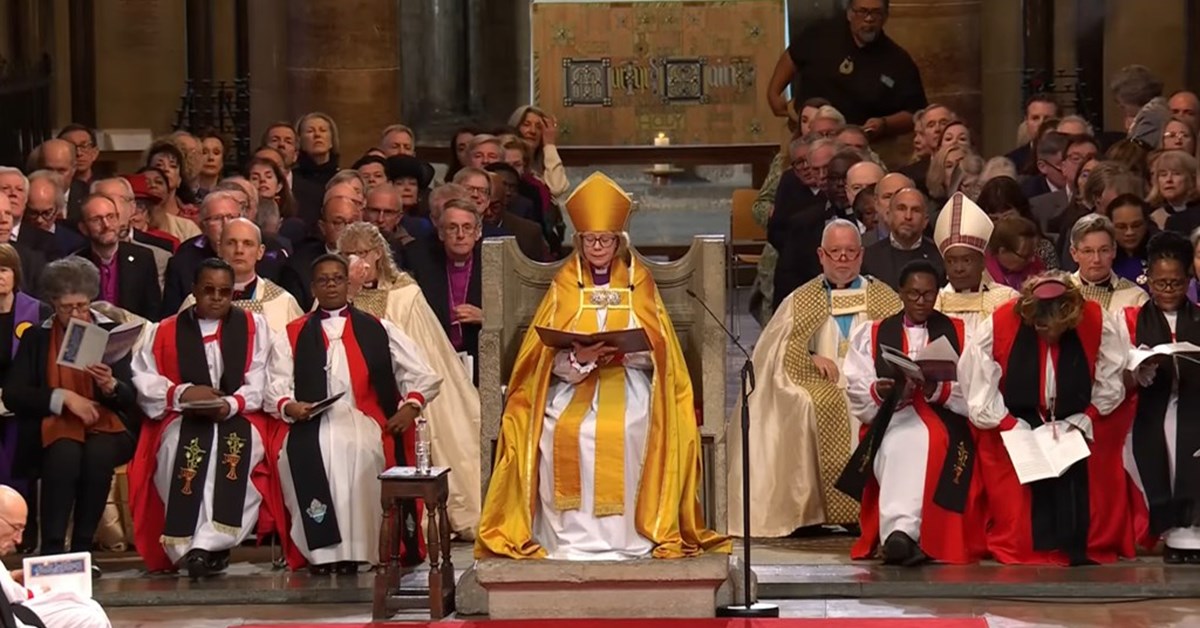
THE Church and its people must strive, like the Blessed Virgin Mary, to have the “audacity” to believe and trust in the promises of God, the Most Revd Sarah Mullally said in her first sermon in her cathedral after being installed as the 106th — and first female — Archbishop of Canterbury.
Addressing, from the chair of St Augustine in which she had just been installed, the 2000-strong congregation on Wednesday afternoon, she began by quoting Luke 1.37: “For nothing will be impossible with God.”
Trusting in this was the central theme of her sermon, which drew on the example of Mary — both in her acceptance of the incarnation and her grief at the foot of the cross, which turned to joy after the resurrection.
“For Mary . . . following God’s invitation to trust in his promises meant trusting in a future she couldn’t yet see — a future she could never have imagined,” Archbishop Mullally said.
“This resonates with me, as I look back over my life — at the teenage Sarah, who put her faith in God and made a commitment to follow Jesus. I could never have imagined the future that lay ahead, and certainly not the ministry to which I am now called.”
She continued: “Mary put her hope in God’s future. She trusted that he was with her, and, through Mary, God did a new thing.”
This was not an easy road, Archbishop Mullally said, and she drew attention to the plight of Anglicans in parts of the world experiencing conflict, including church leaders in the Middle East and the Gulf who could, therefore, not attend her installation, as others from the Anglican Communion were doing.
She prayed for peace in Ukraine, Sudan, and Myanmar, besides acknowledging “the hurt that exists much closer to home” — a reference, in particular, to victims and survivors of abuse, for whom, she said, the Church “must remain committed to truth, compassion, justice, and action”.
Archbishop Mullally walked the 87 miles from St Paul’s Cathedral to Canterbury in pilgrimage to prepare for her installation (News, 20 March) — a “personal” journey, which, she said at the start of her sermon, reflected both her move from her position as Bishop of London and her walking “in the footsteps of the past” — referring to her predecessor Thomas Becket, who had made the same journey 850 years before.
The Church was a pilgrim people, she said later, “and, like Mary, we are called to trust that nothing will be impossible with God, even when we see so much in the world that makes hope seem impossible.”
With Mary, as with “the beautiful stories of women like Hannah in the scriptures”, Christians and the Church were called to be hopeful, and to remember that “We walk with God. . . We do not walk alone. There is hope because we are invited to trust that God will do a new thing.”
This was evident in the work of the Church around the world, through “ordinary” lives, she said. “God is at work in the good news of the gospel and in the hearts and lives of ordinary people who — like Mary — have the audacity to believe that with God we can do extraordinary things.
“For me, this trust and hope in God began as I committed my life to Jesus. And God has been with me, each and every step of my pilgrim path, and I trust he walks with me now.”
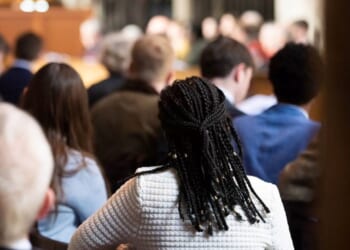
The Archbishop concluded by inviting the congregation — which included her family and friends, faith leaders, charities, health-care workers (representing Archbishop Mullally’s nursing background), and schoolchildren — to “respond to God’s invitation with words as simple as those of Mary: ‘Here I am.’
“As I begin my ministry today as Archbishop of Canterbury, I say again to God: ‘Here I am.’ May we have the audacity to believe in the promises of God: for with him, nothing will be impossible.”