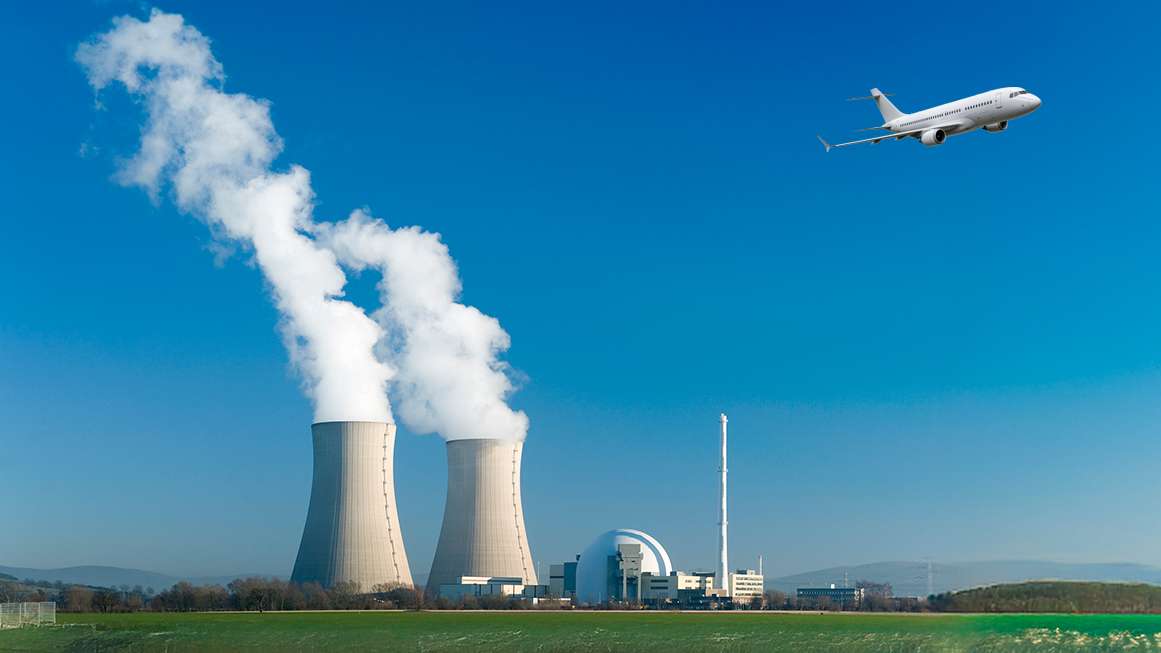
Regulations have made it harder and more expensive to deploy nuclear power in the United States. But in January, the Nuclear Regulatory Commission (NRC) rolled back more than a dozen regulations, including the “aircraft impact assessment.” The rule, which was finalized in 2009, required developers of new power plants to demonstrate to the NRC that their reactor core would remain intact in the event of an improbable 9/11-style plane crash.
The rule did nothing to make nuclear power plants safer, since these facilities are already engineered and regulated to withstand natural disasters such as earthquakes, large fires, floods, and hurricanes. The NRC itself acknowledged this at the time, saying that “compliance” with the rule “is not needed for adequate protection to public health and safety or common defense and security.” Nor did it do anything to improve disaster preparedness; the agency admitted when it finalized the rule that it’s up to the federal government, not nuclear power plant operators, to “prevent the impact of large commercial aircraft.”
The rule was successful, though, in making it harder to build nuclear energy projects.
In late 2008, Georgia Power asked state regulators to approve an expansion project at the Vogtle power plant involving two advanced nuclear reactors. After six months of review, regulators signed off on the project. Despite the state’s approval and the fact that the reactor design was greenlit by federal regulators in 2006, the NRC decided not to permit the project until the reactor complied with the agency’s aircraft assessment rule.
It took three new design iterations, numerous changes to the reactor’s structure, and over two years of work before the NRC allowed the project to move forward, wrote Rod Adams, managing partner at venture capital firm Nucleation Capital, in a 2023 article in Atomic Insights. It’s difficult, if not impossible, to put an exact price tag on these delays, Adams says. But it is fair to say that the aircraft impact rule played a major role in delaying the buildout, and thus increasing the cost, of Vogtle’s two new nuclear reactors, which ran more than $15 billion over budget and were completed seven years behind schedule.
Like so many other regulations for nuclear power, the aircraft impact rule was more of a P.R. gimmick designed to ease concern over the energy source than it was a sound rule. Other edicts are still in place that make it unnecessarily hard to build nuclear power. But for now, we can celebrate that the government finally acknowledged that the cost of this regulation (less clean energy) far outweighed its benefits (none).
This article originally appeared in print under the headline “New York City’s OMNY transit fare system is a privacy risk.”