The Revd Dr Jeremy Morris writes:
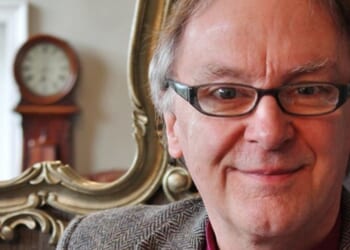
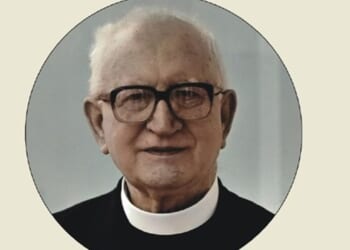
CANON James (Jim) Garrard, who died unexpectedly in December just before his 60th birthday, spent more than 17 fulfilling years as Precentor of Ely Cathedral. It was a fitting end to a ministry of abundance.
Born in Woolwich, he came from a clerical household and spent his early years in the north of England, before coming back to London. (His father, Richard, was later Bishop of Penrith and Director of the Anglican Centre in Rome).
Jim was an outstanding theological student at Durham, and so it perhaps seemed almost inevitable that he would follow his father into the ministry. Four years of research at Oxford under Geoffrey Rowell were followed by a further two at Westcott House, Cambridge, where he met his future wife, Ros Lane. Jim speculated that his 27 consecutive terms of higher education might even have been a record.
Jim was ordained in Wakefield diocese, where Ros, also, served her title. He rapidly added diverse parish ministry to his academic credentials. His curacy at Elland preceded the post of Team Vicar of Brighouse. Subsequently, he moved to be Priest-in-Charge of Balderstone in Blackburn diocese, where he was also Warden of Readers, and where his and Ros’s children, Richard and Sophia, were born.
Jim brought remarkable gifts to his ministry — including insight, commitment, forbearance, and good humour. He was shrewd. He understood that complex, erratic, and often frustrating beast the Church of England instinctively; he knew his way around it, and how to help people and get things done.
But the surface facts of Jim’s career, and even his evident commitment to ministry, do not do justice to the man many of us knew and loved as colleague and friend. To start with, Jim’s scholarly achievements, rarely paraded by him, were out of the ordinary.
He was part of a group of historians and research students who have quietly revolutionised the study of the modern Church of England, dusting down long-neglected figures, illuminating forgotten or underestimated trends, and retrieving the reputation of the Church in what historians have called the “long 18th century”, which stretched from the constitutional crisis of 1688-89 to the crisis of reform in the 1830s.
Jim’s work on Archbishop Howley, at Canterbury from 1828 to 1848, was ground-breaking. No one had worked closely on Howley before, and yet he was Archbishop throughout the turbulent years of the Oxford Movement and parliamentary reform of the Church. In most people’s minds, Howley was a mere cipher, a caricature of a woolly, indecisive, stuffy, bewigged Establishment cleric. Jim showed something quite different: he gave Howley life, and depth, and authority. The book that followed the doctorate, many years later, finally brought all this into public view.
When he came to Ely, Jim landed on his feet. He was never happier than there. His long tenure as Precentor gave him a sort of fixed point around which his public life and his service to the Church revolved. He was, as someone has said, a Precentor “without fuss or faff”.
He loved the cathedral, relished the cathedral community, and flourished in leading and organising its liturgy and musical life. He enjoyed travelling abroad with the choir. His tastes were mostly quite traditional — he had a deep love and appreciation for the traditions of the Church of England — but he was also good at spotting and naming nonsense.
Actually, the real fixed point around which his life in Ely revolved was his family, a first vocation for him. That underpinned everything: he got the priorities right. One always sensed in Jim at Ely a real, solid contentment, a joy not only in what he was doing himself, but first and foremost a delight in his family. With his cathedral responsibilities, and Ros’s ministry in a succession of chaplaincy posts, life was full and demanding.
But their home in Ely was always a place to which clergy, ordinands, organ scholars, visiting choirs, friends, and many others were welcome; barbecues on Bonfire Night for the choristers were a regular treat. I think that Jim saw hospitality almost as a moral duty; but it was certainly something that he delighted in offering.
People mattered greatly to Jim. He was a sensitive and concerned pastor to many. He was loyal to his friends, warm and genuine in his concern for them. Besides history and travel (especially to Italy), he loved good food, good wine, and, above all, good company. He was always fun and often funny, if a little mischievous sometimes. His love for life, his chuckle, and his delight in the people and the situations that he encountered will be missed by those who knew him.
Beneath all that, and his love for and pride in his family, was his faith. It was never the heart-on-sleeve, openly emotional kind. Jim was a high-church Anglican by conviction, not narrow or rigid in his appreciation of tradition, open to change, appreciative of the faith of those with whom he may have disagreed, but, at the same time, deeply grounded in the life and prayer of the Church of his birth and his ministry.