ON ORTHODOX Holy Saturday, the tradition for many of Palestine’s 2000-year-old Christian community is to make the journey up to Jerusalem to attend a special ceremony at the Church of the Holy Sepulchre. On the site where it is believed that Jesus Christ was crucified, buried, and rose again, the Greek Orthodox Patriarch leaves the aedicule and shares the flame of the holy fire with thousands of candle-carrying pilgrims, which symbolises the bringing of Christ’s light into the world.
This year, however, such joyful Easter celebrations will be markedly different for many of Palestine’s 50,000 Christians. Reaching the Old City in Jerusalem over the weekend for the majority of residents of Gaza and the West Bank will be impossible because of travel restrictions imposed by the Israeli government. According to the Palestinian Lutheran minister the Revd Dr Munther Isaac, these restrictions are just a small part of a wider crackdown on Palestinian life in the Occupied Territories.
“The West Bank is now fragmented,” Dr Isaac, who oversees congregations in Bethlehem and Ramallah, explains. “We face the yoke of checkpoints on a constant basis — that’s a daily reality. But now, it’s having its toll on us, to the extent that we just avoid them. But, more than that, we avoid travelling out of fear — what will happen at the checkpoint, or on the roads that settlers control or have access to?”
Israeli settler aggression in the West Bank is reported to be at an unprecedented high this Easter. Amid the fog of war with Iran — when the international community’s focus is elsewhere — extremist settlers are seizing the opportunity to attack Palestinians in the Occupied Territories with an increasing sense of impunity, he says. Settler violence is a deliberate attempt to evict Palestinians from their land, Dr Isaac says.
Since the start of 2026, some 26 Palestinians have been killed in the West Bank by extremist Israeli settlers and IDF soldiers; more than 19,000 violent settler attacks have been recorded in Palestinian villages; and, between November 2024 and October 2025, 36,000 Palestinian residents in the West Bank were forcibly displaced from their homes. An estimated 75,000 people have been killed in Gaza during the recent conflict.
“They want us out: this much is clear,” Dr Isaac says. “[The settlers] are trying to push Palestinians out through these intimidations and terror attacks which are backed by the Israeli government. Israel is a terrorist state, right now. We have Christian families attacked by settlers, and, when they defend themselves, the Israeli military comes and arrests the family for defending itself. . . It’s horrific.”
Only last month, soldiers of the Israeli Defense Forces killed four members of the Owda family, including two children, opening fire on the family car in the village of Tammun. The family was returning home after a shopping trip to buy holiday clothes in Nablus near by.
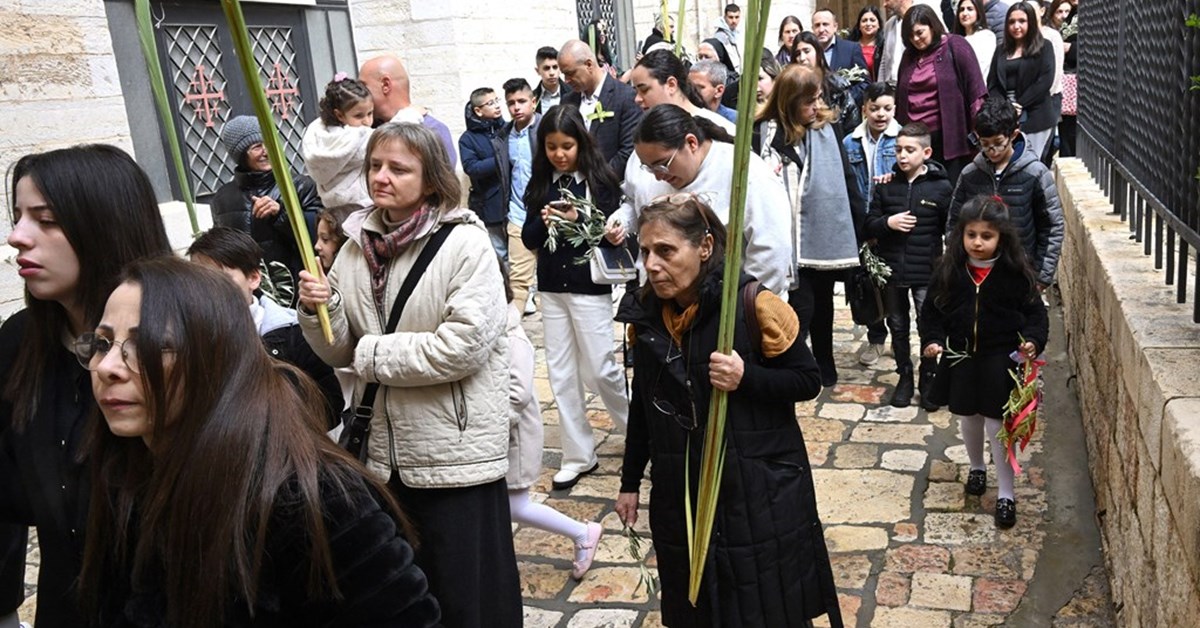
Dr Isaac is critical of the Western Church for what he sees as its failure to call out Israeli atrocities in Gaza. But he says that the Palestinian Christian community in the Holy Land remains resilient. Churches held Palm Sunday marches across the country; Easter music will be played on loudspeakers in public places on Good Friday; and there are Holy Week services, prayers, and traditional family-related activities on Easter Day.
“With my family in Beit Sahour, where I come from, all 200 to 250 of us gather together to greet each other with the words, ‘Al-Masih qam’, meaning ‘Christ is risen’ [in Arabic]. So, Easter is very much a community event.”
For Dr Isaac’s congregation at the Christmas Lutheran Church in Bethlehem, Christians tend to dwell mostly on the image of the cross at Easter.
Dr Isaac calls Holy Saturday “the Saturday of resilience” now, he says, “because that’s when you need to endure and wait. I think of the metaphor of the tomb — darkness, death, silence. That’s how Palestinians feel. Whether its with the genocide, or here in the West Bank now with horrific things happening: Easter Sunday offers us a reminder that, ultimately, Sunday is coming. Ultimately, God wins. And this is an opportunity to preach resilience to people, to preach hope. And to remind them that the cross did not have the final word.”