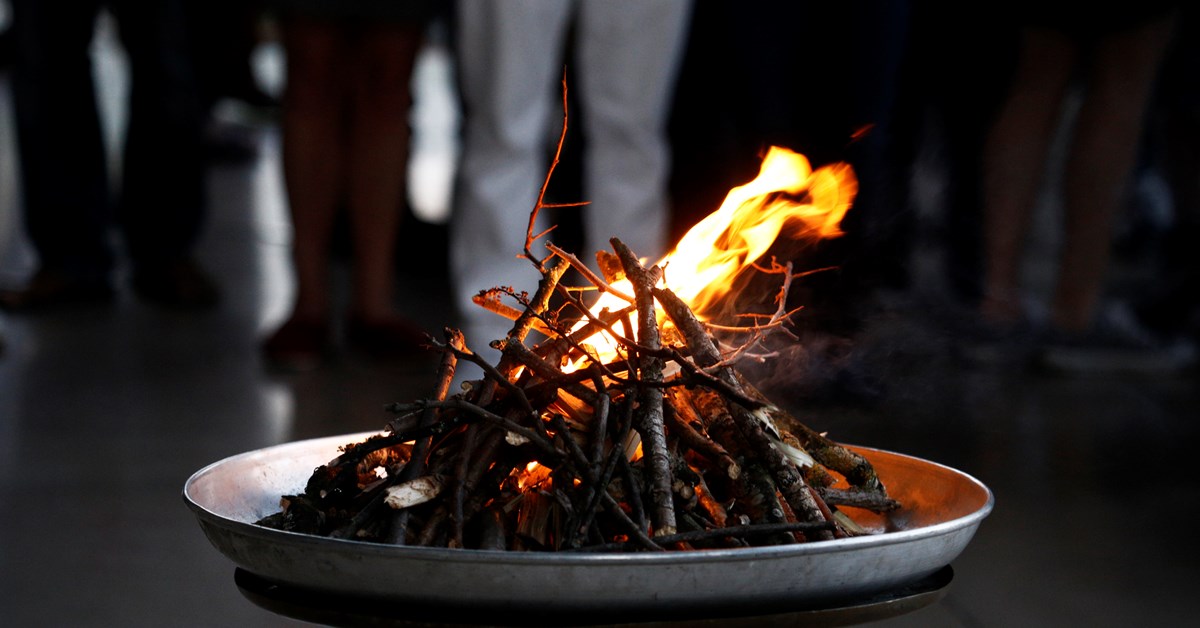
THE liturgy of Holy Saturday is full of hazards. The first is getting there at all, especially if it is scheduled for dawn. The second is the lighting of the fire. I can remember rainy nights when the fire refused to light, in spite of the firelighters stacked under the twigs and branches; and windy nights, when members of the congregation have had to dodge flying embers.
I remember, at least once, holding my breath in fear as a server’s alb dangled dangerously close to a rising flame. (Common Worship does not make provision for the incineration of an acolyte.) Cigarette-lighters are the best way of setting the thing off, but not many of us have them these days, and, anyway, the point is to give the impression that the Easter fire springs into life without too much human intervention. Here, as so often, a shower of rain can stop play.
I have a strange dreamlike impression that one Easter, at Christ Church Cathedral, in Oxford, the liturgy began with a masked, Batman-like figure abseiling down the spire and lighting the fire with a flame-thrower before disappearing into the shadows. The memory may be coloured by whatever it was that the college chaplain gave us to drink before the ceremony at a supper party for those about to be baptised and confirmed.
Visiting bishops can be a hazard, especially those who find it difficult to read liturgical instructions in the dark, while saying the prescribed words and simultaneously poking the five nailed incense grains into the Paschal candle.
“By his holy . . . and glorious wounds . . . may Christ our Lord . . . guard us . . . and keep us.” When I was in a parish, a well-loved retired bishop managed to drop an incense grain on to the grass — an error that he confessed at the end of the service. I was up at dawn the next morning to find the grass covered with a light dusting of snow, and I spent hours attempting to retrieve it. Fortunately, it popped up when the snow disappeared, and found its proper place in the candle before the end of Easter Day.
The next hazard is the singing of “The light of Christ” as the lit candle is processed into the church, traditionally by a deacon, who has to pitch the note accurately and then raise it twice by a semi-tone. Singing the Exultet (“Rejoice heavenly powers. . .”) is an amazing joy, and, for me at least, required weeks of practice when I did it for the first time. But, when it is over, phew! Sit down, listen to scripture, recover, give thanks to God for the joy of the resurrection.
Holy Saturday happens only once a year, and, if you can’t cope, then at least try a cheerful evening prayer with a blessing of the Easter garden. There is a place for Anglican restraint, and it is very C of E.
Good Faith: Why England needs its Church by Angela Tilby is published by Hodder & Stoughton at £25 (Church Times Bookshop £20); 978-1-3998-0163-8.