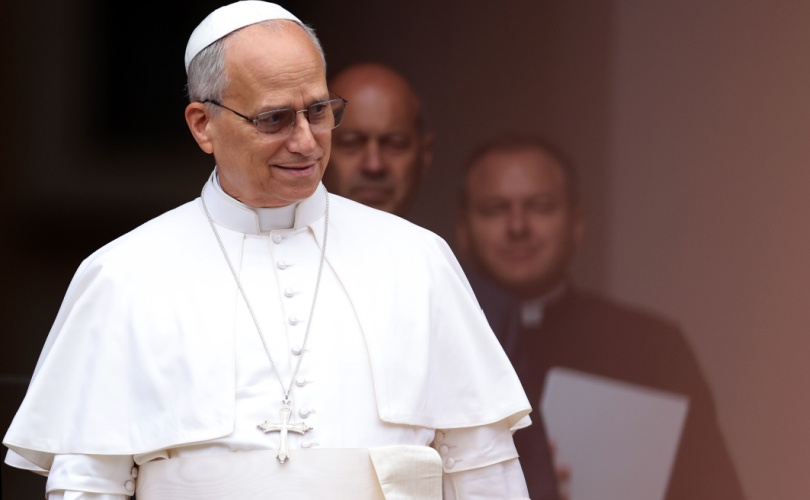
VATICAN CITY (LifeSiteNews) — Pope Leo XIV has appointed 19 new consultants to the Dicastery for Interreligious Dialogue, confirming a line of nominations consistent with those made under Pope Francis.
On Monday the Holy See announced that Pope Leo XIV had named 19 consultants to the Dicastery for Interreligious Dialogue in Vatican City, selecting clerics, religious, and lay academics from various countries to advise the dicastery in its mission of fostering relations between the Catholic Church and followers of other religions.
Among the newly appointed consultants is Emilce Cuda, who is also secretary of the Pontifical Commission for Latin America. She stated in a 2020 interview: “I do not comment on abortion because I am specialized in social morality, not in bioethics.”
Cuda attracted international attention in 2022 following the decision of the United States Supreme Court to overturn Roe v. Wade. Commenting on the ruling, she warned that many Catholics “confuse the defense of life with the defense of ideological positions” and argued that human dignity should not be reduced to the issues of abortion and euthanasia alone. Cuda is also publicly associated with the “theology of the people” (teología del pueblo), a current of thought originating in Argentina and germinated from the condemned theology of liberation.
Another appointee is Mónica Santamarina, a leading figure in the World Union of Catholic Women’s Organizations (WUCWO). In June 2023, Santamarina called for combating what she described as “clericalism” by expanding the presence of women in seminaries and in Church leadership. Speaking to the daily newspaper of the Italian Conference of Bishops, Avvenire, she said: “It is no secret that the gap exists. Obviously not at all levels, and not in the same way.” In the same interview, she praised Pope Francis as a “champion” of inclusion for appointing women to senior Vatican roles, while maintaining that “much clericalism still persists, especially at the local level.”
The list of consultants also includes Ana María Bidegain, president of a confederation of lay movements called Pax Romana. In a June 2023 interview with CatalunyaReligio.cat, Bidegain said: “Our great challenge is how to help articulate and build the Synodal Church.” In the same interview, she stated that, “without the work of the laity, Liberation Theology would never have been born.” She also referred to theologian Gustavo Gutiérrez as then serving as an adviser to Pax Romana groups in Peru. Gutiérrez, the founding father of liberation theology, died in October 2024.
From Latin America, Sofía Nicolasa Chipana Quispe of Bolivia was named among the consultants. Chipana is associated with indigenous, feminist, and decolonial theology and is a member of the Community of Indigenous Women Theologians of Abya Yala, which is the indigenous name for the region of Latin America and Caribbean. She has been presented by the World Council of Churches as “a primary voice of an indigenous theology that values living in dignity and sacredness with the earth and respect for all forms of life.” Chipana has also spoken of Andean spirituality as “unconditionally linked to Pachamama, the Mother Earth.”
The final highlighted appointment is that of Fr Wasim Salman, a Syro-Italian priest incardinated in the Diocese of Palestrina. Salman has described interreligious dialogue as the only path to peace between religions, stating that “it is the love for our Muslim brothers that will mark our activities, especially since the Church shares with Islam the same concerns described and developed extensively in the Document on Human Fraternity.” He has also referred to Islam as “this great religion whose spread is impressive today.”
The Dicastery for Interreligious Dialogue was established by Pope Paul VI for dialogue between Catholics and members of other non‑Christian religions. After the reform of the curial structure carried out by Pope Francis with Praedicate Evangelium, the dicastery adopted the specific aims of “promoting mutual understanding, respect, and cooperation between Catholics and followers of other religious traditions; encouraging the study of religions; and fostering the formation of people dedicated to dialogue.”
The latest appointments by Pope Leo XIV continue this trajectory, drawing on figures previously active in synodal processes, interreligious initiatives, and controversial theological movements across the Church.