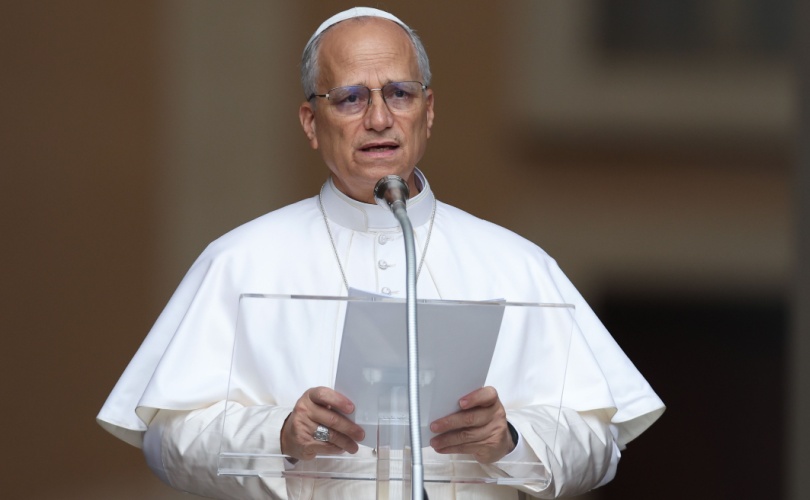
VATICAN CITY (LifeSiteNews) — Pope Leo XIV on Wednesday said the Second Vatican Council is the “guiding star” of the Church’s path in his strongest statement to date in support of the controversial council.
“It is the Magisterium (of the Second Vatican Council) that still constitutes the guiding star of the Church’s journey,” Pope Leo said during his Wednesday general audience, Vatican News reported. He extolled Vatican II while beginning a new catechism series based on the documents of the Council.
Announcing the new catechesis series on X, Leo reiterated, “The Council’s Magisterium remains even today the North Star guiding the Church’s journey.”
The pope praised the “liturgical reform” launched by Vatican II, which laid the groundwork for the revolutionary Novus Ordo Missae, the new Mass. The Council “set in motion an important liturgical reform by placing at the center the mystery of salvation and the active and conscious participation of the entire People of God,” Leo said in his general audience.
He also lauded Vatican II for being responsible for a Church committed to “seeking the truth through the way of ecumenism, interreligious dialogue and dialogue with people of good will,” as if the Church needs to seek truth outside of Herself. The idea that the fullness of the truth is not found within the Catholic Church is heretical.
According to Leo, Vatican II “has helped us to open ourselves to the world and to grasp the changes and challenges of the modern era in dialogue and co-responsibility, as a Church that wishes to open its arms to humanity … and to collaborate in the construction of a more just and more fraternal society.”
Leo’s description of the Second Vatican Council as the “guiding star” of the Church’s path suggests he sees this council as surpassing in importance every other council of the Church. That is especially significant given that Vatican II appeared to contradict previous magisterial councils — which had been consistent until then — in certain respects.
Prelates such as Bishop Athanasius Schneider and Archbishop Carlo Maria Viganò have pointed to errors in the Second Vatican Council regarding religious freedom and other religions.
For example, Bishop Schneider has said Lumen Gentium is “wrong” and errs by suggesting that Christians and Muslims participate together in the same act of adoration when it states that “Muslims, who, professing to hold the faith of Abraham, along with us adore the one and merciful God.”
It errs because Muslims worship on a natural level, at the same level of anyone who adores God with the “natural light of reason,” whereas Christians adore God on a supernatural level as His adopted children “in the truth of Christ and in the Holy Spirit.”
“This is a substantial difference,” Schneider observed. He explained that the use of the phrase “with us” represents a relativization of the act of adoration of God and also of Christians’ “sonship.”
In addition, Muslims reject the Trinity, which they consider to be an idolatrous idea. Christ made clear that “whoever rejects me rejects the one who sent me” (Luke 10:16) and “no one comes to the Father except through me” (John 14:6).
Schneider criticized texts suggesting that Buddhists and Hindus can attain illumination on their own, without “the grace of Christ,” as a heresy. Nostra Aetate claims that “in Hinduism, men contemplate the divine mystery,” and that Buddhism “teaches a way by which men, in a devout and confident spirit, may be able either to acquire the state of perfect liberation, or attain, by their own efforts or through higher help, supreme illumination.”
The bishop has also criticized Dignitatis Humanae for putting forth “a theory never before taught by the constant Magisterium of the Church, i.e., that man has the right founded in his own nature, ‘not to be prevented from acting in religious matters according to his own conscience, whether privately or publicly, whether alone or in association with others, within due limits.’”
Archbishop Viganò explicitly agreed with Bishop Schneider in his criticism of the Second Vatican Council, noting that Vatican II’s formulation of religious freedom “contradict(s) the testimony of Sacred Scripture and the voice of Tradition, as well as the Catholic Magisterium which is the faithful guardian of both.”