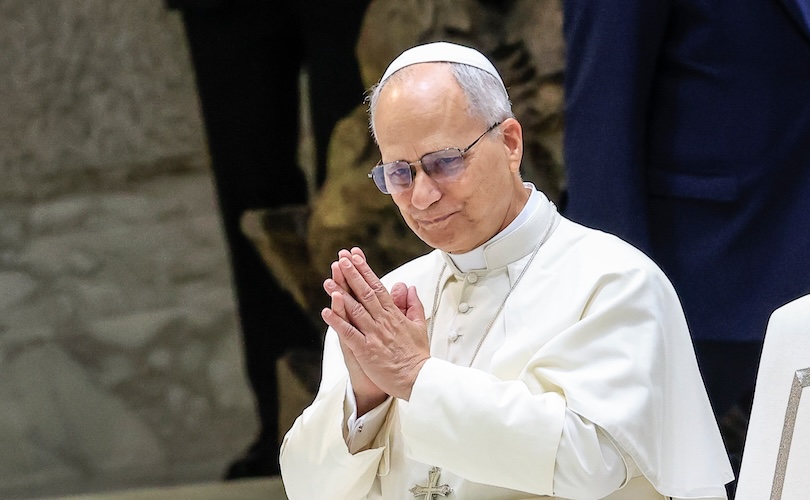
VATICAN CITY (LifeSiteNews) — Pope Leo XIV held a private audience on Monday with Gareth Gore, the British author of the 2024 book Opus: The Cult of Dark Money, Human Trafficking, and Right-Wing Conspiracy inside the Catholic Church.
While the Vatican did not disclose what was discussed during the March 16 audience, Gore claimed in a Substack post that Pope Leo had called his book, which alleges that the Opus Dei – a personal prelature of the Catholic Church founded by Spanish priest Josemaría Escrivá – is responsible for decades of human trafficking, abuse, and various financial misdeeds, a “rigorous piece of work.” The progressive financial journalist, who emphasized that Leo appeared to be receptive to his suggestions, also noted that he urged the Pontiff to launch an independent investigation into Opus Dei and even reopen the beatification and canonization of its founder, Escrivá.
The meeting comes as Pope Leo has considered breaking up Opus Dei and repeatedly met with its members in recent months.
“I ended the meeting by imploring Pope Leo to take action against this abusive group. I urged him to immediately launch an independent inquiry into Opus Dei abuses headed up by both clerical and lay experts – covering allegations of spiritual, psychological, emotional, physical, and financial abuse,” Gore wrote on his Substack. “I said that he should stand ready to close down the organisation if the evidence merits it.”
Opus Dei has strongly denied all of Gore’s accusations and slammed his book as soon as it was published in 2024.
“(T)he book is littered with twisted facts, errors, conspiracy theories and even outright lies, making false accusations on the basis of biased and misread sources,” Opus Dei wrote.
Leo’s meeting with Gore and the Pontiff’s apparent labeling of his book as a “rigorous piece of work” is particularly significant as his Vatican has reportedly planned to break up Opus Dei into three independent parts rather than allow it to continue as a unified juridical and spiritual entity.
As previously reported by LifeSiteNews’ Emily Mangiaracina, these new statutes would split Opus Dei into three separate parts:
- A Clerical Prelature, made up only of Opus Dei’s incardinated priests, now “significantly reduced”;
- The Priestly Society of the Holy Cross, comprised of diocesan clergy who wish to partake in Opus Dei’s charism, now no longer affiliated with the prelature;
- A Lay Faithful Association, a now fully independent association for all lay members including numeraries, associates, supernumeraries, and cooperators, who have previously been included under the prelature.
READ: Pope Leo reportedly set to break up Opus Dei
In 2022, Pope Francis had also begun to clamp down on Opus Dei, issuing the motu proprio Ad charisma tuendum, which stipulated that the personal prelature would no longer be led by a bishop. While some Catholic thinkers speculated at the time that Francis was punishing Opus Dei, several of its members had repeatedly defended the late Argentine pontiff and criticized his opponents.
In one 2017 instance, Monsignor Mariano Fazio, the group’s vicar general and second in command, accused signatories of the filial correction of Pope Francis for his “effectively upheld 7 heretical positions,” of launching an “attack [on] the pope.”
In 2022, Opus Dei expelled Father Jesusmary Missigbètò for his open letters highlighting Pope Francis’ “heresies” and calling Francis to repent. The late pope responded by censoring Missigbètò and banning him from public ministry.
READ: Opus Dei expels African priest for criticizing Pope’s endorsement of same-sex civil unions
During the Monday audience, Gore also exhorted Leo to investigate the beatification and canonization of Opus Dei’s founder, Father Josemaría Escrivá, “because of information that has since emerged indicating potential irregularities in the process.”
Indeed, Pope John Paul II’s 2002 canonization of Escrivá has been criticized by traditionalist Catholics, including members of the Society of St. Pius X (SSPX), for its speed, lack of the traditional “devil’s advocate,” and the fact that former Opus Dei members who personally knew Escrivá were prevented from sharing their objections to his canonization.
Defenders of the canonization point out that canon law was followed in these proceedings, which included 92 individuals who testified in support of the late priest’s canonization, as well as thousands of pages of written testimony supporting his cause.
The re-opening of a saint’s beatification and canonization process after they have already been declared a saint by the Church would be unprecedented.
Bill Donohue, president of the Catholic League, has compared Gore’s criticism of Escrivá’s canonization to the late prominent new atheist Christopher Hitchens’ militant opposition to Mother Teresa’s canonization. Hitchens was notably called to testify against Mother Teresa’s beatification by the Vatican, and repeatedly accused the nun of being a “fraud.”
In February, Pope Leo also held a private audience with Monsignor Fernando Ocáriz, prelate of Opus Dei, perhaps signaling that the Pontiff wishes to hear multiple perspectives before deciding on the prelature’s future.