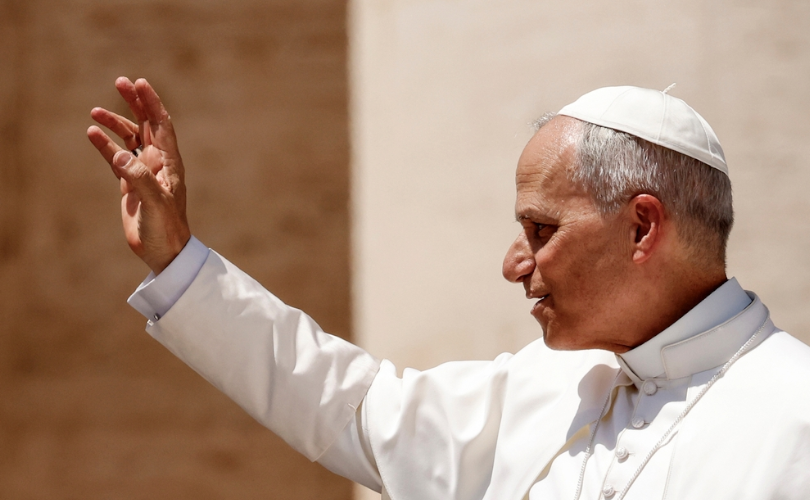
VATICAN CITY (LifeSiteNews) — Pope Leo XIV blessed two lambs in the Vatican on the Feast of St. Agnes, restoring an ancient Roman custom interrupted by Pope Francis.
On January 21, the liturgical memorial of St. Agnes, Pope Leo XIV blessed two lambs at 8:30 a.m. in the Chapel of Urban VIII in the Apostolic Palace in Vatican City, restoring a centuries-old Roman custom linked to the martyr-saint and to the preparation of the pallia, the woolen vestments worn by metropolitan archbishops as a sign of their communion with the Bishop of Rome.
READ: Pope Leo XIV considering invitation to join Trump’s new Board of Peace
The rite had not been personally carried out by Pope Francis from 2017 to 2025. During that period, the blessing of the lambs took place during Holy Mass in the Basilica of St. Agnes Outside the Walls and was celebrated by the Canons Regular of the Lateran.
The blessing of the lambs on the feast of St. Agnes is a very ancient Roman custom, rich in theological and ecclesiological meaning. It is not tradition in the theological sense of the term, because it does not belong to the sources of Revelation, but an extra liturgical rite with strong symbolic value, meant to highlight the primacy of the pope and communion with all metropolitan archbishops.
The name “Agnes” is associated with both the Greek word haghnós, meaning “pure,” and the Latin word agnus, meaning “lamb.” Christian iconography has long depicted the young Roman martyr with a lamb at her side, representing purity, sacrifice, and fidelity to Christ, whom tradition describes as the heavenly Bridegroom she refused to renounce even under threat of death.
Roman piety, long rooted in devotion to its bishop, has seen in these traits – purity steadfast even to the shedding of blood – two qualities that St. Peter’s successors must hand on to the bishops of the entire world. Historical sources attest that the blessing of lambs on the feast of St. Agnes was already practiced between the 4th and 6th centuries.
The lambs blessed by the Pope are donated by the Trappist monks of the Three Fountains Abbey in Rome. After being offered, the animals are entrusted to the Sisters of the Holy Family of Nazareth, who care for them and prepare them for the ceremony. The sisters also carry out the ritual vesting of the lambs. One lamb is dressed with a red cloth, recalling martyrdom, while the other is clothed in white, symbolizing virginity. The same colors are used for the floral crowns placed on the lambs’ heads, and small ribbons are attached to their ears. Once dressed, each lamb is placed in a basket and brought before the Pope for the blessing.
READ: Bishop Schneider demolishes Cardinal Roche’s attack on Latin Mass
After the ceremony in the Apostolic Palace, the lambs are taken to the Basilica of St. Agnes Outside the Walls. In that basilica, during Mass presided over by the Abbot General of the Canons Regular of the Lateran, the lambs are placed upon the altar, above the relics of St. Agnes and St. Emerentiana, Agnes’s sister who died two days after her, before receiving baptism.
Custom holds that it is forbidden to kill these blessed lambs and their wool is used for the making of the pallium, a white band decorated with six black silk crosses and is worn over the chasuble by metropolitan archbishops. It signifies the special bond of communion between the Pope and the archbishops. Each year, the pallia are blessed by the Pope on June 29, the Solemnity of Saints Peter and Paul. On that day, they are imposed upon newly consecrated metropolitan archbishops.