(LifeSiteNews) — A Catholic media group shared the story of a post-abortive woman who struggled with despair for years before finding healing and now helps to bring such healing to thousands of other women with her ministry.
Theresa Bonapartis recently told Hyperdulia Media the heartbreaking story of how she came to have an abortion at age 17 after heavy pressure from her father and then entered a “downward spiral.”
When Bonapartis was growing up in the 1960s, the Sexual Revolution was in full swing, and she recalled how it seemed that “everyone was sleeping around” except her. “And I remember I felt like there was something wrong with me because I wasn’t,” she said.
After becoming pregnant while in a relationship, she had a whole range of emotions, “from being excited about it to being terrified.” She was able to hide her pregnancy from her parents until the fourth month, when she finally revealed it to them.
“I got a very different reaction than what I thought I was going to get. My father got up out of his chair and told me to leave the house and that he was going to forget that I was his daughter and that I should forget that I was his daughter,” Bonapartis said. She remembers her mother then followed her “around the house” giving her cutting remarks.
Being forced to leave her parents’ house, she stayed at a friend’s house temporarily, and during that period started fighting with her boyfriend. “I told him to leave me alone, and he did,” she recalled.
“Every day my father would have my sister call me and tell me he wanted me to have an abortion. And I said, ‘No, I’m not gonna have an abortion.’ … And this went on day after day after day until finally I agreed to have an abortion.”
Bonapartis remembers the doctor injecting her with saline solution, which she explained “burns the baby to death,” although she had “no idea” how the abortion worked at the time — and then going into labor hours later.
“And after many hours I ended up giving birth to a dead baby boy. I remember thinking, ‘How is this allowed?’ And I wanted to put him back inside of me, which I obviously couldn’t.” She was immediately overcome with despair and remembers wanting to jump out the window.
Finally, she watched a nurse come into the room and put her son in a jar.
“To say my life changed after that is an understatement,” Bonapartis shared. “I hated myself. My family still wasn’t talking to me even though I had agreed to have an abortion. My life went into a complete downward spiral because I was filled with guilt and shame that I had done this. I feel like I’m damned to hell, there’s no way back.”
It took a few years for her family to begin speaking to her again, “but nobody mentioned the abortion,” as if “it never happened.”
She married a man who abused drugs and alcohol, explaining that this is what she felt she “deserved” at that point. Meanwhile, she was avoiding church, thinking she was “damned to hell.” When problems with her husband escalated, and one day he came home drunk, she picked up her two children in her arms and left.
As she stayed at her sister’s place, she went back to school and became a drug and alcohol abuse counselor, encountering many post-abortive patients, because alcohol abuse tends to accompany promiscuity and abortions, she explained.
“I couldn’t deal with them because I couldn’t even deal with my own abortion,” Bonapartis said. While she had brought up during counseling with her husband that she had an abortion and it was disturbing her, her therapist didn’t recognize its impact, as her family had not.
“And so I wasn’t healed at all from my own abortion. So I ended up burning out,” she shared.
Even as she was avoiding church, she wanted her sons to grow up with a religious education, so she sent them to a Catholic school. Bonapartis recalled how the parents were asked to attend a first penance meeting, and she hesitantly attended.
“A priest came out and started speaking to us … about God’s love, mercy and forgiveness,” she said, adding that for years up until that time, she had been suffering from anxiety, depression, and suicidal ideation. It was so bad, there were days when she couldn’t bring herself to get out of bed.
Then the priest started naming specific sins that God forgives and mentioned abortion.
“I went home that night with the first hope I had in years. It took me a few days, but I finally got the courage to call this priest and ask him if I could come and see him,” Bonapartis said. “I still very vividly remember going up to the rectory and being terrified to go in.”
“It was so unbelievable because I felt like it was the first time anybody had heard me. Anybody heard the pain, the sorrow, the grief, the shame. It was really amazing,” she said. She made her confession with the priest, and he gave her a Miraculous medal, which she has worn around her neck ever since.
From that point, she was “on a quest to know God.” She began to attend daily Mass, do the stations of the cross, and spend time before the Blessed Sacrament. “I said (to God), I’m not going to leave you alone until you heal me,” she recalled.
Eventually, she consecrated herself to Mary, using the 33-day preparation method of St. Louis de Montfort, along with her church.
“That act of consecration totally changed my life … It’s been 37 years since I did this consecration, and if I had to name one thing that changed my life totally, it would be that.”
However, her healing didn’t come immediately. She did post-abortion counseling and spoke with her priest about her abortion, but felt there was a “block” to her healing. She was still struggling with despair despite the fact that she was praying and receiving the sacraments.
At one point, her therapist asked her if she ever told the Blessed Mother that she is sorry for her abortion. Since she hadn’t, she proceeded to do this at church while kneeling in front of a statue of Our Lady.
That night was emotionally turbulent. After putting her kids to bed, she went into the bathroom and knelt down and repeated, “Jesus, I trust in you.”
“I was in there for hours saying that. And somewhere in the middle of the night, I felt this warm rush go through me, and I knew I had been touched by God. I just knew it. There’s no adequate words to describe what happened. I went to bed that night and the next day I got up and I just felt totally different.”
Now that she had healed, she realized the potential for as well as the need for a healing ministry for other post-abortive women and men. She went to work in the Family Life office of the Archdiocese of New York, where Cardinal John O’Connor was at that time.
“I say I haunted him about this, about how we needed some kind of outreach,” said Bonapartis, adding that she knew there were others like her who suffered silently after abortion. Cardinal O’Connor eventually said he would start the religious order the Sisters of Life and promised Bonapartis that ministering to post-abortive women would be one of their apostolates.
And indeed, the Sisters went on to counsel post-abortive women as part of their ministry. Bonapartis joined them to help put on day retreats for this purpose.
Eventually, after the U.S. Conference of Catholic Bishops called and asked the name of the ministry, Bonapartis prayed about it. One day while in front of the Blessed Sacrament, the name “Canaan” kept coming up. She couldn’t understand what it had to do with healing until she started reading references to Canaan in Scripture and realized that healing from abortion is akin to entering Canaan, the promised land.
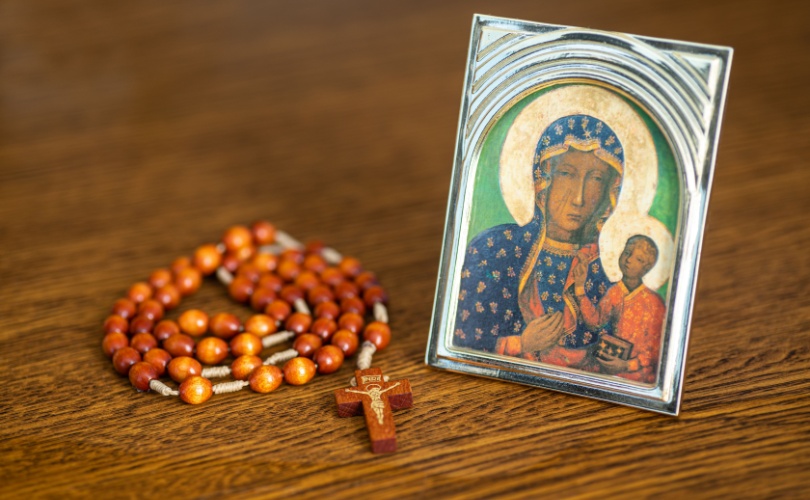
Later on, while praying a novena to Our Lady of Czestochowa, Bonapartis felt her saying, “This is my ministry, I want to be patroness of this ministry.” One of the things that struck Bonapartis about Our Lady of Czestochowa is that her original image was scarred on the cheek, and this scar kept reappearing even after attempts to repair it. It reminded her of women who had abortions: Their scars keep coming back even while people “pretend they’re not there.”
Now in 2026, thousands of people have been helped through the Entering Canaan ministry, and there are many testimonials from women and men who have been healed by it.
Bonapartis said that while abortion is the “ultimate failure of love,” the cross is the “ultimate fulfillment of love,” and “even abortion can’t stop God’s love and forgiveness” offered on the cross.
She wants to continue to spread the message that after abortion women “don’t have to suffer alone. There is healing. There is forgiveness. That God is waiting for them. He’s merciful. And that Mary is waiting to lead them to Him.”