CURRENT events have overtaken this biography. Nowhere does Jeffrey Epstein get a mention. With hindsight, Gordon Brown has now admitted he should never have brought Peter Mandelson (with whom, James Macintyre indicates, Brown had a “love-hate” relationship) back into his Cabinet. Yet, without Mandelson’s support at a crucial time in his premiership, Brown might not have been there to save the global economy.
Recent revelations have done nothing to diminish Brown’s integrity, which was at the heart of both his Chancellorship and his time as Prime Minister, as this thoroughly researched and very readable biography (Feature, 13 February) confirms. Son of the Manse, he is motivated by his Christian faith in all he does, and it explains his lifelong mission to tackle social injustice and poverty.
The author describes Brown’s early life, his formidable intelligence, his lack of worldliness, the loss of his eye, and his formative years as Student Rector of Edinburgh University. Always a man in a hurry, elected to Parliament in 1983, he was in Neil Kinnock’s Shadow Cabinet two years later. In the years that followed, the three modernisers, Brown, Tony Blair, and Mandelson, devised the policies that would become New Labour. Above all, Brown recognised that, to be electable, Labour must have a credible economic policy.
John Smith’s sudden death was a turning point for Brown. Macintyre relates the fraught way in which Blair, backed by the media and Mandelson, emerged as leader, and the still disputed agreement between the rivals about when Blair would resign in favour of Brown. Yet, despite all the hurt and continuing tensions in office, “when they worked well together in their respective positions, the partnership of Tony Blair and Gordon Brown was perhaps the most successful in British politics since the Second World War.”
Brown’s first act as Chancellor was to grant independence to the Bank of England, removing the power of the Treasury to set interest rates for political purposes. Macintyre describes how Brown, though a lifelong pro-European, opposed Britain joining the euro, a decision that he still sees as right, as he does his support for devolution in Scotland to thwart nationalism. There follows a short chapter on the importance of Sarah Brown and the unbearable tragedy of the death of their daughter, which affected “their whole outlook on life”.
Macintyre then spells out the various fiscal measures that Brown took to realise his long-held ambition to reduce poverty, particularly for children and pensioners. Underlying all his actions was the mantra “prudence for a purpose”.
There were failures, as Brown himself admitted, particularly in regulating the commercial banks. But, between 1997 and 2007, there were no recessions. Macintyre specifically praises Brown for his input in supporting international development (“far from today’s politics”) and his huge influence in achieving international cancellation of the debts of poorer countries.
The final years of Blair’s premiership were dominated by not only the question of his retirement, but also policy differences with his Chancellor, whom he had failed to ease out. It was a messy situation made worse by both sides’ supporters. In the end, the still young Blair gave way and in 2007 Brown at last found himself Prime Minister.
Astonishingly, his early months were dogged by damaging indecisiveness chiefly by allowing speculation to run on whether he would call a snap election. Piers Morgan argues that, had Brown won, he really would have been “one of our great prime ministers”. There followed the rapprochement with Mandelson with his return to the Cabinet. His support saved Brown’s premiership as Labour’s popularity plummeted with huge losses in both the 2009 local and European elections. Yet this was the prelude to Brown’s finest hour.
Macintyre describes in detail how the world economy became threatened by the financial crisis of 2008 and the way in which Brown, by sheer determination and endless meetings, secured international agreement to avert global meltdown. He achieved not only a massive injection of money from governments, but also the means of ensuring proper global oversight to prevent future crises. As the Nobel economic prizewinner Paul Krugman wrote, Brown “saved the world financial system”.
The rest of Brown’s time in office was fraught with difficulties, not least with the press. In the 2010 election campaign, he faced media treatment that Piers Morgan describes as “so unfair as to be heartbreaking”.
Looking back at his years in office, it seems that Brown was naturally better suited to the single office of Chancellor than, as a man reluctant to delegate, having to deal with the variety of complex problems that assail Prime Ministers daily.
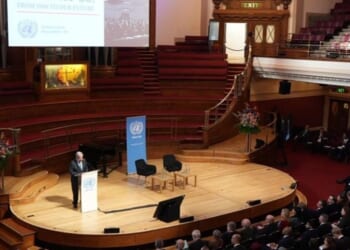
In retirement, Brown has by no means left the national or international stage. In Scotland, he campaigned successfully against both independence and Brexit, where Remain won. Unlike some predecessors, he has been utterly unconcerned with personal wealth or self-aggrandisement (he surrendered his prime-ministerial pension while in office), but has energetically continued his mission to aid the poor and disadvantaged both at home and internationally as United Nations envoy for global education and World Health Organization ambassador for global health financing. What stands out is not only his intellectual and emotional energy, but, above all, his humanity.
Canon Anthony Phillips is a former headmaster of The King’s School, Canterbury.
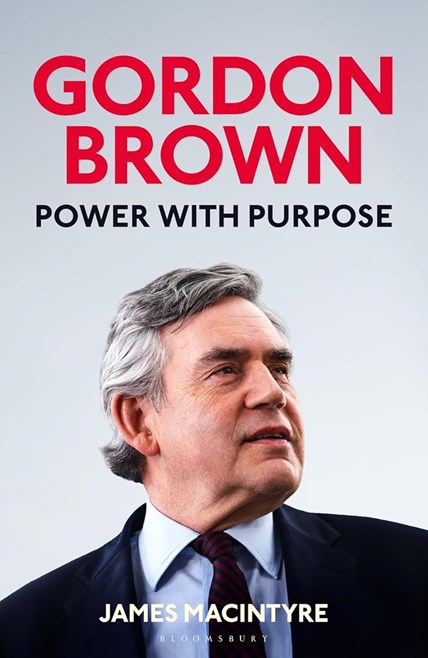
Gordon Brown: Power with purpose
James Macintyre
Bloomsbury £25
(978-1-5266-7341-1)
Church Times Bookshop £22.50
Listen to James Macintyre talk about the book on the Church Times Podcast