AS SOMEONE whose entire professional identity is about making the case for faith in public life, I should be pleased that, during the past week or so, the right to pray publicly has been stimulating political discourse. And yet . . .
It began when the Shadow Justice Secretary, Nick Timothy MP, posted a video online of Muslims breaking their Ramadan fast with an iftar meal and call to prayer in Trafalgar Square recently. It was, he said, “an act of domination . . . not welcome in our public places and shared institutions”. What has ensued has been a somewhat unedifying discourse about what sort of expressions of faith belong in the public square.
In a week of global turmoil, the matter was serious enough to be raised at Prime Minister’s Questions last week. The Prime Minister called on the Leader of the Opposition, Kemi Badenoch, to sack Mr Timothy for his comments. Sir Keir Starmer stated that the diverse celebrations of faith that took place in Trafalgar Square, and other shared institutions, were demonstrative of the strength of our common life, not to be used to create division.
The Bishop of Willesden, in the diocese of London, the Rt Revd Lusa Nsenga-Ngoy, who is the lead bishop for interfaith engagement, criticising Mr Timothy’s comments, said that “to suggest that such an event is somehow threatening risks misunderstanding both the nature of religious expression and the character of our national life.”
It is not the event itself that is a new development so much as the hostility of the reaction. Public spaces, from Trafalgar Square to Wembley Stadium, have hosted iftars, Chanukah celebrations, Vaisakhi events, and carol services for years. As the Bishop of Kirkstall, in Leeds diocese, the Rt Revd Arun Arora, noted, Christian acts of remembrance and lament took place metres away every November, and Christians would gather there in Holy Week for the annual re-enactment of Christ’s Passion.
THE heightened attention and animosity this year, with the throwing around of hyperbolic language such as “domination”, should concern us all at a time when cohesion between communities is stretched and our national identity is contested. There has been a demonstrable rise in anti-Muslim hatred in recent years, and, this week, an arson attack on a Jewish ambulance service is being investigated as alleged anti-Semitism.
Elsewhere, there has been booing from football crowds in response to matches pausing to allow Muslim players to break their fast pitchside. Again, this is not the first season that the Football Association has made provision for this, but the angry reactions and online furore this year feel like a gear change in community relations — and not for the better.
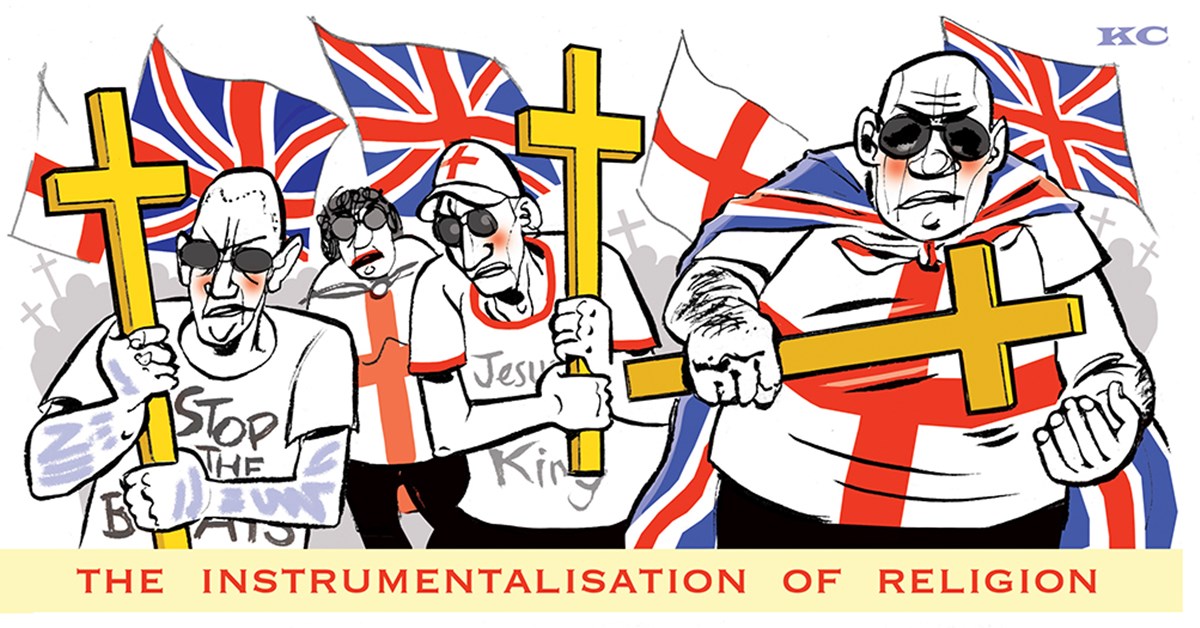
Some, including the Reform MP Danny Kruger, have taken the approach of Christian exceptionalism here: prayer in public spaces is welcome, as is any other expression of faith, but only if it is the Christian faith. Against the backdrop of growing concerns about Christian nationalism, it is hard not to wonder whether this is really about prayer at all. The invoking of “domination” speaks of a burgeoning instrumentalisation of religion, not always by good-faith actors, and one that Christians should resist.
Mr Timothy’s argument that Muslim prayers were permissible, if they were confined to the mosque, was problematic, too. There are any number of reasons that worshippers may want to pray together beyond the walls of their places of worship; in the context of an open iftar, it is an act of hospitality to the wider community.
Mr Timothy objected to the adhan, because it made exclusivist claims about the Prophet Muhammad. To understand these claims themselves as divisive or oppressive is religiously illiterate.
Many religions have core tenets that are “exclusivist” in nature, directly contradictory to those of other religions — “Jesus is Lord,” to name just one, which was famously exclusivist in the context of the politics and practice of first-century Israel. It is possible to hold these beliefs and to state them publicly without seeking to coerce others. Proclamation of such belief is not inherently dangerous.
CONTRARY to Mr Timothy, I believe that the validity of our own faith and its expression is strengthened rather than threatened by parallel expression by our brothers and sisters of other faiths. The place of faith in public life and the freedom of religion and belief extend to all faiths and none, or else they are meaningless.
The theological truths that we hold are not diminished by the expression of the different, conflicting, prayers and beliefs of others in our plural public square. As Bishop Nsenga-Ngoy puts it, “We cannot, with integrity, defend the public role of Christianity while questioning the visibility of other traditions. To do so would be not only inconsistent, but unjust.”
When Christians in town squares and high streets gather this Palm Sunday, we will proclaim that Jesus is Lord. Maybe the fact that we may well do so accompanied by a donkey will make it evident that this is far from an act of domination, theologically or politically; but we should be equally clear that neither is the iftar meal shared in Trafalgar Square.
Hannah Rich is director of Christians on the Left and senior researcher at Theos.