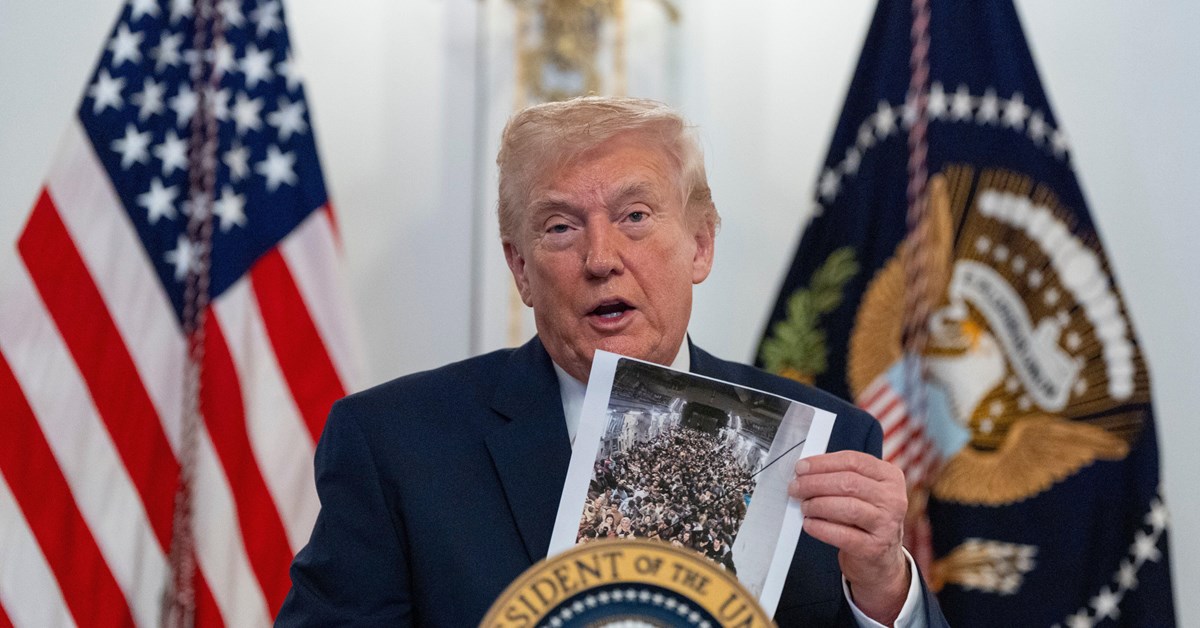
PRESIDENT TRUMP announced on the social-media platform Truth Social last week that he would “permanently pause migration from all third world countries”. It was a nasty, divisive message: an attack on his political opponents, and a rant against the “political correctness” of other nations who have, as he sees it, let themselves be torn apart by mass migration.
It was particularly hard to take at Thanksgiving, when Americans remember their own deliverance from war-torn Europe, and the Providence that, they believe, guided their destiny. It was also a reminder, if any were needed, that mass migration is one of the most serious issues of our time.
Recognising this is not new. In 1973, the French novelist Jean Raspail produced The Camp of the Saints, a fearful prophecy of the destruction of the West by migrants seeking a better life. The title alludes to Revelation 20.9, in which Satan’s followers surround Jerusalem, only to be destroyed by fire from heaven. The novel has been revived in recent years, and may have contributed to anti-immigration rhetoric both in Europe and the United States.
In 1990, as a contribution to One World Week, the BBC screened a film drama, The March, written by a former colleague of mine, William Nicholson. It tells the story of the march of thousands of African migrants from Sudan on a 3000-mile exodus to Europe, led by a charismatic figure whose challenge to Europe was simply “We are poor because you are rich.” The film, as I remember it, was nuanced and challenging, and its conclusion was ambiguous — neither racist nor “woke”.
It is traditional in Advent to be reminded of apocalyptic themes, and to recall that Christianity emerged as the faith of the Roman world during an earlier period of mass migration, from roughly AD 300-600. Thanks to the Emperor Constantine’s support for the Christian faith, and the missionary efforts of those who reached out to the warlike migrants from the North, the Roman Empire was not destroyed so much as transformed, in ways that were foundational for modern Europe.
The challenge for us is to prepare ourselves and the next generation for turbulent times. Western civilisation is precious, but it has never has been static. The danger is that, without the caritas of our Christian roots, Western nations can descend into the kind of vicious rhetoric that President Trump displayed at Thanksgiving, and which we see with those who flaunt the St George’s Cross as a weapon.
At the same time, we need to be much more realistic about the reasons for mass migration, and to be ready to play a generous but wary part in responding to people clamouring to come to our shores. We are in a time of global transformation, which will bring pain that we are not at all prepared for, but perhaps also promise that we cannot yet see.