Britain could face a major oil and gas supply shortfall within months if the Middle East conflict persists, industry experts have warned.
Ministers may be forced to introduce “rationing” measures, according to sector figures – while the Government can activate contingency powers to restrict the amount of fuel available to Britons at petrol stations.
The UK uses around 1.4 million barrels of oil every day, with domestic North Sea production covering roughly half that amount.
But the ongoing war has disrupted approximately a fifth of global oil and gas supplies.
Iran’s Strait of Hormuz remains largely shut, creating worldwide shortages that will inevitably affect Britain.
Shipping analysts at Lloyd’s List estimate that even with military escorts, flows through the strait would return to just eight to 10 per cent of their pre-crisis levels.
Nick Butler, a former head of strategy at BP, warned the situation would become “serious” unless oil and gas resumed flowing through the waterway within two to three weeks.
“At the moment, the Strait of Hormuz is almost completely closed and therefore we’re losing something like 20 million barrels a day,” he told Times Radio.
“That’s a fifth of global demand. If that goes on there’s going to be a real shortage of supply across the world and that includes the UK.”

The Government can activate contingency powers to restrict the amount of fuel available to Britons at petrol stations
|
GETTY
Mr Butler said the Government would need to safeguard food supplies, hospitals, schools and transport networks.
“What that means… that is effectively rationing,” he added.
Without preparation, continued disruption for three to four weeks could even trigger panic buying, he added.
Professor Paul de Leeuw, director of the Energy Transition Institute at Aberdeen’s Robert Gordon University, noted that most of Britain’s imported oil arrives from the United States and Norway.
However, he warned that their tankers could be redirected to nations willing to pay higher prices, leaving the UK exposed.
“The Government will need to be thinking about a package of measures to conserve supply similar to that imposed by Germany in the wake of Russia’s invasion of Ukraine,” he said.
So far, Labour has confirmed a six-point £53million cost of living support package for households reliant on heating oil.
CRISIS IN THE MIDDLE EAST – READ MORE:

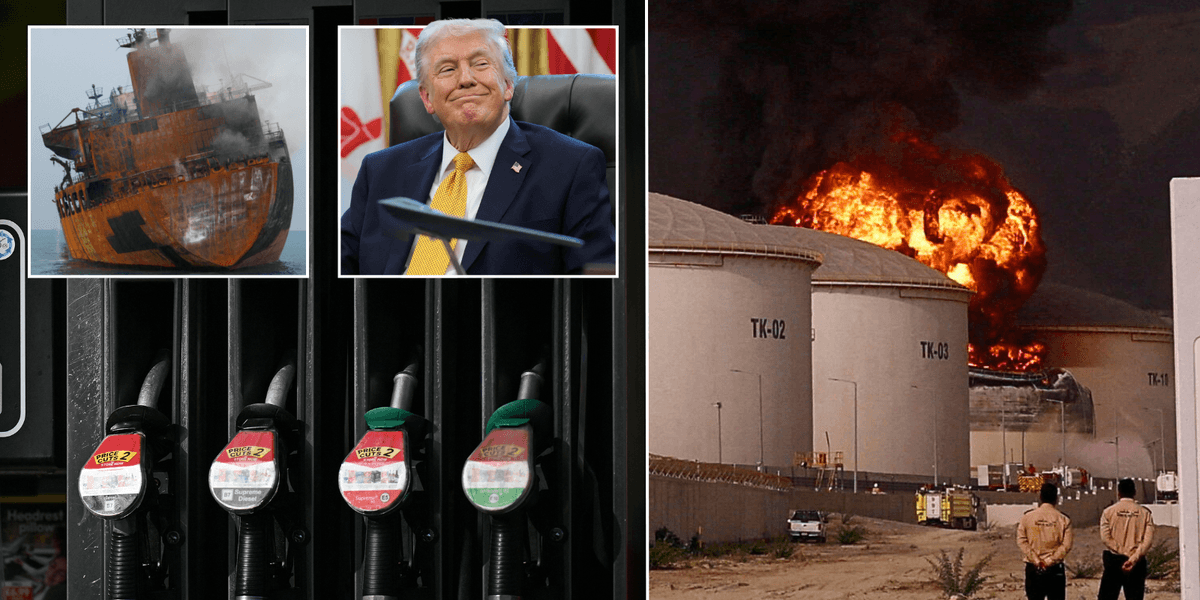
PICTURED: Security guards watch on as an oil facility burns in the UAE after an Iranian strike. The UK uses around 1.4 million barrels of oil every day
|
REUTERS

PICTURED: A tanker carrying Iraqi oil lists in the water after catching fire off the coast of Iraq
|
REUTERS
Prof de Leeuw added: “We are not going to run out of oil, but we could have a period of time when we need to prioritise supply to protect and safeguard essential services and vulnerable communities.”
He also voiced concerns over Britain’s crippled refining capacity – with just four oil refineries working today compared to 17 in the 1970s.
Several nations dependent on Gulf energy supplies have already begun rationing, with Bangladesh restricting petrol and diesel sales and India prioritising household gas over industrial users.
The British Government’s powers include the ability to limit fuel purchases at petrol stations and restrict their operating hours.
Authorities can also order distributors to prioritise deliveries to emergency services and public transport.

Britain’s North Sea production accounts for roughly 700,000 barrels of oil per day
|
GETTYMotorists have already begun filling up ahead of expected price rises, though motoring groups maintain this is a price, not a supply, crisis.
As well as feeling the crunch at the petrol pump, Britons could soon see the knock-on effects of a global oil crisis.
Wholesale fuel costs have climbed 32 per cent since late February, raising concerns about supermarket prices given how 80 per cent of UK goods travel by road.
Jet fuel prices have nearly doubled since early March, making airfare increases – if flights are still running – inevitable.
And medicines could also face supply chaos, with paracetamol and ibuprofen among the drugs with petroleum as a key ingredient.

Donald Trump’s push to assemble a ‘coalition’ to escort tankers through the Strait of Hormuz could be in peril
|
REUTERS
But as it stands, the Strait will remain shut to Britain.
“It is only closed to our enemies, to those who carried out unjust aggression against our country and to their allies,” Iran’s Foreign Minister said.
Meanwhile, Donald Trump’s push to assemble a “coalition” to escort tankers through the waterway could be in peril.
A source told Axios the White House wants the UK, France, Germany, Italy, Australia, Canada, the Gulf states and Jordan to be part of the group.
Germany, Italy and Japan have already said no to sending their vessels – while France’s Emmanuel Macron gave “a no” but not a “final no”.
Britain has drafted a plan for how a so-called “Hormuz coalition” could be built, and has shared it with the US and a number of other countries – though not all of those in the US-backed group.
On Monday, Sir Keir Starmer confirmed there were “discussions going on in relation to a viable plan”.