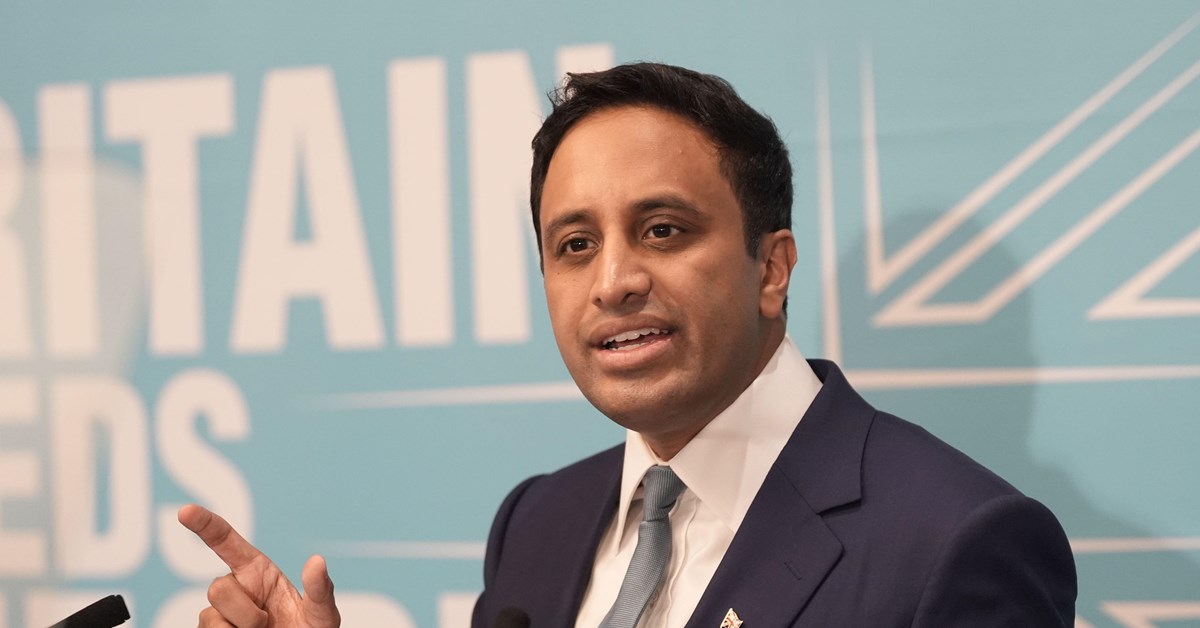
THE TIMES carried a really excellent fact-check and demolition job by its religious-affairs correspondent, Kaya Burgess, on Reform UK’s proposal to help save Britain’s “Christian heritage”. The proposal had been outlined by the party’s home-affairs spokesman, Zia Yusuf, in an interview with the paper’s Home Affairs Editor, Matt Dathan, the previous day. The party proposed to save the country’s “Christian heritage” by listing all church buildings, so that they could not be turned into mosques. This is the kind of proposal that could be made only by someone with no knowledge of English Christianity; and, sure enough, the man who put it forward is a practising Muslim.
The evidence that churches were being converted to mosques was — wait for it — a Wikipedia page, which The Times did not link to, but which apparently listed 41. My own fossickings through Wikipedia turned up a partial listing of mosques in England which had nine mentions of “church” and five of “chapel” in it. I have no idea where the other 26 are to be found. Even 41, as Burgess pointed out, would amount to 0.09 per cent of the churches that have closed in England since the 1960s.
It is also 41 times the number of former C of E churches that have become mosques. There is one church in Peckham which was shut in 1965 and became a mosque very much later. Otherwise “It can’t happen,” in the words of someone at Church House. Restrictive covenants applied by the Church Commissioners mean that redundant churches can never become sites for worship by other religions.
Of course, this applies only to the Church of England. As Burgess put it, “The Wikipedia list of mosques in former church buildings pointed to by Reform shows that they mostly belonged to Methodist, United Reformed, Seventh -Day Adventist and Plymouth Brethren denominations.”
This is a story, in part, about the imaginary establishment of the Church of England. It is supposed to contain all visible English Christianity. I think all denominations are about the same thing in the popular imagination: all parts of “the Church”. The collapse of organised Nonconformity has been so complete that not even its absence is visible today. All those disused Dissenting chapels are now seen as disused “churches” in the popular imagination, and so something else for which the Archbishop of Canterbury can be blamed.
Disorganised Protestantism, in the form of Charismatic or Evangelical churches, is also hidden from the secular imagination. Where I live, one of the more vigorous churches meets in a converted garage, but I am reasonably certain that Reform is not planning to list that, or any of the other repurposed industrial buildings that function as churches today. What the story teaches us is not that Church Times readers know that the Reform plan was crazy, unwelcome, and bound to make Christianity even less attractive, but that Times readers needed to be told this, and that the journalist who interviewed Mr Yusuf did not pull him up on it at once.
What remains is a sense that Christianity was once an integral part of the England that has disappeared, but this sense is strongest in people who would never themselves go to church except on social occasions. George Orwell, who came up with the image of old maids cycling to communion as an integral part of Englishness, also wrote, of Evelyn Waugh, that “One cannot be really a Catholic & grown-up.”
The old maids had a comeback under John Major, when he was trying to restore a lost decency to public life. They haunt the imagination of Reform, whose core voters are the self-identified Anglicans who never go to church and voted in great numbers to leave the EU. Listing a building preserves it from change, and so it is a magnificent symbol for all the people who really want their country listed, and the furniture and fittings made inviolable.
I did try to get some kind of a statement out of Reform about who, if anyone, had been consulted about the plan — there are a couple of high-profile practising Christians in the party who must have known that it was nonsense — but, of course, no one got back to me.
Although the policies of Danny Kruger, the MP who is leading preparations for a Reform government, are politely described as socially conservative, they are, in fact, socially reactionary. For the State once more to regulate the sexual marketplace, as he told the magazine The House he wanted, is a wildly unpopular belief — except, of course, among the immigrant communities whom the party wants to expunge. The contest between Nigel Farage and Zack Polanski will be an even more disastrous and depressing version of the choice that we faced between Boris Johnson and Jeremy Corbyn.