“THAT wasn’t a walk,” my father exclaims. “It was a quest, a spiritual journey. . .” We are flushed with adrenaline, having completed a route in Mallorca from which, every year, walkers are rescued, and which the president of the local mountaineering foundation describes as “not even hiking: it’s descending a ravine”.
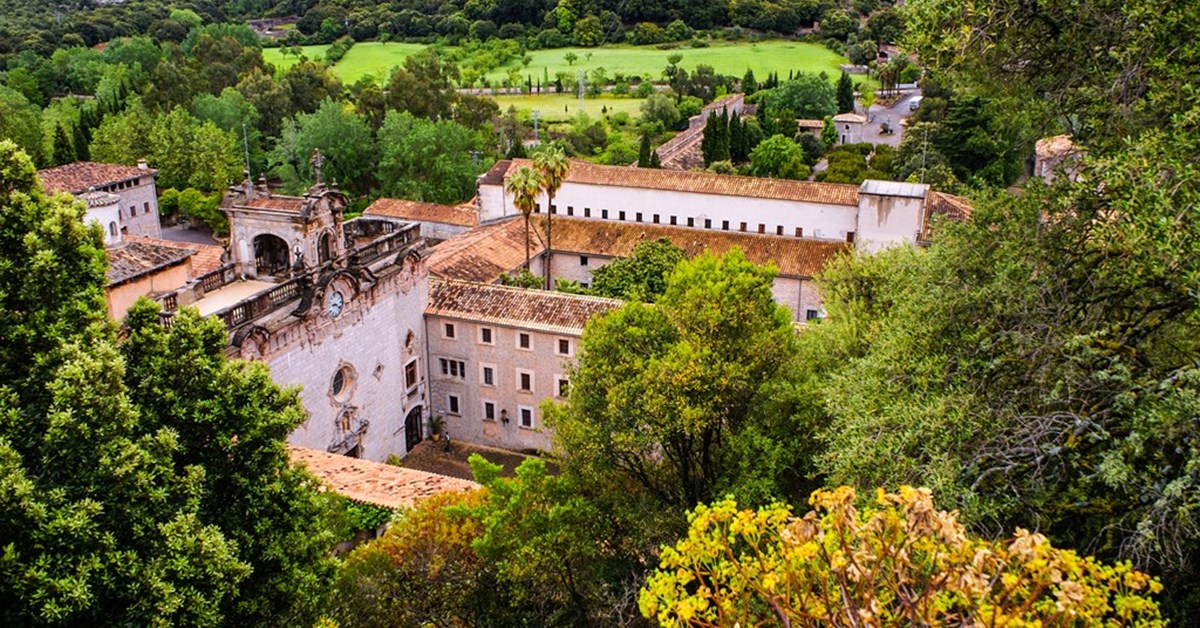
We recount our adventure in our apartment in Santuari de Lluc, a monastery in the folds of the Serra de Tramuntana mountain range, on the north-west coast of Mallorca. The monastery traces its roots to the 13th century, when, legend has it, a statue of the Virgin Mary was discovered by a shepherd boy, and taken to a church in Escorca, a village near by. But the statue kept reappearing in the place where it had been found, and, after the third miraculous translocation, a shrine was built to house it. Over time, this evolved into the monastery that stands today as the spiritual heart of Mallorca.
Despite its remote location, Santuari de Lluc has never been home to a sequestered monastic order, but has always been a more outward-looking religious community. Run by the diocese of Mallorca, it functions as a place of worship and a school, the choristers (known as blauets after their distinctive blue robes) sing at a short service after the daily mass.
 Francis MartinSantuari de la Mare de Déu del Puig
Throughout the summer, busloads of tourists visit daily (fanning themselves as they tour the grounds) and say a prayer at the foot of the diminutive statue of the Virgin of Lluc. Come nightfall, however, the monastery retreats into tranquillity, populated only by those staying there. It includes appropriately austere (but perfectly comfortable) rooms, as well as self-catered apartments.
Like us, most of the guests are here to walk. Lluc is positioned at the epicentre of Mallorca’s most famous long-distance routes.
The Dry Stone Route (Ruta de Pedra en Sec) is an 87-mile route of restored ancient paths with enough places to stay en route that it can be walked from start to finish. But it can also be traversed piecemeal, using Lluc as a base.
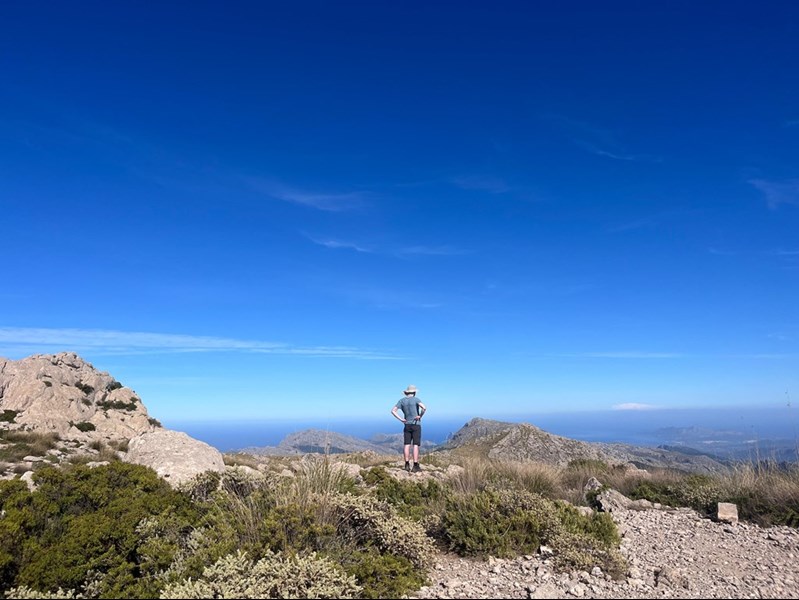
Also known by the unlovely designation GR221, the Dry Stone Route is well signposted and not particularly hazardous, though it’s best not to be overconfident: at one point, a goat, that byword for surefootedness, scrambles across the path in front of me and stumbles, ending up on its belly before trotting off somewhat sheepishly (which, for a goat, is surely the worst of insults).
 Ashten HarberThe Dry Stone Route, or GR221
Most people walk the GR221 west to east, and the 12-mile leg from Lluc to Pollença, a quaint town near the coast, is easier if you stick to this convention: a climb towards the start, before a long descent through almond, olive, and carob groves. As we walk it in the afternoon sun, the stones underfoot turn honey-coloured, and the lingering heat of autumn draws the musky fragrance from the heather blossom.
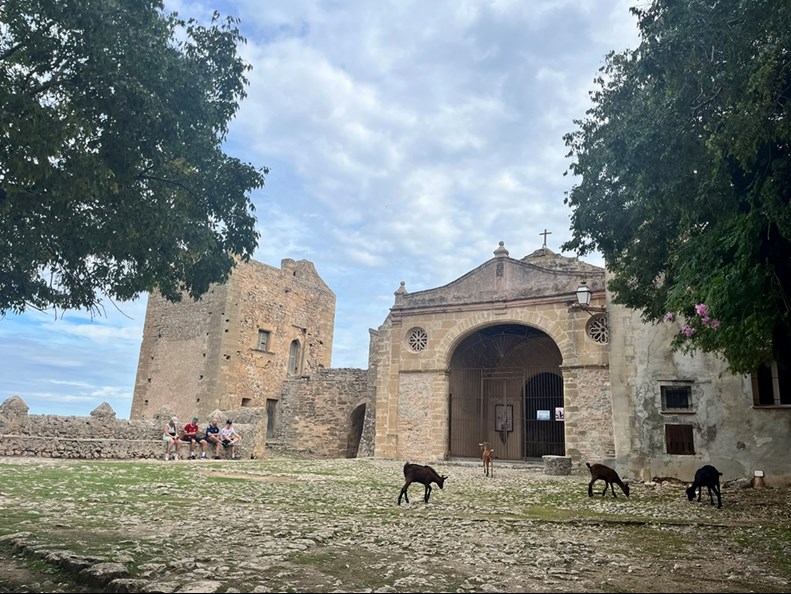
IN POLLENÇA, we visit two elevated shrines. We find the first, known as Calvari, at the top of a straight set of stairs that rise majestically from a square in the town centre. The second, Santuari de la Mare de Déu del Puig, is an hour’s walk from the same spot, most of it uphill. It was home to various orders of monks and nuns, and a pilgrim’s hostel, in the past. The gates of the church are now padlocked and the refugi is shuttered. The view from the top of the puig (peak) is divine: the mountains are as jagged as the spikes on a dragon’s spine, framing the glinting scales of the Mediterranean. It is so mesmerising that you might not even notice the goats stealing your picnic.
If you time it right, you can catch the bus from Pollença back to Lluc in time for dinner, though be warned: the buses serving the mountains are infrequent. A set menu in Santuari de Lluc’s dining hall (whose high ceilings, marble columns, and white tablecloths have little in common with a spartan refectory) is cheap at €18, though the quality is variable: my sopa de pescado tastes more of vinegar than fish. An alternative restaurant just outside the monastery gates serves up regional specialities such as goat and tumbet, a vegetable stew.
On another day, we take the bus westwards a couple of stops, and walk back to Lluc along the GR221, arriving back exhausted but enlivened. The terrain along the route changes as you walk: from densely canopied holm oak-forest to exposed scree, in a landscape punctuated with dry-rock features from Mallorca’s pre-tourism economy, including lime kilns, snow houses, and charcoal-burning platforms.
And then, the big one: a walk down the ravine known as the Torrent de Pareis. This isn’t part of the GR221, but begins from beside the old church in Escorca, to which the statue of the Virgin of Lluc was initially taken. We scramble over, between, and occasionally through the boulders on the canyon floor, knowing that we can’t get back up the way we came, but at times unsure that we’ll be able to continue.
It’s less than ten kilometres from Escorca to the sea, but, by the time we arrive in the bay of Sa Calobra, it feels like we’ve shed an old skin, and not just because of the scrapes on our knees.
Visit the area on the first Saturday in August, and you can undertake a uniquely challenging pilgrimage: a 50k night march along the road from Palma to Lluc. Known as the Des Güell a Lluc a Peu, it started in 1974 when a group of friends set out to pay homage to the Virgin. Over the years, the pilgrimage has grown into an important date in Mallorca’s cultural calendar, and about 10,000 locals undertake the trek every summer.
WE PASS our final day in Lluc in the monastery grounds, starting with the short, meditative walk that leads uphill from just outside the main courtyard. A winding path leads upwards to a large cross, with views across the neighbouring valley. The path is stationed with huge stone slabs carrying bronze bas-reliefs of scenes from the lives of Mary and Jesus, providing pausing spots for prayer and contemplation.
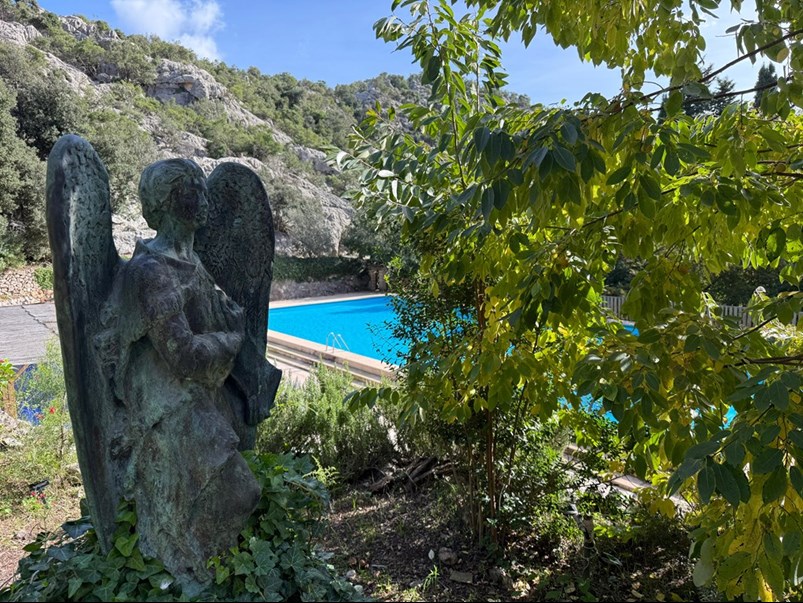 Ashten HarberA glimpse of the pool at Santuari de Lluc
The monastery’s museum contains some interesting art and archaeological finds from the region, along with a display of fantastically kitsch crib scenes — a Mallorcan tradition. During the summer guests can swim in the pool, which itself is overlooked by the winding paths of a mountainside botanical garden, created in the 1950s to invite relaxation and reflection. It is charmingly homespun, with idiosyncratic sculptures and hand-painted signs encouraging silence and asking you not to pick the plants.
At the daily mass, I notice someone else who seems, like me, to be stumbling through the Spanish liturgy. She turns out to be Hungarian, and explains that she is on holiday in Mallorca, although she has had plenty of experience of pilgrimage. We discuss the difference between a tourist and a pilgrim, and agree that it’s hard to draw a hard-and-fast line: today, for instance, she arrived not knowing that there would be a service, but says that attending has affected her, spiritually.
Pilgrimage might be good for the mind and the spirit, “but it’s not always good for the body,” she laughs. It reminds me of our experience in the ravine: battered, bruised, but finding in the journey transformation that we hadn’t expected when we set out.
Travel details
A RANGE of low-cost airlines operate flights from the UK to Palma de Mallorca, but opt for an early flight to get from the airport to the Santuari de Lluc (lluc.net/en) on the same day: it takes a train and a bus, or two buses, and can involve waiting for an hour and a half in Pollença’s old town. Alternatively, hire a car at the airport and drive to Lluc (approximately one hour, including snaking mountain roads).
For those wishing to avoid flying, trains and long-distance buses will get you to Barcelona. From there, you can catch a ferry to Mallorca with Direct Ferries (directferries.com).
TRAVEL AND RETREATS is edited by Christine Miles. Tours and holidays advertised are not guaranteed or underwritten by the Church Times or Hymns A&M. Readers should check for ATOL/ABTA guarantees and take out insurance. Details are correct at the time of publication. See also www.gov.uk/foreign-travel-advice