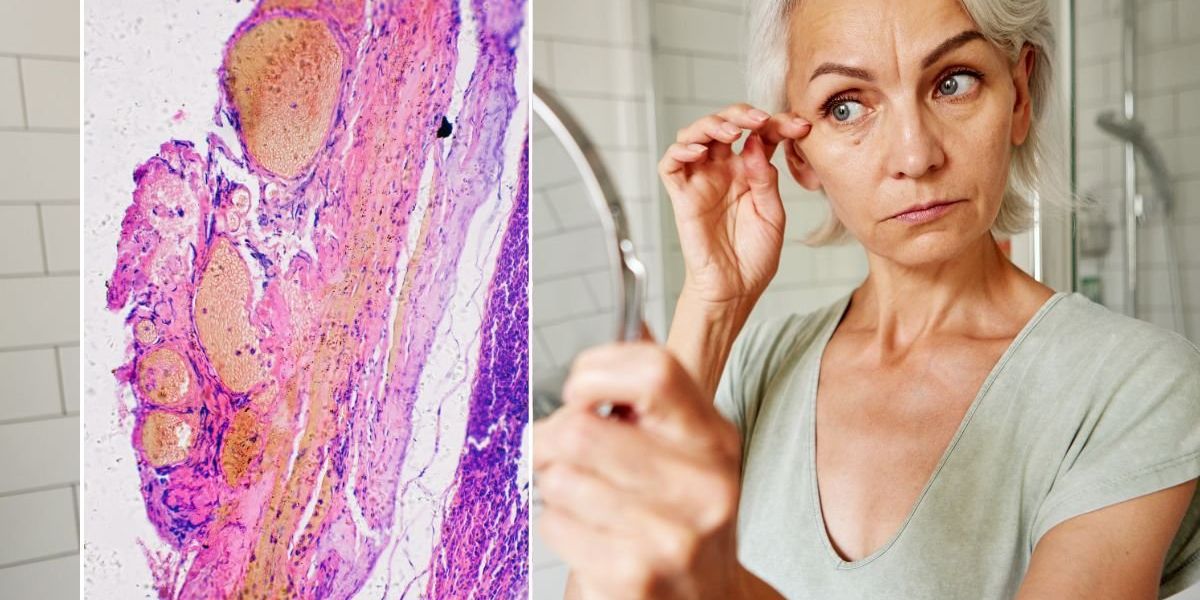
Silver strands appearing in your hair could be a sign your body is actively fighting off cancer, new research from Japanese scientists suggests.
Scientists at the University of Tokyo found that a decline in melanocyte stem cells – the cells responsible for giving hair its colour – may help protect against melanoma, the UK’s fifth most common cancer.
Scientists exposed melanocyte stem cells in mice to various forms of DNA damage, including powerful cancer-causing chemicals and UV radiation. They discovered that these cells essentially face a fork in the road when their DNA gets damaged.
They either slow down and stop dividing altogether, which leads to grey hair, or they go the opposite direction and start replicating out of control, forming tumours.

‘While grey hair develops, the risk of melanoma simultaneously decreases’
|
GETTY
So it seems the greying process might actually be the body’s way of putting the brakes on cells that could otherwise become cancerous.
The researchers were careful to point out that the connection is certainly intriguing, but the findings don’t prove that grey hair actually prevents melanoma.
Professor Yasuaki Mohri, an ageing expert at the University of Tokyo and study co-author, said: “While grey hair develops, the risk of melanoma simultaneously decreases. Our study shows that the depletion of melanocyte stem cells functions as a protective mechanism against melanoma.”
His colleague Professor Emi Nishimura added: “[This study] reframes hair greying and melanoma not as unrelated events, but as divergent outcomes of stem cell stress responses.”
Melanoma remains the deadliest form of skin cancer, responsible for four out of five skin cancer deaths despite making up just one per cent of cases.

The findings could open new avenues for understanding cancer prevention
|
GETTY
Around 15,000 Britons receive a diagnosis each year, with rates expected to jump by a fifth over the next two years.
Fortunately, treatment for melanoma has come on leaps and bounds, and survival rates have soared from under 50 per cent to more than 90 per cent in the past decade.
The Tokyo team now plans to test their theory on human hair follicles, which could open up exciting new avenues for understanding cancer prevention.