(LifeSiteNews) — The Bishops’ Conference of Scotland (BCOS) published a message on Tuesday reflecting on and expressing their concerns over the country’s radical abortion buffer zone laws that have resulted in the arrest of pro-life activists silently praying near abortuaries.
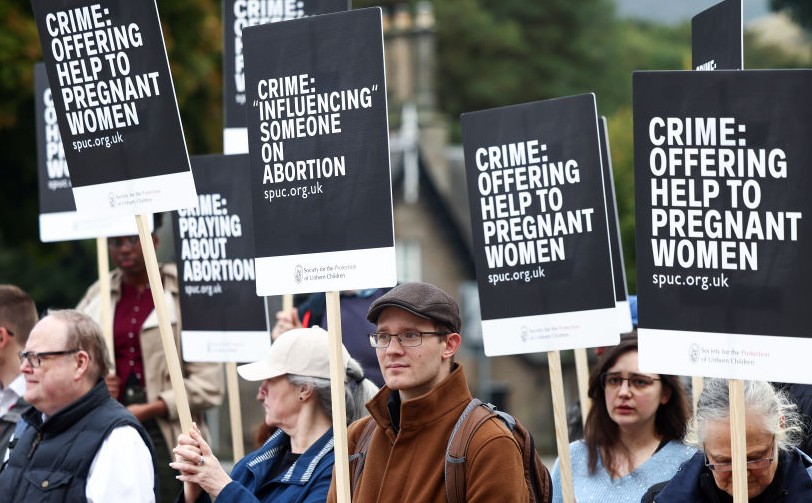
In the January 6 statement, the bishops lamented that Scotland’s draconian “buffer zone” laws have punished pro-lifers for peacefully praying or holding signs outside abortion centers, and could punish citizens praying within their own homes. In 2024, the Scottish legislature passed a law barring the harassment, intimidation, and “influencing” of anyone seeking to kill their babies within 200-meter-wide “exclusion zones” or “buffer zones” surrounding all the country’s abortuaries.
“It is therefore unsettling that this season saw the first person in Scotland charged under the new so-called ‘buffer zone’ law in Scotland; a law the Church believes curtails Scotland’s commitment to freedom of expression and conscience, and restricts critical voices from democratic debate in the public square,” the bishops wrote.
Here, the BCOS appears to be referring to the case of Rose Docherty, a 75-year-old pro-life grandmother who was arrested for silently holding a sign that read “Coercion is a crime, here to talk, only if you want,” within the “buffer zone” of Queen Elizabeth University Hospital’s abortuary last fall. Docherty was held in custody for several hours, during which she was refused a chair to sit on in her cell despite making it known that she had a double hip replacement.
READ: Scottish grandmother arrested for offering to chat with abortion-minded women in ‘buffer zone’
“I can’t believe I am here today. I simply stood, in love and compassion, offering consensual conversation to anyone who wanted to engage,” Docherty said after a court hearing just days before Christmas.
“Nobody should be criminalized just for offering a chat,” she declared. “Conversation is not a crime on the streets of Glasgow.”
The bishops noted that while the Church does not condone the harassment or intimidation of those planning to abort their unborn child, this “undemocratic” law was really meant to deny Scottish pro-lifers their basic freedoms.
“When parliaments introduce criminal offences where existing law is already sufficient, questions should be raised and alarm bells ring,” they said. “We oppose this law because it is disproportionate and undemocratic. It represents state overreach and curtails basic freedoms. The Church would similarly oppose legislation mandating buffer zones outside nuclear weapons facilities or refugee detention centres. This should concern every Scottish citizen, regardless of their views on abortion.”
“As the Parliamentary Officer for the Catholic Church in Scotland pointed out, women experiencing crisis pregnancies may be ‘denied the opportunity to freely speak to people and organisations who may be able to help them,’” they added. “A law supposedly designed to protect choice risks doing the opposite – eliminating one side of a conversation and one set of choices altogether.”
The bishops further stressed their concern that the law extends to private homes within the “buffer zones.”
“The Act extends to private homes within designated zones. A pro-life poster displayed in a window, a conversation overheard, a prayer said by a window; all could, in principle, fall within the scope of criminal sanction,” they said.
READ: Praying at home could be illegal under pro-abortion ‘buffer zone’ law, Scottish lawmaker admits
“That sends a chill down the spine of anyone who cares about civil liberties,” they added. “Criminal law that depends on the perception of a passer-by is certainly not the hallmark of a free Scottish society.”
The BCOS concluded its message by emphasizing that a society confident in its values does not criminalize opposing voices.
“It does not criminalise silent prayer,” they wrote. “It does not ask its police or judges to peer into the minds of its citizens. Scotland’s buffer zones law represents a profound shift in the relationship between the State and the individual – one that restricts free speech, free expression and freedom of religion in ways that should concern us all.”
“As we look to the child in the manger this Christmas and Epiphany, we are reminded that babies do not have a voice of their own,” they added. “It is a shame that the State has now also curtailed the voices of ordinary citizens who advocate for them within its borders.”
Scotland’s “buffer zone” law has been heavily criticized by pro-life activists and conservative politicians across the globe. Perhaps most notably, U.S. Vice President JD Vance blasted the law’s ban on private prayer in the homes of citizens living in these zones during his speech at the Munich Security Conference last year.
“(J)ust a few months ago, the Scottish government began distributing letters to citizens whose houses lay within so-called ‘safe access’ zones, warning them that even private prayer within their own homes may amount to breaking the law,” the VP said. “Naturally, the government urged readers to report any fellow citizens suspected guilty of thoughtcrime in Britain and across Europe.”
To read the bishops’ full statement, click HERE.