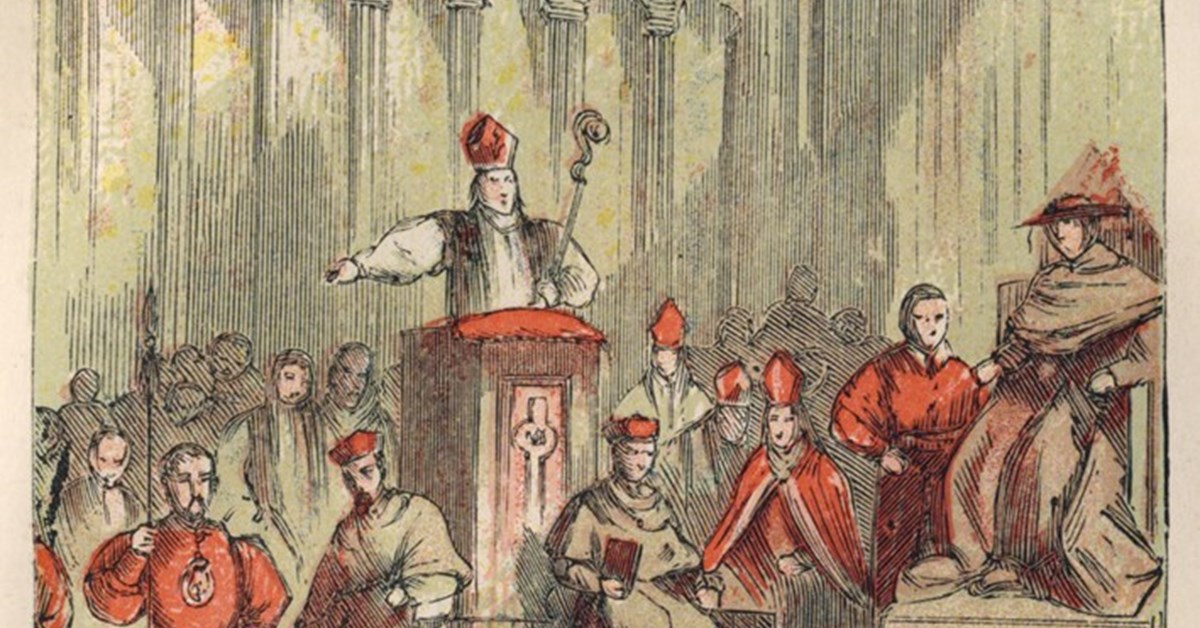
IT WAS not until 1540, almost 15 years after a notorious sermon provoked accusations of heresy, that Dr Robert Barnes was burned at Smithfield. But — as a congregation gathered at St Edward King and Martyr, Cambridge, heard on Sunday — it was a fate foreshadowed in this sermon. “We make nowadays many martyrs,” he told his congregation. “I trust we shall have many more.”
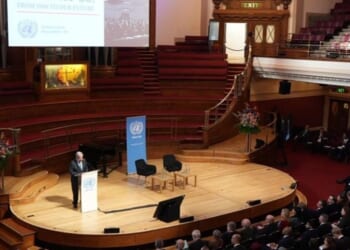
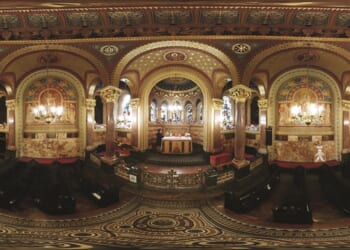
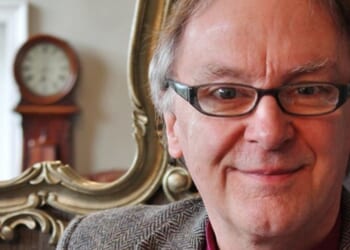
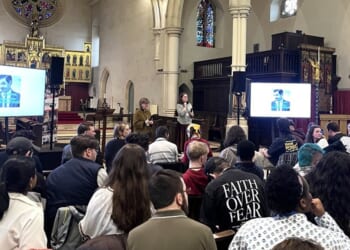
Sunday’s congregation had gathered to mark the 500th anniversary of Dr Barnes’s sermon, delivered at St Edward’s on Christmas Eve 1525 and billed in publicity this month as one that “helped spark the English Reformation”. Its real significance was “not so much what it reveals about that one febrile moment, but what it set in motion”, Professor Ryrie, professor of the history of Christianity at Durham University, observed in a lecture prepared for the occasion.
In the presence of two Church of England bishops, it fell to the Dean of Trinity Hall, the Revd Dr Stephen Plant, to read aloud some of Dr Barnes’ broadside against the episcopacy of his time: three of the 25 paragraphs of his recollection of what he had written, compiled as part of a published defence written six years later. The sermon itself does not survive.
The bishops were, Dr Barnes had said, the “false masters that Peter speaketh of. These be fountains without water, for they give no good doctrine to the people. Now they sell us; they sell the people; they sell holy orders. They sell church hallowing. There is no better merchandise in Cheapside.”
Having ascended the famous pulpit — “almost certainly” that from which Dr Barnes delivered his denunciation — Professor Ryrie observed that there was “no doubt that Dr Barnes was trying to start something, though I also think there’s no doubt that he started more than he intended.”
In 1525, Dr Barnes was 30, an Augustinian friar, and a doctor of theology. That Christmas Eve, he had accepted an invitation to preach at St Edward’s, Hugh Latimer’s church, at the request of Thomas Bilney. All three were, Professor Ryrie noted, set to become “giants of the English Reformation” — and martyrs.
The principle target of Dr Barnes’s sermon was Cardinal Wolsey, before whom he would shortly appear for interrogation. The Cardinal was, in Dr Barnes’s eyes, “only one representative of an entirely corrupt episcopal class”, Professor Ryrie said.
Anticipating that there might be “malicious listeners” among his audience, Dr Barnes had compared them to dogs, “who if they so much as hear the voice of someone who doesn’t belong to their household will set about barking furiously”.
In this case, Professor Ryrie suggested, hearing a true preacher’s voice would prompt barks of “heretic” and “to the fire”.
Yet, he also suggested that the persecution that followed was “almost certainly harder and faster than [Dr Barnes] expected”. Dr Barnes was summoned for an interview with the Vice Chancellor of the University, where he was told that some of his words were seditious, some slanderous, and some heretical. A “good case could be made”, Professor Ryrie said, that this last charge was unmerited. As Dr Barnes argued in his defence, “criticising the wealth, the hypocrisy, the corruption of senior clergymen: this has been a mainstay of Christian preaching for centuries.”
One of the “most potentially explosive” aspects of his sermon was his attack on the use of secular courts: “A Christian man may not contend in judgement with his brother for his private wealth.” There was, Professor Ryrie suggested, “a frisson of radicalism about that claim. It sounds positively sectarian . . . you can catch just a whiff of fanaticism.”
His sermon did not contain “the variant of heresy that would later be called Protestantism”, Professor Ryrie said. Absent were any of the major theological themes already being articulated by Martin Luther, such as the doctrine of justification by faith alone or sola scriptura. Yet, “if we widen the lens, we can see why this sermon in this place at this moment meant more than just its already inflammatory content. . . [and] set off a chain of events which none of the participants could have foreseen.”
Professor Ryrie went on to sketch the wider European context, including the impact of another “combative Augustinian friar and doctor of theology” who had used his university platform to “issue an unguarded denunciation of church corruption”. Dr Barnes had been preaching one year after the Peasants War in Germany, and four years after the burning of Martin Luther’s books at St Paul’s Cross.
During his remarks, Professor Ryrie defended the English bishops of this era, who were “by European standards . . . a remarkably impressive group of men. Scholars, theologians, skilled administrators, most of them men of relatively humble birth who had risen through the ranks on talent, none of them the obviously debauched corrupt aristocrats, simoniacs, who all too obviously filled the episcopate in France, Scotland, in much of Germany, not least in Italy.”
Dr Barnes was speaking, Professor Ryrie observed, as “a sort of spokesman for a restless, reformist mood” among a group of young scholars in Cambridge at the time. But, he argued — drawing on the work of Dr Colin Donnelly, associate professor of Reformation and early modern Christianities at Oxford University — the idea that this movement was Lutheran requires challenging.
“While later Protestant generations naturally wanted to claim these early English reformers for their own cause, that’s not quite how it looked at the time.” The Evangelical mood in 1520s Cambridge wasn’t so much Lutheran as “Erasmus’s ideas with the guardrails removed”.
It was this “restless” mood, rather than doctrines, that Professor Ryrie encouraged his audience to consider. “It’s not Lutheran heresy but it’s land that’s been cleared and ploughed. It will only take a few heretical seeds to land in it for them to be able to take root and discover that the climate suits them perfectly,” he said. Dr Barnes’s arrest served as an encouragement, not a deterrent, to this burgeoning movement.
After spending time in prison, Dr Barnes escaped to Germany, and by 1530 was in Wittenberg where he became friends with Martin Luther. Dr Barnes stood today, Professor Ryrie suggested, as “the emblem of how English evangelicalism transitioned from a nascent, nebulous mood of reformist idealism to serious life-on-the-line commitment to what was going to become Protestantism”.
By the time Dr Barnes returned to England in 1534, much had changed. The following year, Hugh Latimer was made a bishop, But at this point, the court was a “shifting minefield”. After a “ferocious sermon” in 1540, he was burned alive, “almost as an accidental side casualty of that summer’s murderous religious politics”.
It was, Professor Ryrie concluded, “in his death as well as in his life, that he can serve as an emblem of the English Reformation”.
Asked what Dr Barnes might preach today, in the same spirit of critiquing the clergy of the Church, Professor Ryrie professed being “wary”. He said: “The temptation is to start recruiting Barnes to my own prejudices.” But, he concluded, “I suspect his disdain for the process of pursuing one another in law . . . is one that he might feel still had some purchase in our own time.”