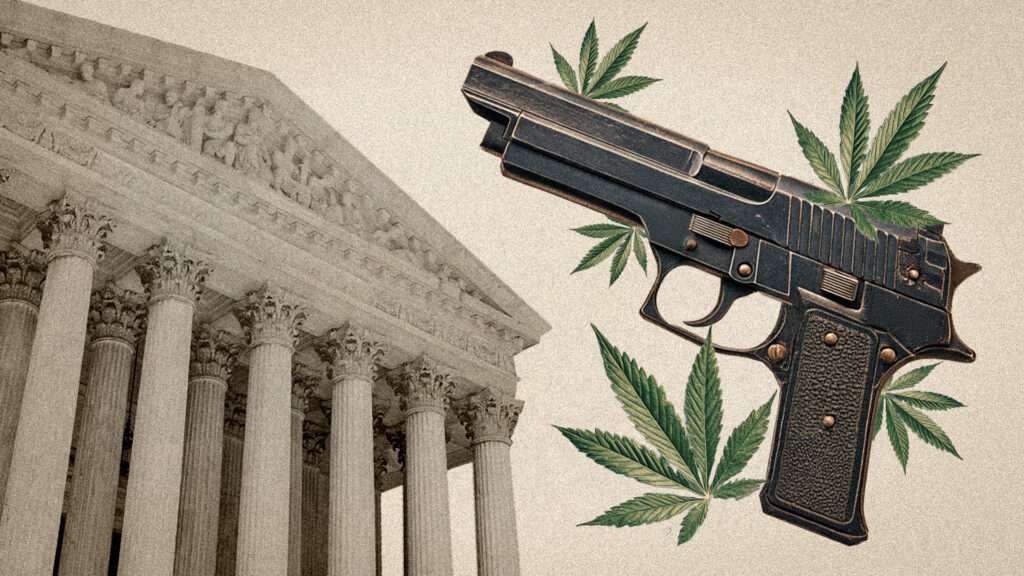
During oral argument in United States v. Hemani on Monday, Principal Deputy Solicitor General Sarah Harris urged the Supreme Court to reinstate a Texas marijuana user’s prosecution for illegal gun possession. Harris argued that 18 USC 922(g)(3), which makes it a felony for an “unlawful user” of “any controlled substance” to receive or possess a firearm, is analogous to the historical treatment of “habitual drunkards.”
That analogy is crucial under the Second Amendment test established by the Court’s 2022 ruling in New York State Rifle & Pistol Association v. Bruen, which requires the government to show that gun laws are “consistent with this Nation’s historical tradition of firearm regulation.” But several justices challenged the premise that the people covered by Section 922(g)(3) are comparable to “habitual drunkards,” who historically could be confined to workhouses as “vagrants” or civilly committed based on judicial determinations.
Justice Samuel Alito was overtly sympathetic to the government’s case, and Chief Justice John Roberts joined him in expressing concern about the practical implications of rejecting it. But the rest of the Court seemed skeptical, to varying degrees, of the Trump administration’s argument that Section 922(g)(3) meets the Bruen test as applied to defendants like Ali Hemani, who was charged with violating Section 922(g)(3) in 2023 after an FBI search of his home discovered a Glock 19 pistol, about two ounces of marijuana, and less than a gram of cocaine.
Hemani admitted that the gun was his and that he smoked marijuana a few times a week, which would have been enough to convict him. But the charge against him was dismissed based on United States v. Connelly, a 2024 decision in which the U.S. Court of Appeals for the 5th Circuit ruled that the Second Amendment bars such prosecutions when they are based on nothing beyond the elements specified by the statute.
Those elements do not require any showing that the defendant’s pattern of drug use disrupts his own life, let alone that it poses a threat to public order or public safety. But according to Harris, that does not matter as long as you accept the government’s claim that people who regularly consume cannabis, even in compliance with state law, are equivalent to people who would have been considered “habitual drunkards” at the Founding or during the 19th century.
Justice Neil Gorsuch was skeptical. “The American Temperance Society, back in the day, said eight shots of whiskey a day only made you an occasional drunkard,” he noted. “To be a habitual drunkard” during the Founding Era, he said, “you had to do double that.” He added that “John Adams took a tankard of hard cider with his breakfast every day,” while “James Madison reportedly drank a pint of whiskey every day.” Thomas Jefferson “said he wasn’t much of a user of alcohol,” since he “only had three or four glasses of wine a night.” Under the government’s theory, Gorsuch wondered, were those Founders “all habitual drunkards who would be properly disarmed”?
That question reinforced a point emphasized by Hemani’s attorney, Erin Murphy: “Habitual drunkards” were not merely people who drank regularly. They were an especially problematic subset of drinkers whose heavy consumption interfered with their ability to take care of themselves and their families. The “whole point” of the concept, Murphy said, “was to distinguish those who consumed alcohol frequently, but mostly in moderation, from those who so habitually consumed alcohol to the point of intoxication as to impair their ability to function even in whatever moments of sobriety they may have had.”
Justice Sonia Sotomayor amplified that point. “The danger of habitual alcohol users was not merely the fact that they were using an intoxicating substance,” she noted. “The way ‘habitual’ was defined was that the state of intoxication didn’t permit you to have a regular life. All the definitions [of] habitual alcoholics centered around not merely taking the drug, but the potential effect it had on you because you couldn’t control it and would continue to use it. You weren’t acting responsibly to your family. You were sleeping in the streets. You were doing other things that showed that it incapacitated you.”
All the record reflects about Hemani, Gorsuch noted, is that he used marijuana “about every other day.” If that is enough to make him similar to a “habitual drunkard,” the justice added, the same would surely be true of a Colorado resident who bought THC gummies from a state-licensed store and took one each night to help him sleep.
Harris had trouble explaining why such people fall into the same category as “habitual drunkards.” Justice Amy Coney Barrett amplified the challenge by noting that Section 922(g)(3) also applies to people who use drugs prescribed for their spouses. “Let’s assume that someone takes their spouse’s Ambien prescription,” Barrett said. “The spouse takes it too—lawfully, with a prescription. But you take it unlawfully because you break into your spouse’s Ambien jar.”
That example, Barrett said, “is important to me” because “it’s not the drug itself in this circumstance that’s causing the dangerousness.” Rather, “it’s the lawfulness,” which stems from the drug’s classification under the Controlled Substances Act (CSA). And as with marijuana, Barrett said, “I just don’t see anything in the scheme that actually reflects Congress’s judgment that this [drug] makes someone more dangerous.”
The CSA’s schedules hinge on “potential for abuse” and “accepted medical use.” On their face, the criteria say nothing about whether someone’s possession of a gun would endanger others. Harris suggested that scheduling decisions nevertheless may be influenced by the Drug Enforcement Administration’s concerns about threats to public safety. But the fact that a drug is classified as a “controlled substance” does not necessarily tell us anything about the danger posed by people who use it unlawfully, as the Ambien example illustrates.
In addition to Ambien (Schedule IV), Barrett mentioned Robitussin AC (Schedule V), Tylenol with codeine (Schedule III), testosterone (Schedule III), Xanax (Schedule IV), Adderall (Schedule II), and Ritalin (Schedule II). “None of those drugs strike me as drugs for which it is obvious that a risk of violence would ensue,” she said. “What if you’re a college student and you take your roommate’s Ritalin twice a week because you think it’s going to help you take exams?”
Harris argued that “it’s not just illegality.” But under Section 922(g)(3), it manifestly is. Illegality alone explains why someone who uses a sleep aid or stimulant prescribed for someone else loses his Second Amendment rights under that statute. It also explains why the law treats occasional or moderate cannabis consumers differently from occasional or moderate drinkers.
“Unlike alcohol, illegal drugs are illegal,” Harris told the justices. “They’re illegal because Congress deemed their use dangerous at any level.” But under Bruen, Justice Ketanji Brown Jackson noted, courts are not supposed to automatically accept such legislative judgments as a justification for depriving people of their Second Amendment rights. They are supposed to ask whether contemporary laws are supported by historical tradition.
“We don’t credit the judgments of the modern legislature about who is dangerous and who needs to be disarmed as a result,” Brown said. “The entire point, I thought, of the Bruen test was to say that the only thing the modern legislature gets to do is follow the judgments of the Founding Era legislature around who was dangerous and who gets to be disarmed.”
Even if you ignore that point, and even if it is true that scheduling decisions reflect judgments about the dangerousness of people who use a substance illegally, as Harris maintained they sometimes do, President Donald Trump’s decision to move marijuana from Schedule I to Schedule III undermines the government’s case. Schedule III drugs are said to have “a moderate to low potential for physical and psychological dependence,” and their “abuse potential” is rated lower than that of drugs in Schedule I or Schedule II.
“The government is considering rescheduling marijuana as Schedule III to facilitate potential medical applications,” Harris said. “But the government is not saying that it is not illegal anymore simply because states are not following federal law.” That argument reinforces the point that disarmament under Section 922(g)(3) depends on a drug’s status under the CSA—and nothing else.
Although 40 states have legalized marijuana for medical use, including two dozen that also allow recreational use, the drug is still federally prohibited. Even if every single state decided to treat marijuana like alcohol, millions of gun-owning cannabis consumers would still be subject to prosecution under Section 922(g)(3) as long as federal prohibition remained in place. But as soon as Congress decided to repeal the federal ban, the marijuana users whom the Trump administration insists are so dangerous that they cannot be trusted with guns would suddenly be in the same category as alcohol consumers.
The government has tried to obscure the illogic of treating all cannabis consumers as public menaces equivalent to “habitual drunkards” by claiming that Section 922(g)(3) applies only to “habitual drug users.” But that is not what the law says. In fact, the provision describes individuals who are “addicted to any controlled substance” as a distinct category of people who are not allowed to possess firearms. It does not define “addicted.” But under the CSA, the term “addict” includes “any individual who habitually uses any narcotic drug so as to endanger the public morals, health, safety, or welfare.”
Section 922(g)(3) “has two prongs,” Gorsuch noted. “One is you’re an unlawful user, and [the] second is you’re an addict, and you prosecuted Mr. Hemani only under the first prong…You’re asking us now to understand that prong to mean a habitual user. What’s left of the second prong? Do you render it superfluous given that an addict is defined by the statute as a habitual user?”
Justice Brett Kavanaugh expressed the same concern. “I don’t know how a habitual user is distinct from a habitual user who endangers the public morals,” he said.
Harris argued that Section 922(g)(3) does not incorporate the CSA’s definition of “addict.” The distinction between the two prongs, she said, is that an addict “has an uncontrollable compulsion to use whenever they get access to the substance,” while an “unlawful user,” even if read to mean “habitual user,” can “voluntarily cease the conduct.”
That proposition is dubious as a matter of psychology, since addicts demonstrably can moderate or cease their drug use. It is even more dubious as a matter of statutory interpretation, since “unlawful user,” on its face, refers to anyone who consumes a controlled substance without legal permission.
The law nevertheless does not say how recent or frequent such consumption must be for someone to qualify as an “unlawful user.” Federal courts have struggled with that question for decades, and Hemani’s lawyers argue that it makes the gun ban unconstitutionally vague as well as inconsistent with the Second Amendment. Section 922(g)(3) “can’t constitutionally be applied to anyone,” Murphy told the justices, “because the statute fails to provide fair notice of what makes someone an unlawful user of a controlled substance [who] can be stripped of their Second Amendment rights.”
If the Supreme Court agrees with the 5th Circuit that Section 922(g)(3) is unconstitutional as applied to Hemani, Alito and Roberts worried, it will make trials under that law more difficult. Prosecutors would have to prove not only that the defendant 1) possessed a gun and 2) used a drug illegally but also that he posed a threat to public safety by, for example, handling the gun while intoxicated. Harris warned that a decision in Hemani’s favor also would cast doubt on other categorical gun bans, such as the provisions that permanently disarm anyone who has been subjected to involuntary psychiatric treatment, even if he was never deemed a danger to others, and anyone who has been convicted of a crime punishable by more than a year of incarceration, even if he has no history of violence.
Both of those concerns strike me as arguments in Hemani’s favor. “I agree with you” that “legislatures can regulate to keep guns out of the hands of dangerous people,” Barrett told Harris. The question, she said, is whether Section 922(g)(3) actually fits that description. “What is the government’s evidence that using marijuana a couple times a week makes someone dangerous?” she asked Harris, who struggled to give a satisfying answer.
Barrett has criticized the federal ban on gun possession by people with nonviolent felony records, arguing that it does not fit the historical tradition of disarming “people who are dangerous.” If so, it is hard to see how that tradition can justify a law that categorically disarms recreational cannabis consumers, unauthorized Ambien users, and college students who take their roommates’ Ritalin to help them prepare for exams.