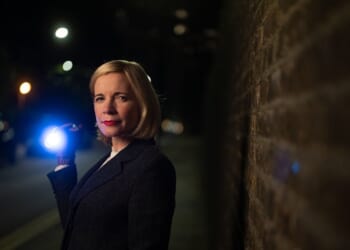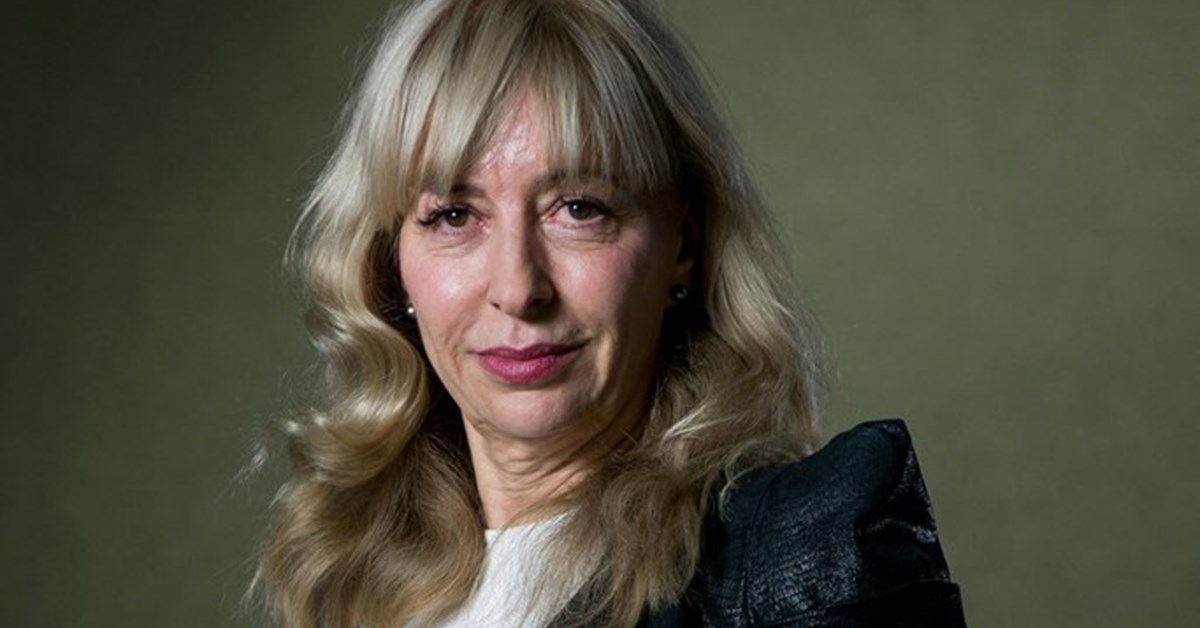
IT WAS a Sunday afternoon when my phone rang. “I’m going to be baptised in the Anglican Church next month,” the voice said, “and I wondered if you could be my godfather.” It took a while before I could react: this was Baroness Greenfield, leading neuroscientist, Oxford professor, author of bestselling scientific books, and sometime Director of the Royal Institution of Great Britain.
I had known her for 20 years, and we had often talked about religion. She was interested, but faith proved elusive — apparently until now. So, after attending her baptism in September 2024, and her confirmation in May 2025, I sat down with her to talk about her conversion.
“I could see that people with faith were deriving some kind of experience that I couldn’t even understand,” she said. “I was aware that this was something other people had but I didn’t, and it increasingly fascinated me and intrigued me. And then, there were certain milestones.”
The first story she recalled was from 2009, when our mutual friend John had become very ill, and we had decided to go to Lourdes to pray for his cure. Susan joined us for the trip, and we had a memorable weekend when we prayed at the famous grotto. She was not familiar with any of the prayers; so I lent her my mobile to read them, as she wanted to be fully involved in everything.
She remembered being “touched by love”, she said. “I’m now much more familiar with the four loves of C. S. Lewis: eros which is romantic love, storge which is love of family, philia which is love of friends. . . But the one I’d never experienced till then is agape, which is spiritual love. And I now realise that what I was experiencing at Lourdes was agape.”
Soon after, another friend arranged a few days’ stay at Ampleforth Abbey for her. “It was a very calming, wonderful time out, where you just left the real world — if it is the real world,” she recalled. “It was strangely refreshing, even though there was no TV, no phones, no anything. Everyone was very kind, and Fr Matthew, the monk designated to look after me, gave up a huge amount of time, just listening and accompanying me on long walks.”
LATER, she had a routine breast-cancer screening, and was called back. “I spent the weekend in pieces,” she remembered, and “made a bargain with God. I said, ‘Look, if it’s OK, if it’s a false alarm, I’ll go and say the Lord’s Prayer at the nearby church, where Shakespeare is said to have worshipped. I don’t know why I wanted to say the Lord’s Prayer, or why I wanted to go into that particular church.” It later emerged the call back was because of a technical error. “In the end, all was well, and I dutifully delivered my end of the bargain.”
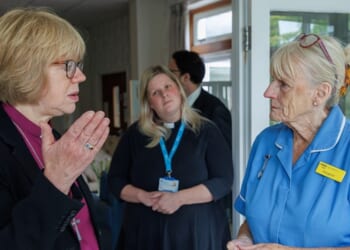
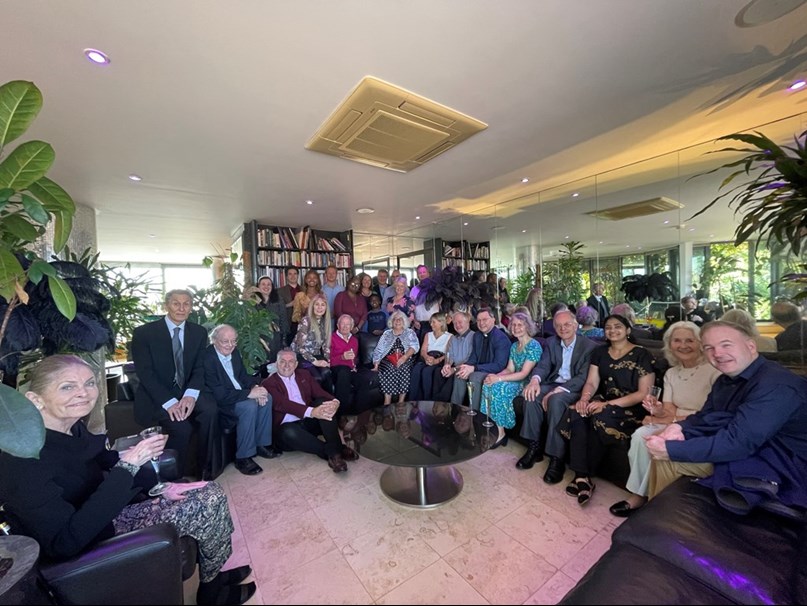 Susan Greenfield Baroness Susan Greenfield with friends after her baptism
That visit marked the beginning of something. “Later, I started to pop in to the same church, St Michael’s, Cornmarket, in Oxford, and just sit there quietly and say the Lord’s Prayer and then rush out again, frightened that someone would speak to me.” But, through her friend Carolyn, she met the Vicar, the Revd Anthony Buckley, who suggested that she attend a Sunday service.
“While we were waiting for the service to start, I suddenly felt a huge sense of being overpowered, just shivery and helpless,” she said. “Not in an unpleasant way, but completely weak, vulnerable, and receptive.” She recalled “a voice that wasn’t a voice saying, ‘You’re not alone, you don’t have to do this on your own.’ That was a very big moment. It has never happened again. But I get the impression that God was doing that just to nudge me along.”
From April 2024, Susan and Mr Buckley started “seeing each other for about an hour each week, and gradually our sessions became very special. He led me to rediscover C. S. Lewis.” She watched the film The Most Reluctant Convert: The untold story of C. S. Lewis, which she described as “really compelling viewing”.
“At one stage, at the end of one of our chats, Anthony said, ‘I’ll pray for you — or we could pray together.’ We did, and, instead of feeling self-conscious, it felt a very special moment. Later on, we were talking about baptism and he said, ‘I could baptise you now.’ I sort of laughed that off. But, as I was walking back, by the time I got home . . . I knew I wanted to get baptised.”
She borrows Lewis’s analysis when I ask her about Jesus: “No one denies Jesus existed. But, unlike everyone else, or the other prophets, he did go around saying he was the Son of God. So, either he was a total liar, or a charlatan, or it was true.
“What I like about Jesus is everything is inverted: the modest inherit the earth, turn the other cheek. He mixed with people who were sinners and not the Pharisees, he was betrayed by a kiss. The whole thing is not what you’d expect.”
Lourdes, Ampleforth. . . Has she ever considered becoming Roman Catholic? “The reason I became Anglican”, she explains, “is primarily due to going into St Michael’s and my experiences there.”
Would she like to share her newfound faith with others? “I think the most important issue is to love other people, but I wouldn’t want to impose my beliefs or faith or ideas. As Michael Faraday said, there’s nothing quite as frightening as somebody who knows they’re right. . . I wouldn’t dream of doing that.”
But, considering her very close friends, she added: “I think they are missing out, and that’s a shame, but I’m happy to tell them about my about my experiences. As always, people like to hear other people’s stories. I can only tell my story. What people do with that story, that’s their affair.”
AS A renowned scientist, she is often asked about the opposition of science and religion. “People use the standard argument that science can explain everything, and religion was used in the past to explain things. Well, what science can’t explain is agape for a start.”
She finds it liberating that we cannot know everything, that we must be open to what comes along. “Another great mystery in science is consciousness. No one will deny that consciousness exists, and yet, as a neuroscientist, I can say this with confidence: we have no idea how it happens or what it is. We can look at brainwaves — which are active or not active — we can look at correlates. But we don’t understand. It’s the most bizarre impossible mystery. And yet, at the same time, it’s the essence of you.”
She says that she is yet to work out how “consciousness and the soul are somehow related. If you believe in consciousness, that does entail belief, I would argue, in a soul. And, if you believe in the soul, the key element of the soul is that it’s immortal, because the mortal soul doesn’t really make sense. The soul is not material, therefore, it can’t die. And if you have an immortal soul, it’s very hard, if you get that far, to think there’s not some higher being of some sort. I’d like to explore further.
“I don’t want to say that proves the existence of God. That would be an absurd and unnecessary goal, even in its articulation, but I think it makes a case for religion and for faith.”
AFTER a distinguished career, Lady Greenfield has set up Neuro-Bio, a lab near Oxford running state-of-the-art research into Alzheimer’s disease. She spends her time directing it and raising the funds for her team of 18 scientists.
Her dream is to develop a treatment that can stop Alzheimer’s from developing. This would involve three steps. First, a test at home. If the result is positive, there would be a second, GP-administered test, because Alzheimer’s occurs ten to 20 years before symptoms appear. And third, if the test shows that one is in that window, a medicine that she is developing can be taken to avoid any more cells dying. And that would stop the symptoms from coming on.
“It has to go through much more stringent regulatory steps. We’d like to think we could do clinical trials in about two years. Already the Neuro-Bio drug works well in animals, but it’s a big jump to work in humans. But phase one, clinical trials, is simply to just show it has no side effects on healthy people.
“I would be very happy if we do get an effective treatment. And I want to say it wasn’t me. I was the mere conduit. I feel that God is at work, and I want him to get the credit, if I do get the treatment.”
It was in September 2024 that 30 of us close friends had gathered at St Michael at the North Gate, in Cornmarket, for Susan’s baptism. After the ceremony, she recalled her journey to faith, the milestones, and the people who had accompanied her. Later, her brother told me that he had never seen Susan as happy as she was that day.
I ask her again what was most decisive on her journey to Christianity. “It’s the agape. It’s unconditional. It’s non-transactional. It’s absolute joy. I have not found it anywhere else.”
Jack Valero is communications director for Opus Dei in Britain, and co-founder of Catholic Voices.