Teachers at a Lancashire school have walked out over a controversial decision to have pupils taught maths by a “virtual teacher” sitting 300 miles away in Devon.
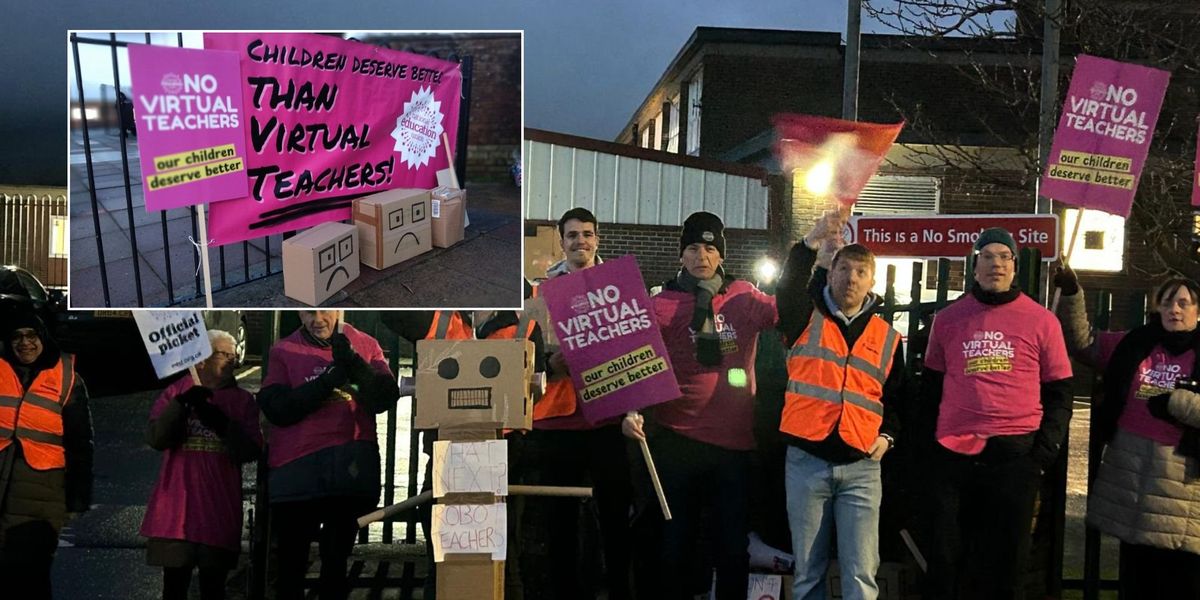
Staff at Valley Leadership Academy in Bacup took to the picket line yesterday, with National Education Union members voting overwhelmingly to strike against the remote learning arrangement.
Star Academies, which runs the school, has defended the setup as a targeted solution to the nationwide shortage of specialist maths teachers.
Emily Cooke, a maths teacher at the school and union rep, was out on the picket line making her feelings clear.
“I will not stand back and allow the teaching profession to be downgraded and diminished into just imparting knowledge over a team’s call,” she said.
For Ms Cooke, the issue cuts to the heart of what teaching actually means.

Teachers at a Lancashire school have walked out over a controversial decision to have pupils taught maths by a “virtual teacher” sitting 300 miles away in Devon
|
X
“Is the teaching profession just about imparting knowledge and red pen feedback, or is it a much, much bigger profession, is it about the pastoral side, that teacher relationship between the teacher and student?” she asked.
She is adamant that the human element of education cannot be replaced by technology.
“It will always be a human endeavour based upon human interaction that cannot be formed or replicated over a screen or over the internet.”
Ian Watkinson, the Lancashire NEU branch secretary, has raised broader concerns about young people’s relationship with screens.

Staff are planning on walking out again on 10 and 11 December, with further strikes planned for 6 to 8 January
|
X
“We’re hearing almost every day about children spending far too much time in front of screens, whether computers or mobile phones,” he said.
“Being in the classroom and engaging with a teacher in real life [is something] you can’t replicate on a screen.”
He also flagged worries about where this could lead, pointing to Star Academies’ communications about embracing technology and AI.
“That’s not to say that there isn’t a place for technology but certainly only [to add value], not the core teacher,” Mr Watkinson added.
The ballot showed strong support for action, with 82 per cent backing strikes on a 73 per cent turnout.
Star Academies has stood firm on its position, describing the initiative as “a win-win” that addresses inequality in education.
The trust argues that children in deprived areas have suffered for too long from supply teacher disruptions and recruitment difficulties.
“Every child, wherever they live, deserves access to excellent teachers,” a spokesman said, framing the move as “about equality and social justice.”
Under the co-teaching model, pupils get lessons from what the trust calls an “outstanding specialist teacher” online, while a second adult supports learning in person.
But this is far from over – staff are set to walk out again on 10 and 11 December, with further strikes planned for 6 to 8 January.
The school has remained open throughout the strike action.