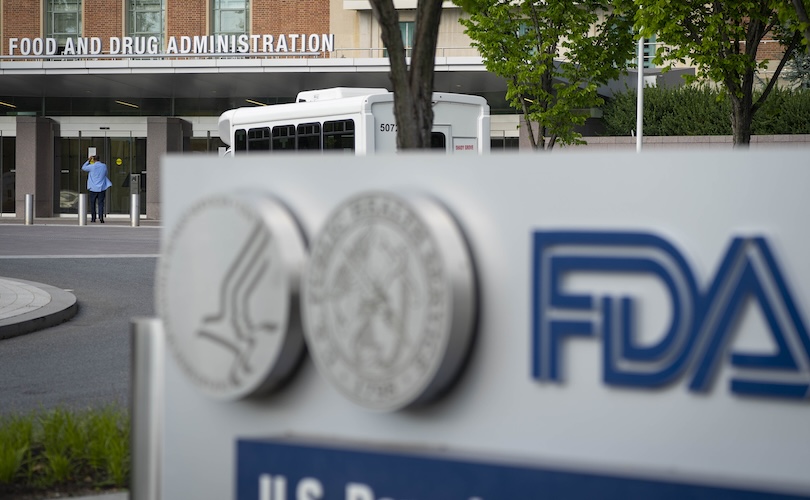
(LifeSiteNews) — Florida Attorney General James Uthmeier and Texas Attorney General Ken Paxton have filed a joint lawsuit challenging the U.S. Food & Drug Administration’s (FDA’s) original 2000 approval of the abortion drug mifepristone, saying that the decision has caused serious harm to women.
WLRN reports that the suit states that the FDA “is responsible for ‘protect(ing) the public health by ensuring that … drugs are safe and effective. Yet the FDA’s approval and deregulation of abortion drugs have placed women and girls in harm’s way.”
It further charges that since then the agency has handled the drug in an “arbitrary, capricious” way, from its subsequent loosening of the regulations surrounding it, from expanding the gestational period during which it may be taken, to letting non-physicians dispense it, to eliminating the requirement that it be dispensed in-person.
“Absent the relief sought in this lawsuit, defendants’ actions will continue to encourage the violation of plaintiffs’ laws and will harm plaintiffs’ sovereign interests in the enforcement and enactment of their laws,” the suit says, stressing that Florida and Texas have an interest in being able to enforce their pro-life laws. The far-left American Civil Liberties Union (ACLU) criticized the suit as an exercise in “political ideology.”
Twelve states currently ban all or most abortions. But the unregulated, no-oversight distribution of abortion pills across state lines has become arguably the abortion lobby’s most effective tactic for preserving abortion “access,” and is particularly problematic in pro-life states, to which they can be sent and taken in complete privacy, without any sign law enforcement can act on.
In November 2022, Operation Rescue reported that a net decrease of 36 abortion facilities in 2022 led to the lowest number in almost 50 years, yet the chemical abortion business “surged” with 64 percent of new facilities built that year specializing in dispensing mifepristone and misoprostol. Citing data from the pro-abortion Guttmacher Institute, STAT says mifepristone “accounts for roughly half of all abortions in the U.S.”
Planned Parenthood Federation of America’s most recent annual report revealed that, almost two years after the U.S. Supreme Court overturned Roe v. Wade and allowed direct abortion bans to be enforced for the first time in half a century, the nation’s largest abortion chain still operates almost 600 facilities nationwide, through which it committed 392,715 in the most recent reporting period. According to the Lozier Institute’s Prof. Michael New, that is a “record number of abortions for the organization and represents approximately 40 percent of the abortions performed in the United States.”
Questions are currently swirling over when and how the Trump administration will handle the problem. Since returning to office, President Donald Trump has taken a number of pro-life actions primarily in the area of taxpayer funding, but concern has brewed among pro-lifers ever since he declared (amid a broader effort to soften the Republican Party’s pro-life plank) that he would not enforce a federal law banning abortion pills from being dispensed by mail, continuing a Biden administration policy that undermines state pro-life laws.
Pro-lifers were given hope in May that the White House’s position might change when U.S. Health & Human Services Secretary Robert F. Kennedy Jr. (another formerly pro-abortion figure who “moderated” during his own presidential bid) promised in May a “complete review” of the medical risks of abortion pills, though no conclusions or timetable have since been announced. But some pro-life leaders have recently called for the firing of FDA Commissioner Marty Makary over reports he is intentionally “slow walking” the review, which Makary denies.