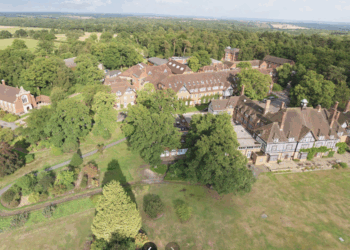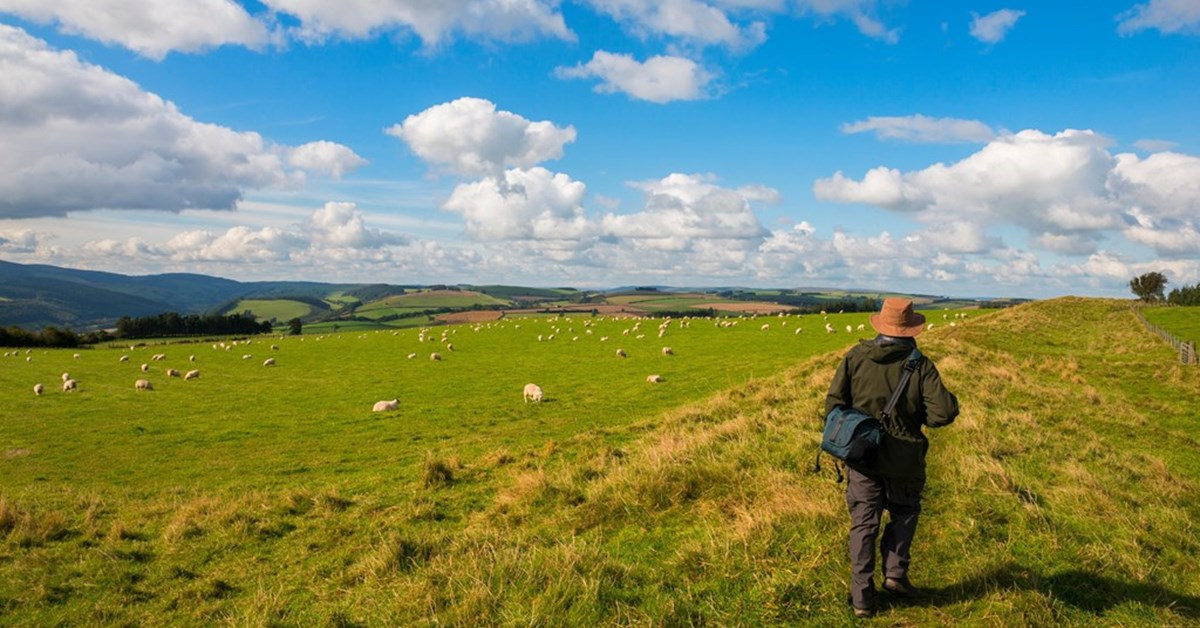
MY VICARAGE is sited some ten metres from the Offa’s Dyke path, the 177-mile- long footpath that stretches along the Welsh borders from Chepstow, in the south, to Prestatyn, on the Irish Sea. A mile after stepping outside my front door, I am on Hergest Ridge, and have gained 500 feet and spectacular views of the Black Mountains to one side and Hay Bluff to the other.
I have walked my stretch of the path in the winter, when it is wet and slippery with mud or snow and you have to make new tracks to avoid falling over. I have walked it in the blazing hot sun, when you need to stop and rest in the shade of the bizarre group of monkey-puzzle trees at the top before you tackle the rest of the journey. I like it best in the spring, with the new growth just beginning, and the trees in the valleys below covered with a green haze of young leaves.
And always there are the sheep: hundreds of them, dotted over the hills, silently sharing the landscape with me. These sheep never stray far from their farms, as they are hefted to the landscape. “Hefting” is the term used for the management of sheep on open land and hillsides. Originally made to keep to their patch of ground by constant shepherding, over time a flock will learn where their boundaries lie, where the best grazing can be found at different times of year, and where to shelter during times of bad weather. The young lambs acquire this knowledge by grazing alongside their mothers, keeping within their territory, only occasionally straying beyond the borders of their farm’s land.
MY ROUTE is always the same and the landscape never changes — achingly beautiful fields and forests, gentle hills, and distant mountains. And yet the walk is always different. Different because of the seasons, adding tone and depth to the perpetual landscape. Different because of who I am when I walk it, the mood I am in, the experiences I am having. Always the same, always new. And I finish where I started, at the door of the ancient church, before I go in and offer some prayers. Like the landscape, this building is always the same, but always new in its offering of peace and shelter, respite and rest, soothing mind and soul.
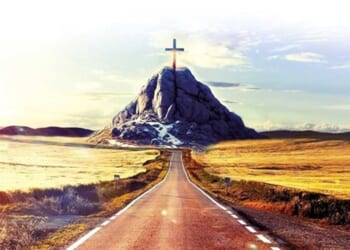
The Christmas story is a lot like this. Of course it is always the same: we know the plot and, even as we celebrate birth, the Good Friday ending looms in our consciousness, the resurrection dawn already shedding beams of light and hope through the darkness. But we hear it differently every time.
 PixabayPixabay
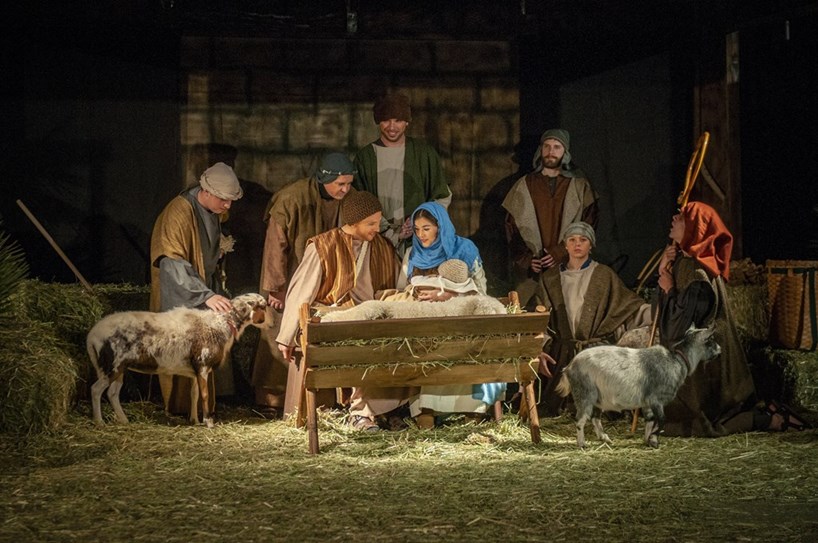
Again, just as the sheep are hefted to the landscape, so the Christmas story is hefted to our memory, our imagination, our very being. It is unchanging and yet ever-changing, part of the soul-story of our lives. Just as different aspects of a familiar landscape strike us each time we walk it, so do the component parts of the story of Christ’s birth have an impact on us at different times in our lives, resonating with our experience, shining a new light on the way things are.
SO, HOW do we inhabit the Christmas story? How do those of us with communities to care for share the Christmas story with others? Our part in the Christmas event is a humble one: an invitation made from the heart to everyone in the community. We offer those with whom we would share the gospel the opportunity to take what they need from the nativity for their soul’s condition at this point in their spiritual lives.
It might be the example of Joseph, trying so hard to live a faithful and righteous life, whatever God throws at him. It might be Mary, whose unconditional “Yes” triggered the whole thing. Some may empathise with the shepherds, who went to the stable not only because the angels told them to, but also, perhaps, because they had nothing to lose by going.
In contrast, others might be struck by the actions of the wise men, who gave up everything for a journey with an unknown end. Or maybe it is the flight of the family into the unfamiliar land of Egypt, forced to build their lives from nothing; or the innkeeper in Bethlehem, whose creativity over space enabled the Messiah to be born in the shelter of a stable.
IN PRACTICAL terms, I think this means ensuring that we take the broadest possible look at what we offer in terms of events and services — not just over the Christmas period, but through the whole of Advent and Epiphany as well. We can offer an interactive, sparkly Christmas to young families who cannot sit still for long, as well as keep alive the tradition of carols and readings. We can provide a space for quiet reflection for those who cannot celebrate, as well as invite in the primary school and the toddlers. Not necessarily everyone, all together, but something for everyone, wherever they find themselves on the journey.
And you, weary leader/volunteer/tinsel-frond gatherer — you, too, whatever this story says to you right now, take time to open your hearts once more to the infant Christ, whose birth into this world brought hope and a new beginning for us all.
The Revd Dr Sally Welch is Vicar of the Kington Group in the diocese of Hereford.