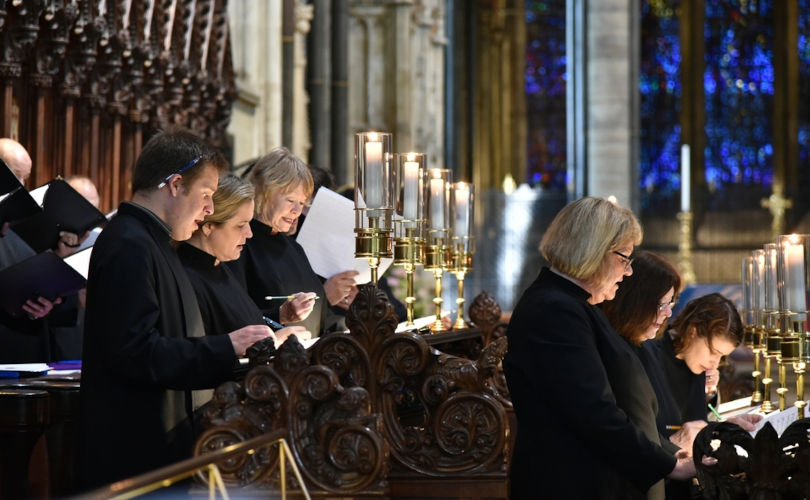
(LifeSiteNews) — My favorite Advent tradition each year is the music. Handel’s Messiah is a perennial favorite, but the Christmas concerts with beautiful carols in softly lit cathedrals edged by shadow are a close second.
Christmas carols are timeless because they do not grow old; they do not grow old because their message will be sung, year after year, until time itself has ended. The oldest known “carol” is “Jesus Refulsit Omnium,” or “Jesus, Light of All the Nations,” which was composed in the 4th century by St. Hilary of Poitiers:
Jesus has shone forth for all,
Devout Redeemer of the nations;
Let the whole race of the faithful
Celebrate praises of His deeds.Whom a shining star, gleaming through the heavens,
Reveals as newly born,
And leading the Magi beforehand
To His cradle.
The original melody of this song is lost to history, and it is believed to have been composed shortly after the first recorded Christmas celebration in 336 AD, during the reign of Emperor Constantine.
The story of Handel’s Messiah is also extraordinary. George Frideric Handel composed it in 24 days in 1741, scarcely eating or sleeping; a servant came upon him bent over his work, drenched with tears. “I did think I did see all Heaven before me, and the great God Himself seated on His throne, with His company of angels!” he exclaimed. His tears fell onto his composition, blurring the words: “He was despised and rejected of men, a man of sorrows and acquainted with grief.”
The sacred music of Christmas is one of the last remaining strongholds of Christian culture; even secular people might attend a choir concert and hear the message of the story that founded our civilization, but that the West has largely left behind. Many can still appreciate the transcendent beauty of the music, even though they do not grasp the transcendent truths the songs convey.
In his magnificent 2017 book Out of the Ashes, Anthony Esolen explained why the traditions of sacred music still retain their strength, even after long centuries:
The old hymns were written precisely for congregational singing. You do not have to be Beverly Sills or Mario Lanza to sing them. They are waiting; just as if there were a great wing of a castle that no one ever entered anymore, filled with works of art by the masters. No doubt a painting of the Prodigal Son by Murillo or Rembrandt reveals its secrets only gradually, so that you can look at it for the fiftieth time and notice something you had never noticed before, or wonder about something that you had seen but taken for granted, such as why Rembrandt’s prodigal has a shaved head, or why there is a little white dog in mid-leap after Murillo’s prodigal, wagging his tail for joy. But those great works also appeal to us immediately, impressing us with their beauty and suggesting that there always will be more, and more, to see and to learn and to delight in. The great hymns are like the paintings in that way. They give us riches at the outset and yet have more and more to give, in abundance.
For those who wish to enter the wing of this castle, there are opportunities aplenty. Earlier this year in England, my wife and I were touring Bath Abbey when we saw that there would be a choir performance later. We took a seat and waited. A group of children and their choirmaster sang a series of old hymns, their young, fresh voices sending up ancient praise in a cathedral built where Christian worship has been held for over a thousand years, and where the Anglo-Saxon King Edgar was crowned in 973 by Dunstan and Oswald.
Of all the concerts I have attended – sacred music from Vivaldi, Hadyn’s Creation, Handel’s Israel in Egypt – the most beautiful was a performance in the Netherlands by a choir from Urk. Urk is a Dutch fishing village with a famous choral singing tradition, and both choirs and soloists from the area have become world-famous. The choristers were dressed in the traditional red-and-white striped shirts, and many of them wore a single gold earring, which the fishermen wore to pay for their funeral in case of drowning.
It was in an old church, and it was packed. The music filled the sanctuary; when the male voices stopped abruptly, the silence rolled across the crowd like thunder. The audience spontaneously burst into applause, and the director whirled, shook his head fiercely, and pointed up. The music was in praise of God, not for praise of man. The gesture stuck with me. The purpose of sacred music is to point us upward, not to merely provoke artistic appreciation.
That is what Christmas concerts are for. As Anthony Esolen wrote in his reflection on Edmund Sears’ “It Came Upon A Midnight Clear,” Christmas carols must point us to “the turning of the world toward the infant of the manger.” In a world still roiled by wickedness, sacred music begs us to pause. As Esolen wrote: “So then, when all the world is filled with angry noise, take some time, go to the manger, go in silence and prayer, and remember, the promise is here, the reality is here.”