THE year 2026 looks set to be momentously significant, bringing threats to the security and well-being of both society and the planetary order. The focus is, more than ever, on finding wise and courageous leaders who will help us to navigate a seemingly fragile future.
Much attention is, therefore, being paid to the impending enthronement of the latest and the first female Archbishop of Canterbury, and what it could signify for England’s social, cultural, and political trajectories.
This agenda formed the round-table discussion curated by the William Temple Foundation in late summer 2025 to mark the 80th anniversary of the report Towards the Conversion of England, published in 1945. Back in 1943, at the request of the Church Assembly, Archbishop William Temple set up a commission under the Bishop of Rochester to “survey the whole problem of modern evangelism”.
Our round table, set in the context of Archbishop Welby’s resignation, was entitled “Towards the Conversion of the Church of England by the Rest of England”. It asked whether the renewal of the Church of England relied on the Church’s listening to, and engaging with, the new forces shaping England. Can the Church convert the nation unless it has been converted, in turn? What sort of England does it aspire to lead and help to shape and define?
A significant theme to emerge from the round table was that of identity. England, as a nation, is in a liminal state, leaving the reassuring certainties of old thresholds and embarking more grudgingly than optimistically, it would seem, on finding a new platform on which to settle and grow.
Professor Linda Woodhead, in her lecture responding to the round table’s findings, identifies the current season as a “post-progressive era”, in which traditionally secular ideas of democratic and technocratic advancement are in retreat. Within this scenario, England and Englishness acquire greater salience.
Andrew Brown, at our round table, observed that the roots of the current Church of England’s crisis lay in the disappearance of an imperial Britain, leaving England without a clear organising purpose or identity. This decline can be traced through a 70-year arc, from the Suez Crisis of 1956 to Brexit in 2016, leaving the Church institutionally “orphaned”, without a clear contemporary mission.
The 2021 Census, meanwhile, discovered that those affiliating with a Christian identity had dropped to 46 per cent, while those identifying as “No Religion” had risen to 37 per cent. Statistically, then, England may be post-Christian; but it is far from being post-religious. We are a vibrant nation of nearly 60 million citizens, comprised of numerous ethnic and faith-and-belief minorities. This should be seen as an opportunity for establishing deep connectivity, more than an obstacle.
HOW, then, might the Church of England reconnect itself to the emerging complexities of what Englishness could signify? Several ideas emerged from our round table: convening national debates about what Englishness means at a time of great transition; rediscovering the traditional strength of holding together disparate theological views in a loose coalition; and resourcing what Professor Tariq Modood identified as a “moderate, public faith-inclusive secularism” that will help the transition to what he calls “public multi-faithism”, without the “radical secularist anguish” experienced elsewhere.
For Professor Woodhead, some strategies for reconnection are strikingly familiar and yet resonate differently in this post-progressive era. Prayer: the increased practice of turning to prayer which she observes taking place in society is a natural point of connection, as the Church of England offers informal opportunities to do this individually or corporately — or, as she describes, it “in solitude or solidarity”.
Place: the Church of England (as one of the seven post-Reformation Churches) is a Church of place, and it has historically helped to make England and define Englishness. It can do so again, but for the current age.
Beauty: its worship, liturgy, and sacred settings offer connection to beauty, without which life is unbearable. Now, as we potentially face the worst of times, this becomes even more a gift that creates connection and helps to cement a common cultural and spiritual unity.
Professor Grace Davie, reflecting in a blog on Professor Woodhead’s response, proposes the advantages of a weak “Established” Church. Strong state Churches run the risk of being excluding and exclusive. A weaker, but none the less Established, Church has different opportunities. “Discerning its strengths”, she writes, “from a distinctive past — that of a partial monopoly . . . can be deployed to welcome rather than exclude, and to encourage rather than to condemn.”
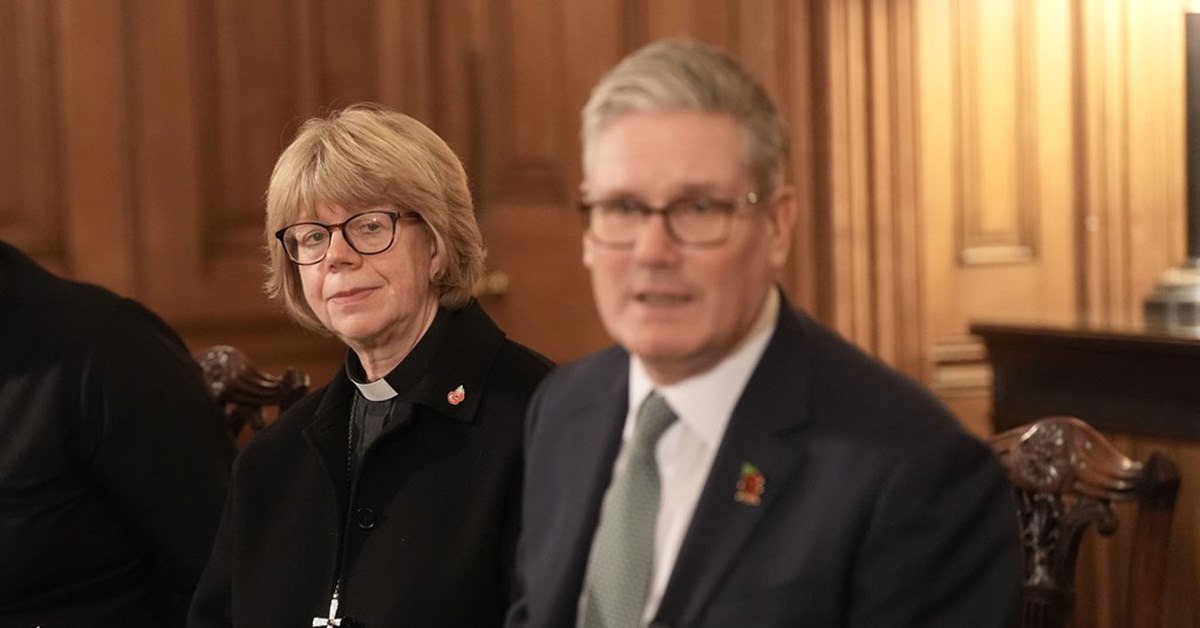
What might these contributions to an English identity mean for the style of leadership that the Bishop of London, the Rt Revd Sarah Mullally, as the Archbishop of Canterbury-elect, might be considering?
Professor John Denham, reflecting on the Foundation’s report from his secular perspective, but also his vast experience as a former Secretary of State for Communities and Local Government, says that, while the populist Right will project a clear and confident vision of Englishness, there is no reason that the Church of England, under its new Archbishop, should not do the same from a totally alternative perspective: giving welcome to the diversity of race and faith in England today; defending the contribution that faith can make to policy and public life; offering leadership that creates space for difficult discussions essential to cohesion; and giving a voice to those who feel that they have none.
“WEAK establishment” is, therefore, a formidable balancing act. It demands clarity about issues of human justice and dignity, and the value of a diverse and pluriform version of what a renewed Englishness might encompass. It must gain the trust of both faith and secular partners in formulating this vision, and invest resources in its articulation. It also has to offer reassurance and continuity through the richness of its own intellectual and cultural tradition — a vocation that has, perhaps, lain fallow in recent years.
The thing is that these are not mutually exclusive charisms, but mutually inclusive. The extraordinary nature of the times demands an approach that resists easy binary and polarising responses. The Archbishop’s leadership will be tested precisely on this balancing act: the capacity to be both prophetic and pastoral, both clear-sighted about injustice and generous in hospitality, and both rooted in tradition and imaginative about renewal. Her task is not to retreat from the public square, but to reclaim it; not to narrow the Church’s vision, but to articulate a more generous and inclusive understanding of what England is becoming.
It is leadership for a liminal age: holding the threshold open while helping a nation find its footing for whatever comes next. It requires someone who understands that a weak establishment, properly conceived, is not a compromise but a charism — the gift of being close enough to power to speak truth to it, and yet free enough from power to speak truth for those beyond it.
We at the Foundation offer our warmest best wishes and support to the Archbishop-elect as she prepares to takes up her new mantle of leadership.
Dr Chris Baker is William Temple Professor of Religion, Belief and Public Life at Goldsmiths, University of London, and Director of Research at the William Temple Foundation. He is also Visiting Professor at the Helsinki Institute for Social Science and Humanities, University of Helsinki.
To download the report Towards the Conversion of England by the Rest of England, visit: williamtemplefoundation.org.uk