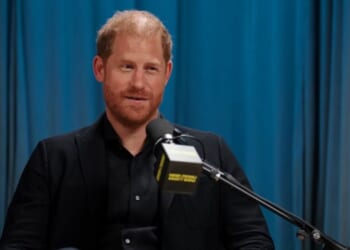
In this episode of “Victor Davis Hanson: In His Own Words,” Victor Davis Hanson explains why the ignorance of American students keeps him up at night more than the threat of radical Islam.
This content was created prior to Hanson’s major surgery on Dec. 30.
Editor’s note: This is a lightly edited transcript of a segment from today’s edition of “Victor Davis Hanson: In His Own Words” from Daily Signal Senior Contributor Victor Davis Hanson. Subscribe to VDH’s own YouTube channel to watch past episodes.
JACK FOWLER: Yeah, we’re worried about the spreading growth of Islam versus the ignorance of America’s students. I mean, pure ignorance of, pure lack of knowledge, dumbness as products of our educational system.
VICTOR DAVIS HANSON: That’s another good question. I think it falls into the same category of overt versus insidious. And so, this time I’ll do the insidious.
Well, I’ll do the overt first because radical Islam can’t hurt the United States abroad.
They don’t have the technological wherewithal to do it. And every time that we’ve mistakenly gone into an Islamic country and not done well, whether it’s Afghanistan or Iraq, the reason is that there were necessary restraints or unnecessary, whichever way you look at it, that we didn’t use the full extent of our power.
In other words, we fought that battle on their terms, not ours. We didn’t do what the Russians did. When they wanted to subdue Chechnya, they just leveled Grozny.
So, what I’m getting at, if you wanted to get into an existential war with radical Islam, you could. And you could win it. And a cost of benefit analysis, maybe it wouldn’t be worth it. And a moral [war], maybe it would be questionable. But if you were an extremist, you could do it.
However, the other matter of our youth and not being able to … what was the word, delayed? Would you call it prolonged adolescence?
FOWLER: Well, you might not have prolonged adolescence and still not know what two plus two times three is, right?
HANSON: Yeah, I’m just trying to say it’s something about our young people that there’s not a code, an ethos, that says “I am 10, I’m 11, I’m 12, I’m 13, I’m 14, I’m 15, I’m going to go to school every single day.”
I can tell you that everybody screws—if I could use that word—around in high school, college. But there was, at least when I was in school, an idea that you did come to class, and you did turn in your homework, and you did learn something.
I was from a very poor school. I went to a rural school that was very poor, and I went to a high school that was rural and had not a lot of money. But I can tell you even there when I went to UC Santa Cruz with all these wealthy kids from prep schools in LA and San Francisco, they had a much better education, but I still was able to with hard work keep up.
And so, the education system was … there were no powerful teachers unions. And the teachers were, I would say half of them were excellent. And nobody attacked a teacher, nobody, and everybody did their homework. And there was no what I would call non-academic topics.
There was one class you had to take called senior problems, and they showed you World War II frightening syphilis movies. They showed you marijuana where you go crazy if you smell marijuana in a room.
And they showed you first aid, how if you’re driving—I remember the movie—you’re driving along and a guy’s in a wreck, and you jump out and tear your shirt into six different types of bandages and save his life.
And then how to write a check and how to shake a person’s hand. It was really good, valuable, I didn’t like it at the time, but I thought it was very valuable.
I think what’s happened is the therapeutic curriculum in the school, it demonizes men. It demonizes white people, white men. It does, because it’s DEI. It doesn’t approach minorities the way it used to.
And I know that people will get angry at this. When I was in fourth and fifth or sixth grade, Mrs. Evans, the speech pathologist, would come in. And I had a pathology. I would say W for R. I would say if you wanted to say, “a red rocket,” I’d say, “the wed wocket.”
And she would say, “You know, you’re not Elmer Fudd. You’re going to get in here,” and she would show me how to make my mouth. I can still remember how to make a round circle with my mouth. And then they had an old tape player, and then they would play it back. I was mandatory 20 minutes a week with her.
And everybody had that. And then if you had a strong accent, she would say, she would come to our class, “I have a stick shift Chevy.” And half the class were recent immigrants.
“I got a stick chip chubby.”
“No, you do not have a chubby. It’s called a Chevy. And I’m saying this because I want you to excel, and I want you to speak the King’s English without a trace of accent. And that goes for all of you.”
And it was very valuable. But you would be fired today for cultural appropriation or something like that. But you just have to look at the results.
I live in a town where I’m 72, and I think that almost everybody I went to high school with who’s still alive, who’s Mexican American, is an unqualified success. Everyone. Everyone.
I mean that sincerely. And I can tell you that the next generation below me was a success. But this new therapeutic DEI victim [education emphasis] is not working. Because again, commission and omission.
The omission is you waste time on these therapeutic studies classes, and you don’t give them math, analysis, logic, language, syntax, grammar, biology, and commission. You fill people’s heads that they can’t make it, that they have an enemy holding them back.
You don’t tell people, you wouldn’t dare tell people as we were told, “Well, you’re 18 and we would expect that you, if you’re going go to college or learn a trade by 20, you’re on your way. And we would expect all of you by 21 or 22 to have your house and by 23 at the latest to get married.”
I got married at 23 and I remember I saw a teacher, one of my old teachers, “Well, I was wondering when you were going to get married, what happened to you?”
FOWLER: Old man Hanson.
HANSON: Yeah. “What happened to you?” 23.
I mean, it’s prolonged adolescence. It’s the toxic masculinity. It’s the curriculum. It’s the therapeutic. It’s the DEI.
And the result is I get really tired of all these leftists that brag on themselves. “Look at what we’ve done. Look at what we’ve done. Look at the society we’ve created.”
I just say to them, do you really think that if you took people from 1965 out of a high school class versus today in any major high school they would be better or worse at algebra.
I can tell you they’d be a lot worse today.
We publish a variety of perspectives. Nothing written here is to be construed as representing the views of The Daily Signal.