IT SEEMS remarkable that Rupert Gough has been in charge of the choir at Royal Holloway, University of London, for more than 20 years. Also Director of Music at St Bartholomew the Great, West Smithfield (London’s oldest surviving church, founded 1123), he started as a chorister at the Chapel Royal, went from there to the Purcell School, and then to the University of East Anglia (Master’s degree in English church music), and was organ scholar at Norwich Cathedral. Especially notable were his 11 years as assistant organist of Wells Cathedral.
But, amid his involvement with the King’s Singers, the Britten Sinfonia, and others, Royal Holloway has been the scene of his greatest triumph. Choral scholarships have been created, and a sizeable choir has been nurtured. By stages, this has come to match the standards of Oxford and Cambridge college choirs — Merton, New College, Trinity, Clare, the best of the bunch.
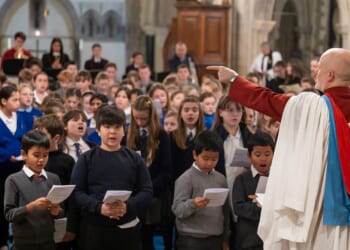
It has been a remarkable, even staggering, achievement. Regrettably, Gough himself was indisposed for their utterly professional concert, promoted by Leamington Music — here under the masterful command of George Arthur Richford, who stood in to conduct their bracing programme in St Mary’s, Warwick, last month, entitled “The King, the Archbishop, a Spy, and the English Exiles”.
The excellence and proficiency of the choir was patently obvious throughout. It is difficult to single out any one item in this agreeably designed event, but one thing especially brought satisfaction. The choral works of the Tudor composer John Bull (1562-1628) are surprisingly rarely heard. More familiar is his extensive keyboard output, of which the Fantasia Chromatica was given a sensible and expressive performance by the organist Daniel Ayers, whose use of flute stops both here and in accompanying was notable.
Aside from buoyant Byrd (“Laudibus in Sanctis” and an intelligently and gently woven Agnus Dei from the Mass for Five Voices), in which, amid the universal excellence of the sopranos and the perkiness of the basses, the tenors often stood out, the other composers were Richard Dering and Peter Philips. Dering (c.1580-1630), as a Roman Catholic, absented himself to Brussels, but latterly returned to England to serve Queen Henrietta Maria. Philips (c.1560-1628), likewise a Catholic, but also a priest, was exiled to Antwerp and stayed there.
The Royal Holloway’s singing of these buoyant works, including well shaped alleluias, and culminating in Dering’s spacious Magnificat, was exemplary throughout. Perhaps the surprise was that, although both composers sometimes pointed the way forward to the Italianate 17th century (a bridge, Rochford explained, between English music and the broader European Catholic repertoire. little of that seemed to apply here. The singing, with superb dynamic changes, from the Royal Holloway brought rich life to fruits of the English Renaissance.